





The consultant or specialist veterinarian
 9 November 2018
 3 minute read
Traditionally veterinary services have consisted of attending sick animals and the diagnosis of disease and treatment. This fire brigade type of work has usually been carried out by the general practitioner dealing with other species as well, in a multi-species mixed practice. As pig units during the past ten to twenty years have become larger and their techniques of production more sophisticated, the level of knowledge and expertise required from the veterinarian has increased substantially. As a result more-specialised comprehensive veterinary services have developed. They differ in different countries in the way they have become organised but the basic requirements are similar. In the UK a second service has developed, that of the independent pig specialist, who spends the majority of his or her time working amongst pigs on his clients farm within the frame-work of the general practice to which he belongs. A third even more specialised role is that of the person who is totally dealing with pig health, management and production and who could be classified as a consultant. He or she not only attends herds within the practice but also is invited to advise on herds in other practices often at considerable distances away. There is a fourth role within the industry, that of the specialist veterinarian fully employed by large pig organisations or ancillary industries, but his job perspective can often (but not always) become more of an administrative and decision making one rather than "hands on" on the pig farm.
A somewhat similar development of veterinary services has developed in North America except that here a number of very large pig producing organisations have emerged each comprising of 100k to 200k sows and their progeny. These employ full-time veterinarians with highly specialised roles. Similar developments have occurred in some countries of South America and Australasia.
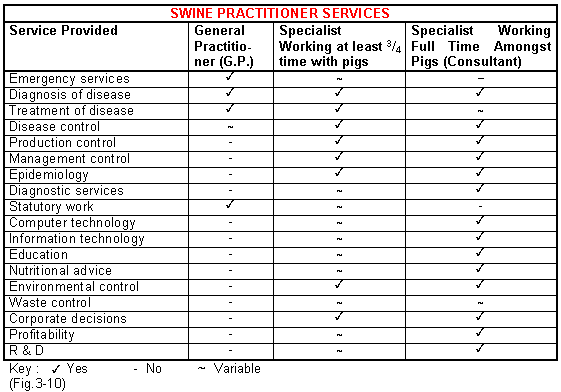
Nevertheless, the actual resources required in different countries have some comparisons even if the organisations are different. The three different types of service shown in Fig.3-10 are those most commonly found in the UK.
Veterinary services should be used to:-
- Increase efficiency.
- Further educate and help understanding.
- Contribute to management.
- Control disease.
- Prevent disease.
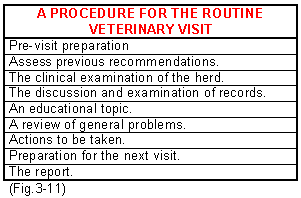
The fundamental needs of the modern pig unit are to maximise production and efficiency and thus the return on the investment. The achievement of maximum profitability however must be carried out within the economic constraints and accepted practices of animal welfare. Part of the service must include a routine visit to the farm every two to three months, or in the case of the large farm a shorter period, so that studies of the inter relationships between management, the pig, the environment and organisms can be carried out, relative to the problems. The most successful farms are those which achieve high productivity and give attention to detail. They invariably have good team work, disease control and understand how to maximise biological efficiency. A major role of the veterinarian at his periodic visit must be to help in this understanding and awareness of the problems on the farm and identify the procedures to correct them. Fig.3-11 shows a format that could be used at the veterinary visit. It starts with a discussion and an examination of records followed by a clinical examination of the herd or vice versa. At each visit a special topic for discussion and education should be pre-planned, that relates to a problem area on the farm. During the clinical examination of the herd the personnel responsible for each area of the farm should accompany the veterinarian to give their observations and discuss weaknesses and strengths. This also provides an opportunity for education and motivation.
A written report of the observations and advice should be provided so that it can be used and acted upon pending the next visit. It is also a reminder of the discussions that took place and it can highlight agreed recommendations not acted upon.
The veterinarian can influence the relationships between people, management and pig and this communication and the dissemination of knowledge associated with it, can be one of the main attractions for the purchase of veterinary services, particularly when the results are increased profitability.
Fig.3-12 shows some of these inter relationships that occur, starting with the bank, the spouse or partner, the owner, the pig and finally profit. Within each group of people there must be constant interactions and dialogues with the ultimate aim of improving profitability.
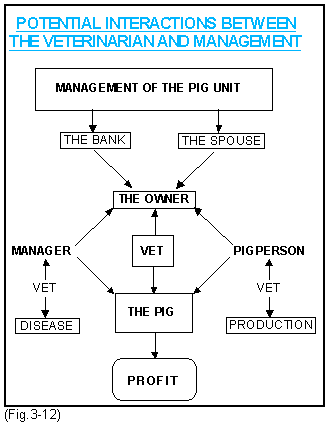
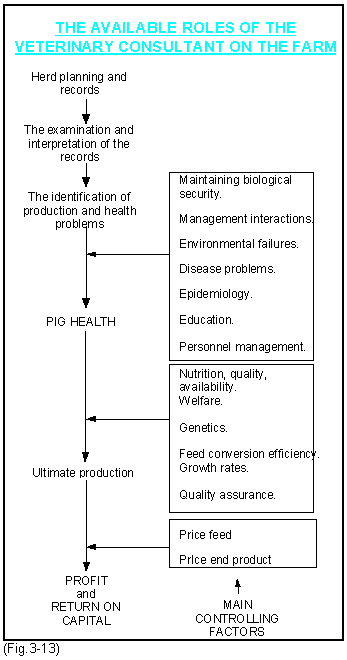
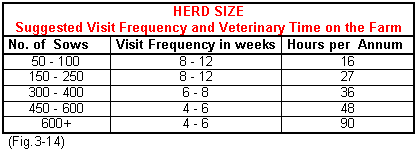
Fig.3-13 outlines detailed interactions by the specialist or consultant on the farm and some guidelines. The frequency and time necessary for the veterinary visits relative to herd sizes, is shown in Fig.3-14. It should be noted that a new emerging role involves participation in quality assurance schemes and auditing the farm against required standards.