






The stillborn pig
 9 November 2018
 7 minute read
Stillbirths are usually recorded as such when they are found dead behind the sow. However this can be an erroneous assumption because there are three possible causes:
- Death before farrowing.
- Death during farrowing.
- Death after farrowing.
If the pig dies before farrowing, then depending on how long before, it will show varying degrees of post mortem or degenerative changes including discoloration of the skin and loss of fluids. If death occurs in the early stages of pregnancy a fully-formed mummified pig will be seen.
A pig that dies during the process of farrowing or immediately afterwards will be fresh and normal. The two can be differentiated easily. The chest is opened and the lungs and the trachea examined to determine whether the pig had breathed, i.e. born alive and then died. The lungs of the true stillborn pig are a dark plum colour, showing none of the pink areas associated with inflation and breathing. Pigs that attempt to breath during the process of farrowing will also show evidence of mucous obstructing the wind pipe.
Ask your veterinarian to show you the differences.
A good target level for stillbirths is 3 to 5 % of total pigs born. At this level there is no point in carrying out investigations because it is unlikely that external inputs can alter the situation. However once the level reaches beyond 7% it is worthwhile carrying out an investigation by records and post-mortem examinations. The following factors need to be considered as causal or contributory to the problem:
- Stillbirths increase with the increasing age of the sow and beyond 5th parity may reach 20%.
- Individual sows may be regular offenders and these can be identified by the sow litter card. The farrowing process should then be monitored.
- Stillbirths occur in larger litters.
- They are more common in pure breeds.
- Sows that have prolonged farrowings will have a higher number of stillbirths.
- Farrowing house temperatures above 24ºC (75ºF) increase the risk of stillbirths due to the difficulties of the sow panting and resting during delivery.
- Sows with uterine inertia and particularly if it is associated with calcium deficiency produce high numbers of stillbirths. One sow can make the average look bad.
- High carbon monoxide levels in the air associated with faulty gas heaters can raise stillbirth rates significantly.
- Pigs found dead behind the sow can sometimes be related to specific farrowing crates in certain rooms, associated with draughts behind the sow, the pig dying shortly after birth due to hypothermia.
- An examination of records both by parity and total numbers born per individual litter, will clarify whether the problem is one of individual sows or there is an infectious or common environmental component.
- Stillbirths are raised where there is a long gestation period and in such cases prostaglandin injections can be used. In some herds the use of prostaglandin has reduced stillbirths and yet in others it has increased.
- Lack of exercise may have an effect on the stillbirth rates.
- Diseases of the sow such as fever, mastitis, septicaemia, acute stress or haemorrhage.
Diseases associated with the stillborn pig
- Anaemia.
- Aujeszky's disease.
- Enteroviruses.
- Eperythrozoonosis.
- Erysipelas.
- Leptospirosis.
- Mycotoxicosis.
- Parvovirus (sequential to the delivery a mummified pig).
- PRRS.
- Toxoplasmosis.
Where stillbirth levels are high it is necessary to eliminate disease as a possible cause and then identify the predisposing factors and their relevance. Most stillbirths in the absence of diseases or environmental faults are related to age, individual sows and large litters.
To reduce stillbirths
- Do not let the age of the herd spread beyond the seventh litter.
- Identify problem sows. Observe farrowing behaviour.
- Look at breed differences.
- Check farrowing house environments.
- Check farrowing pen designs.
- Monitor farrowings.
- Interfere early in prolonged farrowings.
- Give good management at farrowing.
- Provide a heat source behind sow at farrowing.
- Study herd records.
- Check haemoglobin levels in sows.
- Check parasite levels.
- Check for blood parasites.
- Check for diseases in the sow.
The poor viability pig (often called low viable)
Poor viable pigs are usually classified as being small and less than 800g in weight, but they can also include those of good birth weight that are weak and lacking vitality. It is necessary to differentiate between the poor viable and the non-viable one. The latter is the pig considered, on that farm with that management, to have no possibility of survival. The rule of thumb is simple, when the body temperature has been brought up to normal and if the pig has no suckling reflex when the little finger is placed inside the mouth, it is unlikely to survive and therefore management time should not be wasted on it.
The size of the piglet is in part determined very early on in its life at around the time of implantation. While we do not understand all the mechanisms that are likely to produce a large or small placenta and thereby a large or small piglet, nevertheless, several contributing factors can be identified.
- Breed is important and in particular hybrid vigour. This is clearly seen in the difference between breeding from a pure-breed or pure line and a cross-bred female. There are different levels of hybrid vigour between different hybrid and breed combinations. The selection of a good breeding female should include the capacity of that animal to produce good even birth weights.
- Nutrition during the early part of pregnancy, particularly around implantation, may play a role. Unidentified growth factors contribute to the establishment of the placenta. Field experiences have shown that major problems of poor viable piglets (up to 40%) tend to occur more in herds where milk by-products such as whey, have been fed in the first three weeks post-mating. In such farms when the ration was changed to a cereal diet, the problems went away. The reasons for this are not known and one can theorise that dietary insufficiencies or unknown growth inhibiting substances might be present in some diets.
- Some authorities recommend increasing the daily ration during the last 3 to 4 weeks of pregnancy in order to increase the birth weight of all the pigs in the litter, particularly for outdoor sows in winter. This however, will not reduce the variation within the litter.
- As the age of the sow increases so do the numbers of poor viable pigs and there is a greater disparity in birth weights
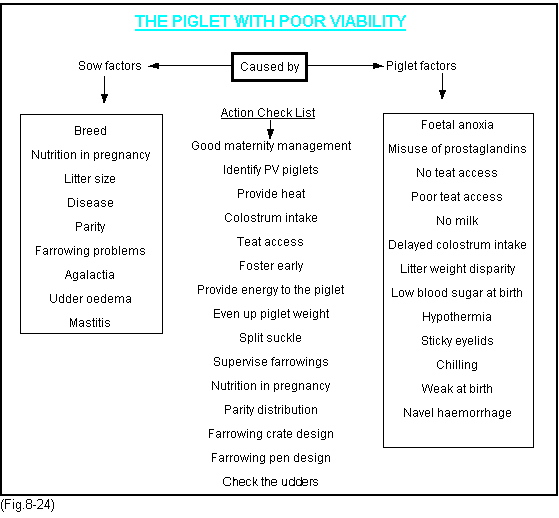
Diseases such as swine flu, PRRS, swine fever and parvovirus (in fact any disease that can cross the placenta), can produce marked increases in poor viable pigs. If there is a herd problem, it is necessary to assess the overall clinical picture to identify any diseases that might be associated. Fig.8-24 shows the factors that contribute to poor viability.
Key points to managing the poor viable piglets
- Immediately place the piglet in a draught free environment at a temperature of at least 30ºC (86ºF), ideally in a well bedded box with an infra-red lamp above.
- Make sure that the lamp is not too far down to burn the skin.
- Poor viable pigs rapidly deplete their minimal energy resources if they are allowed to dry off in the normal farrowing house environment.
- Always make sure that the eyelids are prised open because some are born with eyelids stuck together.
- Provide the piglet with a rapid source of energy. Sows colostrum is ideal, obtained at farrowing and given to the piglet by syringe.
- Do not use a stomach tube because it does not stimulate a suckling reflex and the sooner this is established the better. Do not syringe colostrum into the piglet until a suckling reflex is felt by the little finger placed in the mouth. Cow or goat colostrum collected soon after parturition and stored deep frozen can be used as an alternative source. It is thawed out in warm water (do not microwave) as and when required. Poor viable pigs should be given between 5-10ml as soon as the body temperature has returned to normal and this again repeated 4 to 6 hours later. Commercially produced artificial colostrums are available but they are expensive and no better than the natural products.
- A poor viable pig has a much less chance of survival if it is left within the litter to compete with the bigger piglets. Where a number of sows are farrowing at the same time collect all the small pigs together to form a new litter so that they are given special attention and a much warmer more comfortable environment. A newly farrowed sow with easy teat access should be selected to suckle these under privileged animals.
- Split suckling is useful if poor viable piglets have to be left on the sow. The litter is divided into two weight groups and the smaller weaker ones given uninhibited access to the udder on at least two separate occasions, as soon as they can be collected together after birth.