




Pig outlook: Lean hog futures bulls work to stabilize prices
Livestock analyst Jim Wyckoff reports on global pig news
 5 December 2025
 7 minute read
 By:
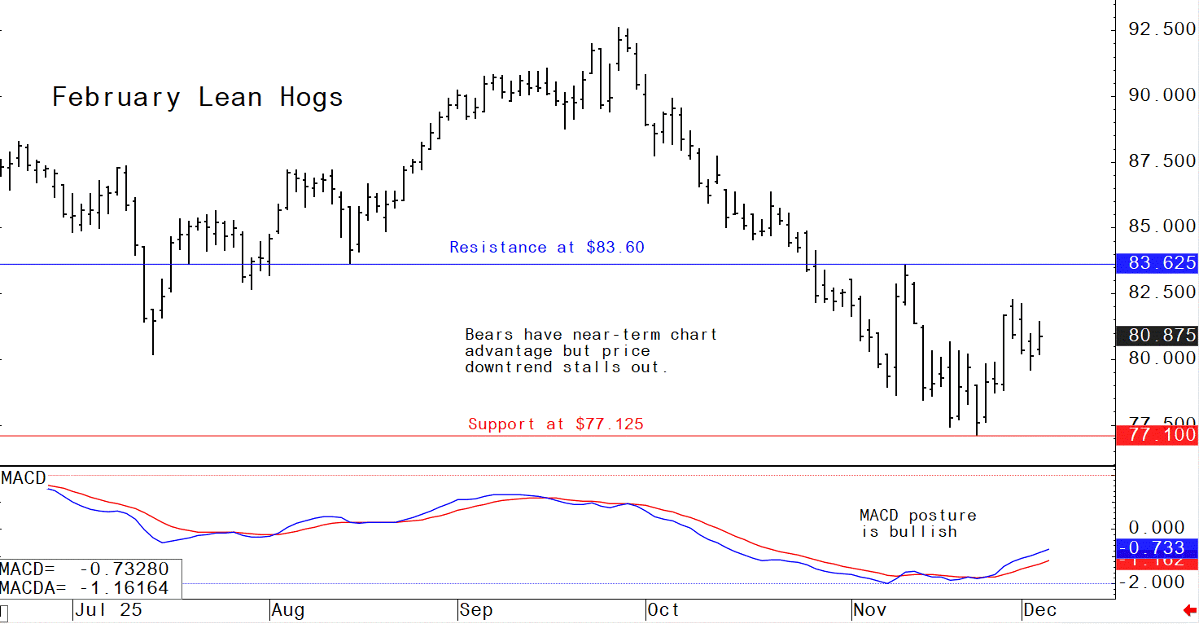
By: February lean hogs on Wednesday rose 82 1/2 cents to $81.00. Lean hog futures saw some short covering following losses on Monday and Tuesday. The overall chart posture for the hog futures market remains bearish, which will likely limit speculator buying interest in the near term. More gains in the cattle futures markets Wednesday also supported buying in the hog futures. Steadily falling cash hog prices have constrained lean hog futures bulls. Until the cash hog market stabilizes and starts to turn back up, buyers in futures will remain timid. However, daily losses in the cash and CME lean hog index have begun to get smaller. The latest CME lean hog index is down another 6 cents to $81.61. Today’s projected cash index price is up 6 cents at $81.67. Wednesday’s national direct 5-day rolling average cash hog price quote is $69.36.
Pork Industry and related news
China’s pork prices continue to decline, suggesting sagging consumer confidence
China’s pork prices have been declining all year are likely set to drop even lower, with government efforts to cull the breeding herd and a seasonal demand boost not enough to arrest the slide, Bloomberg reported. “Wholesale prices have dropped 18% so far in 2025 and are at the lowest level in more than three years. Consumption of China’s most popular protein normally picks up as temperatures cool, but the declines highlight how fragile consumer sentiment is at the moment. A trade truce with the U.S. has restored a semblance of economic calm, but the property-market slump and a weak jobs market mean consumers aren’t splashing out just yet. With the 5% GDP growth target for 2025 in sight, Beijing also appears likely to hold back on stimulus, although that leaves room for support early next year,” Bloomberg Economics said. China’s restaurants and retailers should be starting to stock up on supplies for winter and the upcoming holidays, when Chinese people go out for meals more and also entertain at home. But the external environment as well as an oversupply of hogs means pork prices will likely keep dropping this month, according to commodities consultancy Mysteel. Beijing has been pushing this year for major hog producers to cut their breeding herds, along with other measures to tackle oversupply. Sow numbers were down 2.1% at the end of October from a year earlier, according to government data, but the drop hasn’t been big enough to have a meaningful impact on pork prices.
Spain’s pork exports to China resume after ASF regionalization deal takes effect
New protocol contains fallout from Bellaterra outbreak, allowing trade from disease-free zones
Spain’s new regionalization agreement with China is already paying dividends after an African swine fever (ASF) detection briefly halted the country’s pork exports to its largest non-EU customer. China suspended all Spanish pork imports on Nov. 28 following confirmation that two wild boars found dead in Bellaterra tested positive for ASF. But under the Nov. 12 protocol reached during King Felipe VI’s visit to Beijing, both sides agreed to limit trade disruptions to affected zones rather than impose blanket bans.
Spain’s agriculture ministry announced that China has now implemented that deal — establishing an exclusion zone around the Bellaterra area—and has resumed pork imports from all regions outside the containment zone.
The move is significant for Spain, the EU’s largest pork producer, which ships €3.5 billion ($4.05 billion) in pork annually. China alone represents 42% of Spain’s pork exports beyond the EU.
Authorities are still investigating the source of the outbreak. The European Commission said it will refrain from comment until an EU veterinary team conducts an on-site assessment this week. Meanwhile, Spain has imposed operating and sales restrictions on hog farms within a 20-kilometer radius of the detection site as part of its containment protocol.
Of note: The situation underscores the importance of regionalization agreements which limit the trade impacts from animal diseases with the U.S. and China inking a regionalization on highly pathogenic avian influenza (HPAI) deal via the Phase One agreement just ahead of a case being found in South Carolina turkeys. Prior to the regionalization agreement, China would normally have blocked all U.S. poultry, but the deal prevented the widespread trade halt.
Why the Big Four Meatpackers Keep Their Grip — And Why Trump’s New Crackdown Won’t Break the Mold
Decades of failed reform attempts show how structural economics, regional lock-in, and strict antitrust standards have allowed JBS, Tyson, Cargill and National Beef to dominate — and why the latest push by President Trump, USDA and DOJ is likely to yield investigations and transparency rules, but not a fundamental industry overhaul.
For more than half a century, four companies have dominated America’s beef and pork processing sector despite repeated efforts by presidents, USDA leaders and rural lawmakers to loosen their grip. The reason is simple: massive economies of scale, geographically concentrated livestock supplies, and high legal thresholds for proving anticompetitive harm have repeatedly neutralized reform efforts, even when political pressure is intense. While President Trump, USDA and the Justice Department are again targeting packer power with new investigations and rulemaking, the underlying economics of the meat industry still favor the entrenched “Big Four.” As a result, industry experts say the current crackdown is likely to produce stepped-up enforcement actions and new transparency requirements — but not a structural breakup or a meaningful shift in market dominance.
1. Immense Economies of Scale Make It Hard to Break In
Modern beef, pork, and poultry processing requires:
• Facilities costing hundreds of millions to build.
• High-throughput lines, cold storage, wastewater systems, robotics.
• Nationwide trucking and distribution networks.
• Dedicated supply relationships with thousands of feeders and ranchers.
This means:
• Entry barriers are enormous, even for well-funded new players.
• Existing “Big Four” (JBS, Tyson, Cargill, National Beef) keep per-unit costs far lower than any newcomer.
Result: Antitrust action doesn’t easily create viable new competitors.
2. Farmers’ Livestock Is Geographically Concentrated
Feedlots and hog/poultry complexes are clustered in:
• Texas/Kansas/Nebraska (beef)
• Iowa/Minnesota (pork)
• Arkansas/Georgia (poultry)
Packers built massive regional plants in these hubs. Even if new companies tried to enter, the industry’s geographic lock-in means farmers have few realistic alternatives.
Result: Structural advantages persist regardless of political will.
3. Antitrust Law Has a High Burden of Proof
To “break up” or restrain packers, DOJ must prove:
• Market power, not just size.
• Anticompetitive intent or effects, not merely farmer dissatisfaction.
• Consumer harm, usually meaning higher prices.
But:
• Meat is a globally traded commodity, which weakens monopoly claims.
• Courts have repeatedly rejected rancher-led cases for failing to show concrete anticompetitive harm.
Result: Structural consolidation is legal unless clear collusion or price-fixing is shown.
4. Congress Has Never Fully Resourced Competition Policy
Farm-state lawmakers criticize packers publicly, but:
• Livestock states also depend heavily on packers as major employers.
• Rural delegations often resist aggressive antitrust enforcement that could close plants.
This means political pressure is split — angry producers vs. job-dependent communities.
Result: Congress sends mixed signals that neuter long-term structural reforms.
Why Past Presidents Have Failed
• Obama: Tried GIPSA “Farmer Fair Practices” rules; Congress repeatedly defunded enforcement.
• Trump (term 1): Criticized packers but largely focused on trade shocks; COVID plant closures exposed concentration but didn’t lead to structural change.
• Biden: Launched a $1B “independent packer” initiative; most projects stalled or too small to compete meaningfully.
Pattern: Administrative actions can't overcome the underlying economics.
Fate of Trump–USDA–DOJ’s Current Focus (2025)
1. They will make noise and bring select enforcement actions
Industry analysts expect:
• A push for investigations into buyer-power abuses.
• DOJ likely probing procurement practices, potential collusion signals, and labor-market suppression.
But serious structural remedies like breakups remain a long shot.
2. No meaningful breakup unless DOJ finds “smoking gun” evidence
A modern breakup would require:
• Hard evidence of coordinated slaughter reductions, procurement agreements, or price signals.
• Explicit internal communications.
Historically, such cases rarely materialize. Unless DOJ obtains internal emails or data showing explicit coordination, courts will not allow it.
Probability of forced divestitures: Very low.
3. USDA will focus on transparency, not restructuring
Expected actions:
• Strengthened reporting under LMRA.
• Faster mandatory reporting on plant downtime.
• Possibly updated GIPSA rules on tournament systems (especially poultry) and unfair practices.
These will increase visibility, but won’t change concentration.
4. Industry structure will remain largely unchanged
Even if Trump demands a more competitive landscape:
• You cannot build a new major beef packer in under 5–7 years.
• No private investor wants to risk $500M+ for a plant that competes with JBS/Tyson’s scale.
• Packers have the labor, logistics, export channels, and customer relationships that newcomers cannot replicate.
BOTTOM LINE: the Big Four will still dominate in 2030 unless a black-swan antitrust case succeeds.
Most Likely Outcome (2025–2027)
✔ More investigations and public pressure
✔ Possible fines or settlements (labor-market cases are most likely)
✔ New transparency rules from USDA
✖ But no structural breakup
✖ No significant new competitors entering the beef/pork market
Why? The economics of meatpacking overwhelm the politics of meatpacking.
The next week’s likely high-low price trading ranges:
February lean hog futures--$79.00 to $84.00 and with a sideways bias
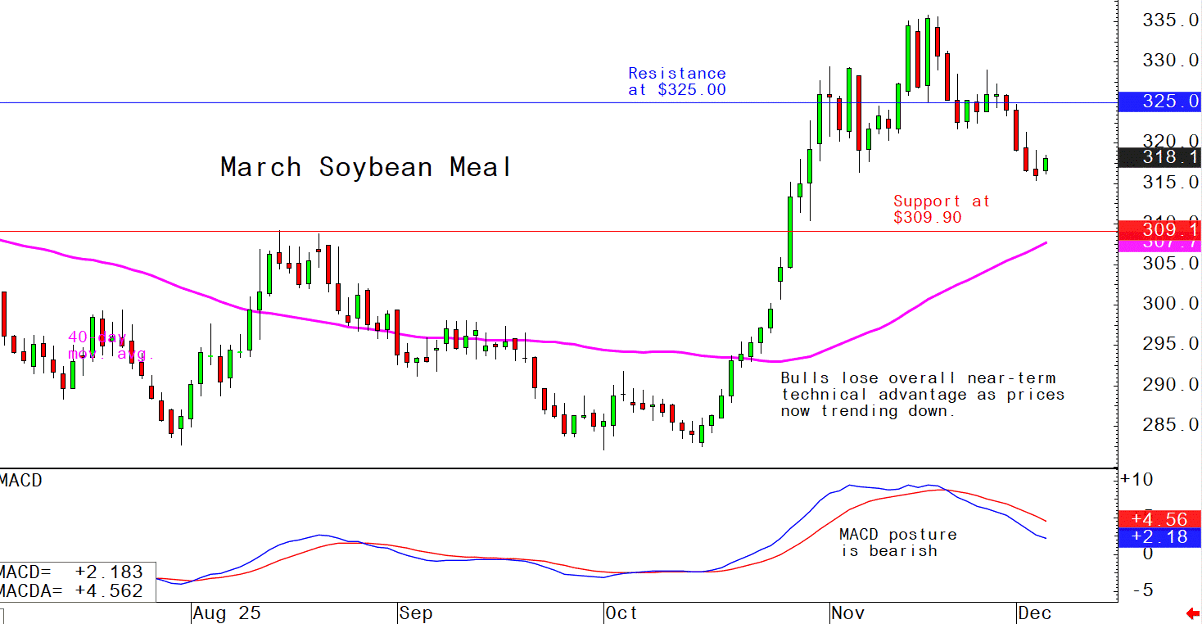
March soybean meal futures--$310.00 to $325.00, and with a sideways-lower bias
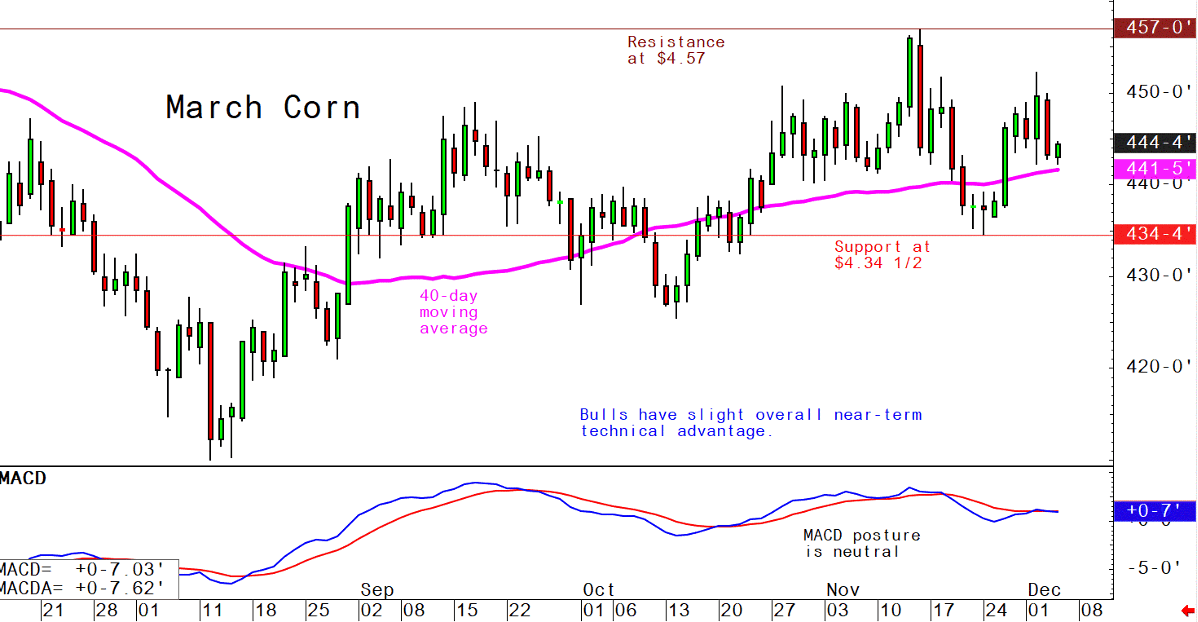
March corn futures--$4.34 1/2 to $4.57 and a sideways bias
Latest analytical daily charts lean hog, soybean meal and corn futures