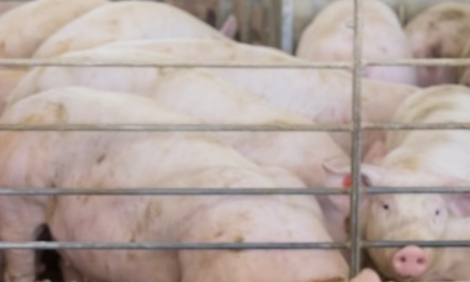






Weekly pig outlook: Lean hog futures prices decrease
Hog prices are slipping as cash strength fades, while rising food inflation and a pivotal US–China summit could create both headwinds and fresh demand opportunities for producers
 3 April 2026
 6 minute read
 By:
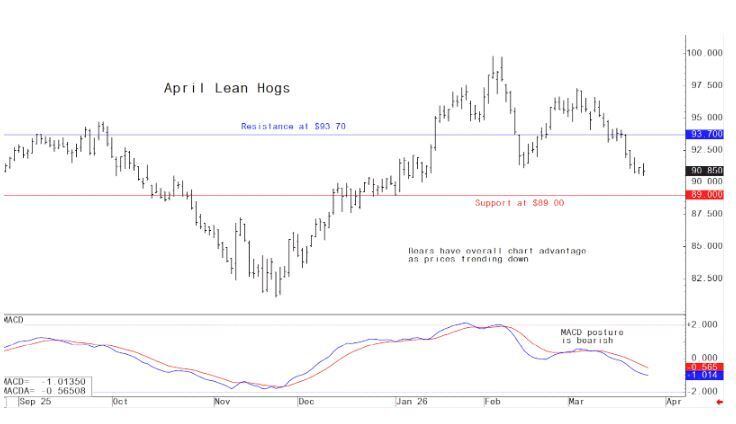
By: April lean hog futures on Wednesday fell $0.15 to $90.90 and hit a nine-week low. The hog futures market saw mild technical selling pressure amid a price downtrend in place on the daily chart. The rally in the cash hog market has stalled out and prices are starting to slip. The latest CME lean hog index is down 7 cents at $91.71. Today’s projected cash index price is down another 5 cents at $91.65. The national direct five-day rolling average cash hog price quote Wednesday was $69.44.
Pork Industry and related news
Trump: Xi Summit Reset for Mid-May as Trade Agenda Takes Shape
President says Beijing meeting scheduled for May 14–15 after Iran conflict delay, with agriculture and Phase One enforcement back in focus
President Donald Trump said Wednesday he will meet with Chinese President Xi Jinping in Beijing on May 14–15, rescheduling a late-March summit that was postponed due to US military operations tied to the Iran conflict.
The announcement — echoed by White House Press Secretary Karoline Leavitt — sets up a high-stakes bilateral engagement at a time of elevated geopolitical tension and ongoing efforts to stabilize US/China trade ties. “I’m pleased to announce that President Trump’s … long-awaited meeting with President Xi in China will now take place in Beijing on May 14 and 15,” Leavitt said. When asked whether the new dates suggested the Trump administration expected the Iran war to wind down by May, Leavitt responded that the trip was only postponed for three or four weeks. Asked if there was a precondition that Iran would not be taken up during the meeting, Leavitt said Trump and Xi had discussed the rescheduling, and the Chinese leader understood that it was “very important” for the president to be in the US “throughout these combat operations.”
The White House press secretary also announced that Trump, along with his wife, first lady Melania, will host “Xi and Madam Peng Liyuan for a reciprocal visit in Washington, DC, at a later date to be announced this year,” suggesting a broader diplomatic push that could include multiple leader-level meetings in 2026.
If current plans hold, Trump and Xi could meet as many as four times this year, including potential sidelines at a G20 gathering in Miami and the APEC leaders’ meeting later in China — signaling an unusually active phase in US/China leader-level engagement.
In a social media post, Trump described Xi as “the highly respected President of China,” adding that “representatives” on both sides were “finalizing preparations” for the “historic” visit. “I look very much forward to spending time with President Xi in what will be, I am sure, a monumental event,” he added.
China’s embassy in Washington did not immediately comment.
Trade groundwork is already underway. Senior officials have begun laying the foundation for potential agreements. Treasury Secretary Scott Bessent and US Trade Representative Jamieson Greer met with Chinese counterparts in Paris recently, emerging with what they described as a “work plan” for deliverables tied to the leaders’ summit.
Agriculture front and center. Multiple ag sectors are pressing for outcomes at the summit:
— Soybeans: Trump has floated additional Chinese purchases of 8 MMT, a key pressure valve for US producers amid global uncertainty.
— Corn: US and Chinese officials recently discussed potential China purchases of US corn.
— Beef: The US industry is seeking reinstatement of export licenses for facilities that lapsed last year.
— Poultry: Ongoing Highly Pathogenic Avian Influenza (HPAI) issues continue to complicate trade flows and reentry protocols.
— Biotechnology approvals: US officials are pushing for more predictable and timely Chinese approvals.
There is also renewed focus on enforcing elements of the Phase One trade agreement, particularly provisions governing the resumption of poultry exports after disease outbreaks.
Geopolitics and timing. The delay of the original meeting underscores how the Iran conflict is reshaping global diplomacy. While Leavitt emphasized the summit is not contingent on the war’s end, the administration has acknowledged the conflict’s expected four- to six-week timeline and its impact on scheduling.
Bottom Line: The mid-May Beijing summit is if it takes place is shaping up as a pivotal moment to test whether recent diplomatic groundwork can translate into tangible trade gains — especially for US agriculture — amid a volatile geopolitical backdrop.
USDA Lifts Food Inflation Outlook Above Long-Term Norms
Beef surge drives upward revisions while eggs, dairy and fats offer limited relief
USDA’s latest Food Price Outlook points to a renewed acceleration in food inflation for 2026, with all major categories — groceries, restaurants, and overall food — now projected to rise well above their 20-year averages.
- All food prices are forecast to increase 3.6% in 2026, up from 3.1% in February and above the 20-year average of 3.0%.
- Food away from home (restaurants) is seen rising 3.9%, topping the 3.5% historical average.
- Food at home (groceries) is projected up 3.1%, exceeding the 2.6% long-run norm.
Beef leads broad-based grocery inflation. The sharpest upward revision comes from beef and veal, now expected to jump 10.1%, nearly double USDA’s February forecast and marking the largest increase for any category.
- Beef’s surge reflects tight cattle supplies and would represent the biggest annual gain since 2014.
- Broader meats, poultry, and fish inflation was revised lower to 3.0%, though still a key contributor to overall food costs.
- Fish and seafood prices are expected to rise 4.3%, while pork (+1.3%) and poultry (+0.3%) show more modest gains.
Across grocery categories, 8 of 15 are now projected to rise faster than their historical averages, including fresh vegetables, processed foods, cereals, and beverages — signaling persistent, widespread price pressure.
Eggs, dairy, and fats provide limited downside. USDA continues to project price declines in a handful of categories:
- Egg prices are forecast to fall 26.8%, even with ongoing highly pathogenic avian influenza (HPAI) detections, as production rebounds.
- Dairy products and fats and oils are also expected to decline modestly.
These declines, however, are not enough to offset broader inflation across most food categories.
The expected drop in egg prices would mark the largest annual decline since 1974, following multiple years of steep increases.
Processed foods and produce add pressure.
- The “other foods” category — including processed and convenience items — is now seen rising 3.0%, double the prior forecast and a major driver of grocery inflation.
- Fruits and vegetables are projected up 2.5%, with fresh produce leading gains.
Inflation outlook climbs despite incomplete war impact. The revised forecasts place 2026 food inflation above 2025 levels and reinforce growing pressure on household budgets already strained by higher fuel costs tied to the Middle East conflict. However, USDA notes the outlook only incorporates CPI and PPI data through February — meaning any additional war-driven increases in energy, transportation, or inputs like fertilizer are not yet reflected.
Bottom Line: Food inflation in 2026 is becoming more entrenched and broad-based, led by a sharp spike in beef prices and rising costs across processed foods and produce. While declines in eggs and select categories offer some relief, they are unlikely to materially offset the upward pressure facing consumers.
Smithfield tops estimates as packaged meats demand holds firm
At-home eating trends and holiday protein demand boost sales and margins, while acquisition strategy signals further growth
Smithfield Foods exceeded Wall Street expectations for fourth-quarter sales and profit, underscoring the resilience of US consumer demand for packaged meats even as broader household budgets remain under pressure. Shares of the pork processor rose nearly 4% in premarket trading following the earnings release.
The company reported quarterly sales of $4.23 billion, up 7% year over year and above analyst expectations of $4.14 billion, according to LSEG data. Adjusted earnings came in at 83 cents per share, well ahead of the 68 cents analysts had projected.
Performance was driven largely by continued strength in Smithfield’s packaged meats segment — its core profit engine — where sales rose 4.3% in the quarter. Fresh pork sales also posted modest growth, increasing 2.1%.
Weekly US pork export sales
US Pork: Net sales of 40,300 MT for 2026 were up 43 percent from the previous week and 23 percent from the prior 4-week average. Increases were primarily for Mexico (14,100 MT, including decreases of 200 MT), China (9,700 MT, including decreases of 100 MT), Japan (5,800 MT, including decreases of 300 MT), South Korea (3,700 MT, including decreases of 800 MT), and Canada (1,500 MT, including decreases of 400 MT). Exports of 39,100 MT were up 10 percent from the previous week and 2 percent from the prior 4-week average. The destinations were primarily to Mexico (16,700 MT), South Korea (4,700 MT), Japan (4,600 MT), China (3,900 MT), and Colombia (2,000 MT).
The next week’s likely high-low price trading ranges:
April lean hog futures--$88.00 to $92.50 and with a sideways-lower bias
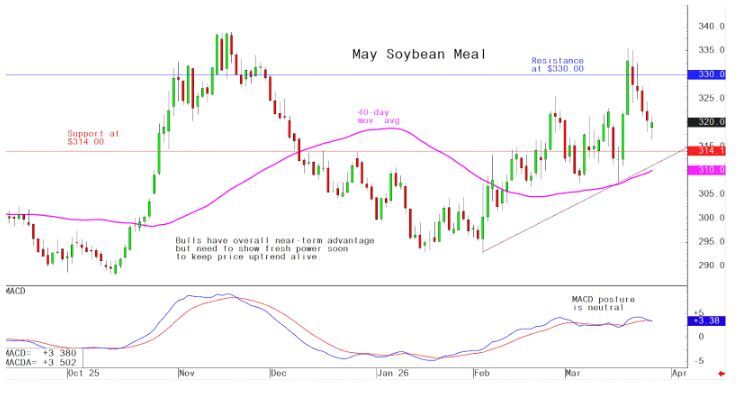
May soybean meal futures--$310.00 to $330.00, and with a sideways-higher bias
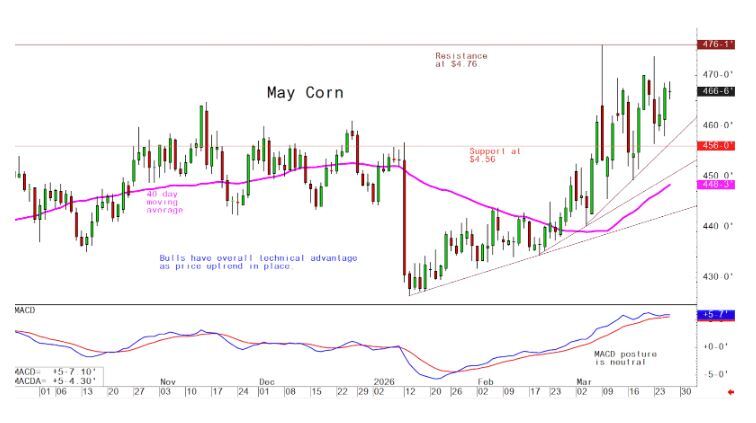
May corn futures--$4.55 to $4.80 and a sideways-higher bias
Latest analytical daily charts lean hog, soybean meal and corn futures