





Brazil positions itself as stable supplier in global protein trade
Government, industry point to reliability amid market volatility
 22 April 2026
 7 minute read
 By:
By: At a time when disease pressure, geopolitical instability and shifting trade flows are testing supply chains across every continent, Brazil is positioning itself as a reliable anchor in global animal protein markets.
At a meeting in São Paulo, government officials and industry leaders said the country's continued export growth driven less by opportunism and more by a growing responsibility to feed the world.
The country is the world's largest exporter of chicken meat and beef, and ranks third in pork shipments. It is also the second-largest beef producer globally. Together, the sectors supply animal protein to more than 150 countries, with shipments spanning every continent. That growth is the result of a combination of factors, including expanding market access, diversified trade relationships and production conditions that are difficult to replicate elsewhere.
A responsibility to feed the world
Ricardo Santin, president and CEO of the Brazilian Animal Protein Association (ABPA), was direct about what that position means in practice. Brazil now holds approximately 38% of global poultry trade, a share he said comes with consequences.
“It's a very, very huge responsibility that we have now,” he said in a one-on-one interview. “There are a lot of people that need Brazil to work well to eat.”
He pointed to Jordan as an example. The country relies on poultry imports to meet demand. Brazil supplies 91% of the market against a very small domestic production base.
“When you look at this, you say, I need to find some solutions — because there are children there, there are elderly people that need our meat,” he said.
Brazil exports to more than 160 poultry markets, more than 100 for pork and more than 80 for eggs. Santin said production growth is calibrated to meet demand rather than driven by volume targets. The country's export model is designed to complement, not displace, local industries in importing countries, he said.
The same logic applies to beef, where Brazil's shipments of specific cuts fill gaps in importing countries' supply chains rather than competing head-on with domestic production.

Part of what supports Brazil’s market position, according to Ingo Plöger, president of the Brazilian Agribusiness Association, is a combination of natural advantages that are easy to underestimate outside of Brazil. Tropical agriculture operates on three times the photosynthetic power of temperate farms in the northern hemisphere. Brazilian farms can harvest 2-3 crops in the same field in one season. The result? Brazil is the world's largest soybean producer and third-largest corn producer. This gives livestock sectors a cost advantage that competitors in higher-input environments cannot match.
"The Brazilian potential international influence is not in rates for the long term," Plöger said. "It is in proteins."
He described how Brazilian protein exporters have built their position not by shipping volume indiscriminately, but by learning what each market actually wants.
“In the Arabic world, we have one kind of meat,” he said. “In Europe and the US, another one. In Asia, a different one.”
Market intelligence, he said, is as important as production capacity.
Market expansion continues
On the trade policy side, Luis Rua, secretary for trade and international relations at Brazil's Ministry of Agriculture, Livestock and Food Supply, laid out the pace of market-opening work. Since 2023, bilateral negotiations have unlocked 548 new markets for Brazilian agri-food products. More than 4,000 export certifications have been approved, enabling additional processing plants to access foreign markets, with more than 250 market expansions extending the pool of eligible Brazilian exporters.
"We are toppling barriers to trade, we're opening doors," Rua said.

The government’s work is supported by a network of 40 agricultural attachés based in embassies abroad, alongside trade missions and cooperation agreements. Rua said trade missions took him to 32 countries last year.
USDA forecasts reflect Brazil’s ambitions. Chicken meat production is forecast to reach a record 15.8 million metric tons in 2026, up 3%. As Brazil opens new markets and consolidates existing ones, exports are expected to climb a further 2%.
USDA projects pork exports to rise 7%, reaching 1.83 million metric tons. This increase, the department said, is supported by firm external demand and Brazil's improving disease status. The biggest competitors in Europe and Asia are currently grappling with African swine fever (ASF).
Beef exports, while forecast to fall slightly from record shipments in 2025, are still projected at 4.15 million metric tons, maintaining Brazil's position as the world's largest beef exporter for the ninth consecutive year.
A significant milestone further supports the Brazil’s beef and pork outlook. In May 2025, the World Organisation for Animal Health declared the country free from foot-and-mouth disease without vaccination, a status that is now opening negotiations to expand exports to include offal and bone-in cuts to existing partners, while also unlocking new markets.
Globally, trade patterns continue to evolve. The Philippines has overtaken China as the leading destination for Brazilian pork. This shift is being driven by population growth, rising incomes and domestic disease pressure. China continues to rebuild its swine herd following years of losses due to ASF. It now accounts for a smaller share of pork purchases than it once did. Despite that growth, Santin said China remains an important trade partner, particularly for specific cuts and by-products.
In poultry, demand from the Middle East and Southeast Asia continues to drive growth, with the United Arab Emirates, Japan and Saudi Arabia among the top destinations in 2025.
Both Rua and Santin pointed to Brazil's sanitary standing as a central pillar of its export credibility. The country reported its first case of highly pathogenic avian influenza in a commercial flock last year. While 122 markets remained open, the outbreak led to the temporary closure of 28 markets. The outbreak, he said, was quickly contained, and all 28 subsequently reopened.
“It happened, but it didn't spread,” Santin said. “This is quite a proof to the world.”
Market stability amidst an outbreak is partially due to the regionalisation and compartmentalisation agreements the sectors established over the past 15 years. The agreements allow trade to continue from unaffected zones during disease events.
Santin was critical of countries that close their borders to Brazilian products while managing outbreaks of the same virus in their own countries. He said he’s still waiting for an agreement to be finalised with the European Union.
Despite its incredible growth, infrastructural constraints remain a problem. Santin was candid about the country’s logistics, calling them Brazil’s biggest domestic bottleneck. Several ports lack the depth to accommodate newer, larger container vessels. Even the Port of Santos near São Paulo, the country's largest and best-equipped, has its limitations.
“We’re three generations behind what the world is using now,” Santin said.
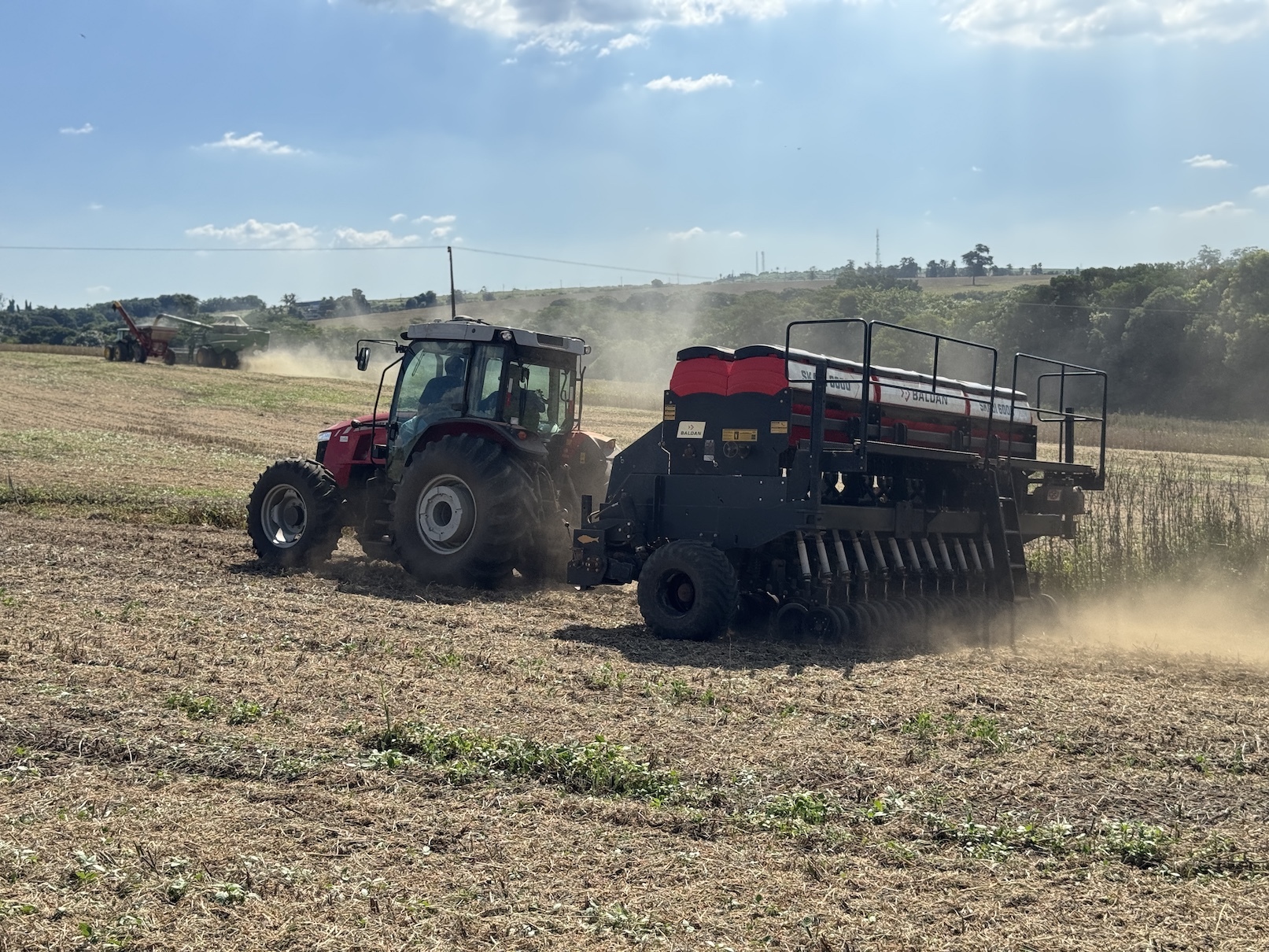
Plöger also offered context into the infrastructural issues Brazil faces. Grain production has grown by roughly 6% annually since 2010, while storage capacity has expanded at around 0.5% per year. This gap forces product onto roads and waterways before the infrastructure is ready to receive it.
Because tropical harvests arrive in rapid succession with one crop following another within mere months, it’s a compounding issue. Brazilian grain cannot simply sit in on-farm storage. It has to move immediately, which compresses enormous volumes into short windows and places intense strain on rail and port networks that were not designed for that kind of production rhythm.
Plöger pointed to promising signs of progress on the horizon, though. A bridge between Brazil and Paraguay is due to open soon, marking the first step in a long-planned bio-oceanic network that will eventually connect central Brazil to Pacific ports. The new route will cut 12 to 17 days off shipping times to Asia. A 700-kilometre rail investment in Mato Grosso is expected to be operational within three years, as well.
“We wait 40 years, and now in four or five, we will have it,” Plöger said.
Brazil's historically complex tax system has added further friction for exporters, though a recently approved reform is moving the country toward a VAT model that is expected to improve the business environment over time.
Both Rua and Santin agreed that closing infrastructure gaps will be central to sustaining the country's long-term position. For now, Brazil's argument to the world rests on the combination of what it has — land, water, grain, integrated supply chains, biosecurity — and what it has demonstrated it can deliver through turbulence.
Santin put it plainly when asked about Brazil's competitive standing. “We are not better than anyone,” he said. “But there is no one better than us.”

Melanie Epp
Melanie Epp is a freelance agricultural journalist from Ontario, Canada.