






Ileitis demands greater attention from producers
What is ileitis and what causes it?
 23 June 2026
 3 minute read
 By:
By: Key takeaways
- Ileitis, caused by Lawsonia intracellularis, can be difficult to eradicate from affected production sites.
- Ileitis is more typically seen in warm summer months and during periods of higher stress.
- Subclinical ileitis may reduce pig performance without apparent clinical signs.
Porcine reproductive and respiratory syndrome, porcine circovirus associated diseases, and Mycoplasma hyopneumoniae are all important swine health concerns grabbing headlines and attention, but ileitis may be silently stealing pig performance.
What is ileitis and what causes it?
Caused by the bacterium Lawsonia intracellularis, and also known as porcine proliferative enteropathy (PPE), ileitis is a persistent gastrointestinal challenge in growing pigs that primarily affects the mucosa of the distal ileum. Depending on the age of pig when infected and the exposure dose, observations of clinical signs like diarrhea and severity of production performance reduction will be influenced.
Lawsonia replicates within the epithelial cells of the ileum lining; being intracellular makes it difficult to eradicate through treatment. The bacterium is transmitted through fecal shedding, which can continue for up to 12 weeks after clinical signs have subsided. Lawsonia can survive outside the pig and infect susceptible pigs for up to two weeks at temperatures between 41° F and 59° F.1
While ileitis may occur year-round, it is typically seen more in warm summer months and during times of higher stress.
Ileitis can be transmitted pig-to-pig and possibly through biological vectors such as rodents, birds and insects as well as mechanical vectors (fomites) like boots and equipment.1
Acute and chronic forms of ileitis
There are two forms of clinical ileitis, with varying degrees of signs:
- Acute — Affects finishing pigs older than 4 months, causing bloody or black diarrhea; weakness, depression and pale appearance; and sudden death. On necropsy, blood clots in the lumen of the intestine may be found.
- Chronic — Typically occurs between 6 and 20 weeks of age, causing soft, watery, and/or pasty diarrhea, as well as poor and uneven growth rates among pigs.
Additionally, subclinical ileitis, where pigs show no apparent clinical signs of disease but are positive for L. intracellularis through diagnostic testing, may have a larger influence on pig performance. In an experimental challenge of young pigs, subclinical ileitis resulted in a statistically significant (p<0.05) decrease in average daily gain of 37% and increase in feed efficiency of 27%, but this could vary drastically in conventional settings.2 Stress can cause subclinical disease to elevate to clinical ileitis.
Understanding normal versus abnormal in fecal consistency and postmortem findings is important when considering whether diagnostics should be submitted. Diagnostic tests for ileitis include collecting oral fluids or fecal samples from suspect pigs and submitting samples to the veterinary diagnostic laboratory for a Lawsonia intracellularis polymerase chain reaction (PCR) test or blood samples for serological tests. Postmortem, ileitis can be diagnosed through gross evaluation of lesions and/or submitting tissue to the diagnostic lab for histopathology-immunohistochemistry.3
It is also important to monitor pig operations on an ongoing basis to identify the presence of Lawsonia and the age at seroconversion.
Economic impact of ileitis — clinical and subclinical disease
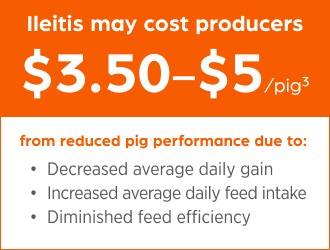
Ileitis is a widespread, complex disease, with estimates that more than 95% of herds in the Unites States reported to be seropositive.1 Ileitis may cost $3.50 to $5.00 per pig due to reduced pig performance, with reductions in average daily gain, feed efficiency, and increases in feed intake.3
Management factors to mitigate ileitis outbreaks
Ileitis outbreaks can occur anywhere, so preventing outbreaks is key to managing ileitis. Standard biosecurity practices, including Danish entry systems, where there is a distinct line of separation between the “clean” pig side and “dirty” entry area, and all-in/all-out pig movement, can help limit Lawsonia spread.
Cleaning and disinfecting barns and handling equipment between groups may also help break the transmission cycle. Disinfectants that include quaternary ammonium are effective.4
Maintaining rodent and bird control practices in and around swine production facilities can also help limit the spread of Lawsonia between pig groups. While the barn may be cleaned, rodents are still around and can bring pathogens back into a cleaned facility.
Developing immunity to Lawsonia through vaccines is also important. While natural infection confers robust immunity and resistance to reinfection, vaccines help elicit cell mediated immunity and prime the humoral immune response involved in protection against Lawsonia. 4 Live-attenuated and inactivated Lawsonia vaccines have been shown to reduce lesions and shedding of L. intracellularis and to decrease antimicrobial use for control of ileitis.
| References | ||||
|---|---|---|---|---|
| Gebhart, C. Lawsonia Intracellularis infections. in Proceedings. 19th International Pig Veterinary Society Congress. 2006. | ||||
| Paradis MA, McKay RI, Wilson JB, Vessie G, Gebhart C, Dick PC. Subclinical ileitis produced by sequential dilutions of Lawsonia intracellularis in a mucosal homogenate challenge model, in Proceedings. 36th Annu Meet Amer Assoc Swine Vet, 2005. | ||||
| Winkelman N. Subclinical ileitis: Diagnostic monitoring, R2, and economics, in Proceedings. 49th Annu Meet Amer Assoc Swine Vet, 2018;488-493. | ||||
| Karuppannan AK, Opriessnig T. Lawsonia intracellularis: Revisiting the disease ecology and control of this fastidious pathogen in pigs. Front Vet Sci. 2018;5:181. | ||||