





Weekly pig report: Chinese hog industry reforms aim to reduce oversupply cycles
China is introducing new measures to regulate overcapacity in its hog industry after years of boom-and-bust production cycles
 7 March 2026
 4 minute read
 By:
By: Lean hog futures bulls in control
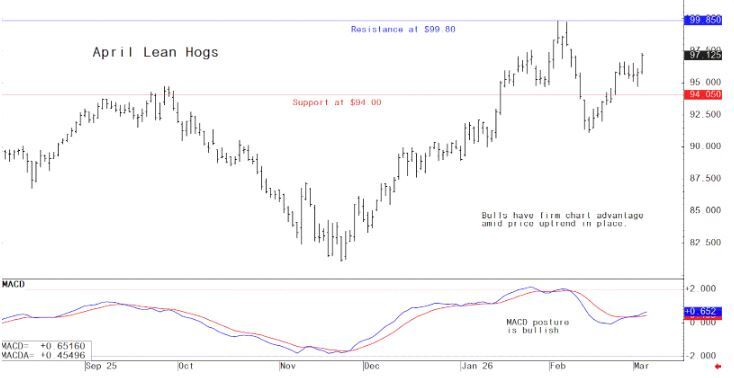
April lean hogs on Wednesday gained $1.325 to $97.075 and hit a three-week high. Hog futures saw renewed technical buying amid a price uptrend on the daily bar chart that was restarted Wednesday. Solid rallies in the cattle futures markets also supported buying interest in hog futures, as did firming cash hog prices. Some improved risk appetite in the general marketplace at mid-week also aided the hog futures bulls.
The latest CME lean hog index is up 15 cents at $89.84. Today’s projected cash index price is up another 34 cents at $90.18. The national direct five-day rolling average cash hog price quote Wednesday was $67.90.
Pork Industry and related news
China remains the world’s largest importer of several commodities
This policy supports continued Chinese engagement in global agricultural trade, including purchases from major exporters such as the United States, Brazil, and Argentina.
Livestock sector restructuring. The plan also highlighted structural reforms in China’s livestock sector, including:
- Regulating overcapacity in the hog industry, which has faced cycles of oversupply and collapsing prices following herd expansions after African swine fever.
- Policy support for the dairy and beef sectors, both of which have recently been protected by tariffs as Beijing seeks to stabilize domestic producers.
These measures suggest Beijing aims to stabilize livestock markets while protecting domestic production, potentially shaping import demand for feed grains and meat.
Implications for global agriculture. For agricultural markets, the plan reinforces several long-term trends:
USDA semiannual report on Brazil livestock sector
EXECUTIVE SUMMARY
Swine
- Pig Crop: Post forecasts a 3.3 percent increase in 2026, due to strong external demand, positive domestic demand, increased availability of feed due to record corn and soybeans crops, and devalued domestic currency.
- Slaughter: Post forecasts a one percent increase in 2026, reaching 49.2 million head.
- Pork Production: Post forecasts a three percent increase in 2026, reaching 4.9 million metric tons CWE, as a result of increased slaughter and feed availability, strong foreign demand, and investments made to increase production.
- Consumption: Post forecasts a one percent increase in consumption in 2026 at 3.07 MMT CWE. Expected lower pork prices will likely increase consumption.
- Exports: Post forecasts a seven percent increase in 2026, based on firm external demand, increased purchases from new markets, export growth to existing consumers, and Brazil’s sanitary status versus its competitors.
Senate Democrats push bill to break up major meatpackers
Wall Street Journal exclusive outlines proposal targeting industry consolidation and foreign ownership
A group of Senate Democrats led by Senate Minority Leader Chuck Schumer (D-N.Y.) is preparing legislation that would restructure the US meatpacking industry by forcing major processors to split their operations and limit market concentration, according to a Wall Street Journal exclusive reported by Patrick Thomas.
The proposal would prohibit companies from processing more than one type of meat — potentially requiring major firms to spin off beef, pork, or poultry divisions into separate companies.
The bill would also impose caps on market concentration in the beef sector and grant the Federal Trade Commission authority to order divestitures, including selling plants or spinning off business units.
Targeting industry consolidation. The measure would directly affect the dominant firms that currently control most US beef processing:
- Tyson Foods
- JBS
- Cargill
- National Beef Packing Company
Together, these companies process roughly 80% of US beef, making the sector one of the most concentrated in the American food system. Tyson alone processes about one in every five pounds of chicken, beef, and pork consumed in the US
The legislation would also mandate a review of foreign ownership in the meatpacking sector, including Brazilian-based JBS and pork processor Smithfield Foods, which is majority owned by Hong Kong–based WH Group.
Political push tied to high beef prices. Schumer and other Democrats are framing the proposal as part of a broader effort to address consumer affordability as beef prices remain elevated.
The bill arrives amid increasing scrutiny of the meatpacking sector in Washington. The Trump administration has already launched investigations into possible anti-competitive practices in the industry while pursuing other policies aimed at lowering prices, including increasing beef imports.
President Donald Trump recently signed an executive order to quadruple beef imports from Argentina and earlier reduced tariffs on Brazilian beef — moves intended to increase supply, though they have yet to significantly reduce retail prices.
Industry backlash and uncertain prospects. Industry groups sharply criticized the Democratic proposal, arguing it would weaken the efficiency of the US food system. Julie Anna Potts, president of the Meat Institute, said breaking up meat processors would raise costs across the supply chain. “This clearly will drive up costs for producers and consumers,” Potts said, calling the proposal “absurd.”
While industry officials see the legislation as unlikely to pass in the Republican-controlled environment, some analysts believe it could still push regulators or the Trump administration to take additional steps to reshape the sector.
Impact of Surging Diesel Prices on US Farmers
Higher fuel costs hit fieldwork, harvest, drying and freight — squeezing already tight margins
Surging diesel prices are especially painful for US farmers because diesel is the primary fuel that powers modern agriculture — from planting to harvest to transporting grain and livestock.
Here’s how the impact flows through the farm economy:
Direct impact: higher operating costs
Diesel fuels:
- Tractors and combines
- Grain trucks and semis
- Irrigation engines
- Grain dryers
- Livestock equipment
A spike of 30–50 cents per gallon during planting or harvest season can translate into thousands of dollars in added costs per farm, depending on acreage.
For row crop producers:
- Corn and soybean operations are highly mechanized and diesel intensive.
- Harvest season requires long combine hours and heavy truck movement to elevators.
For livestock producers:
- Diesel powers feed mixing, manure handling, and transport.
- Rising fuel prices increase feed delivery costs.
Unlike many businesses, farmers cannot easily pass these costs on. They are price takers in global commodity markets.
The next week’s likely high-low price trading ranges:
April lean hog futures--$94.00 to $100.00 and with a sideways-higher bias
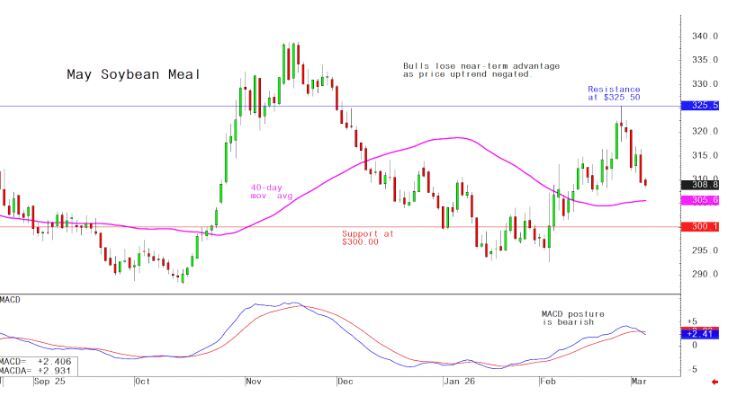
May soybean meal futures--$305.00 to $320.00, and with a sideways bias
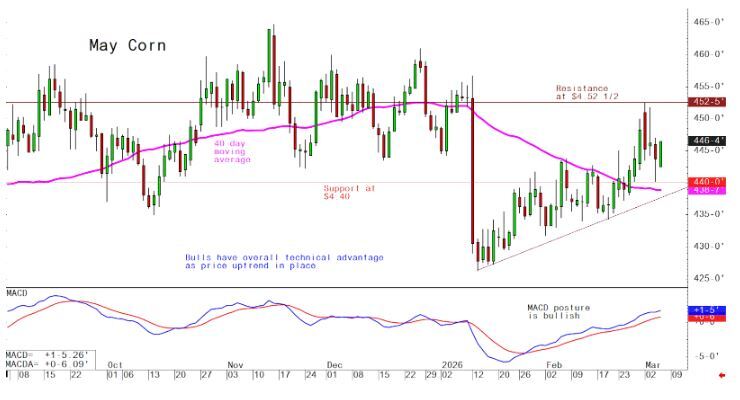
May corn futures--$4.35 to $4.52 1/2 and a sideways-higher bias
Latest analytical daily charts lean hog, soybean meal and corn futures