





Pig outlook: Lean hog futures see solid rebound, new ASF outbreaks
Livestock analyst Jim Wyckoff reports on global pig news
 30 November 2025
 4 minute read
 By:
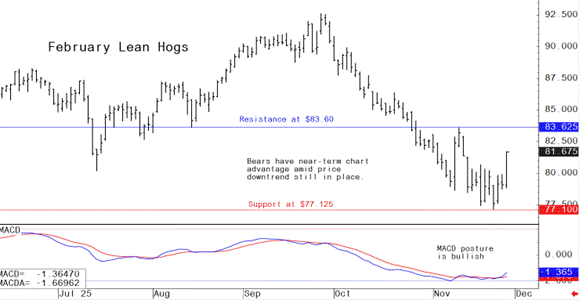
By: Lean hogs see heavy short covering. February lean hog futures rose $2.375 to $81.375 on Wednesday and hit a two-week high. Hog futures saw solid short covering and perceived bargain buying following recent losses. Strong gains in the cattle futures markets Wednesday also spilled over into buying interest in lean hog futures. Still, steadily declining cash hog prices will limit the upside in futures, until the cash market stabilizes and starts to turn back up. The latest CME lean hog index is down another 80 cents to $82.81. Friday’s projected cash index price is down another 54 cents at $82.27. Wednesday’s national direct 5-day rolling average cash hog price quote is $70.92.
Lean hog futures traders monitoring African Swine Fever breakout in South Korea
South Korea was on heightened alert Tuesday after authorities reported an outbreak of African Swine Fever at a pig farm in the country’s top pig-breeding region, Reuters reported. Authorities raised the national alert level to “serious” after 1,423 pigs were culled due to the outbreak at a farm in Danjin, South Chungcheong province, the report said. Authorities were on the lookout for further infections at around 140 related farms, according to South Korea’s agriculture ministry. The ministry also issued a 48-hour “standstill” order for all livestock facilities in the country in a bid to curb the risk of further spread. The report said the incident marked the sixth isolated outbreak of ASF in South Korea in 2025, but the first in the province – an area that hadn't seen a previous outbreak. South Korea was the fourth-largest importer of U.S. pork by value in 2024, according to Pork Checkoff.
African swine fever returns to Spain after 30 years
Outbreak raises risk of China limiting pork imports
African swine fever has returned to Spain after three decades with the finding that two wild boar found dead near Barcelona tested positive for the virus, Reuters reported, citing the Agriculture Ministry on Friday, putting growing pork exports to China at risk of a ban. The outbreak, the first since 1994, coincides with Spanish efforts to court Beijing and gain market share in the pork sector. But any ban could be limited in scope after China and Spain signed a deal this month that would mean China would only restrict imports from an affected region rather than from all of Spain.
Spain is the European Union's leading pork producer, accounting for roughly a quarter of the bloc's output, ahead of Germany, according to the Agriculture Ministry.
"It's not good news. The European market is already struggling after a 20% drop in prices since July," said Jean-Paul Simier, a meat analyst at French commodities research group Cyclope. "There is a risk of an embargo against the biggest EU pork exporter, notably in Asia, and China in particular."
The ministry said it had notified the European Union and activated emergency measures in the affected area, urging pig farms to tighten security measures while investigators try to find the source of the infection.
The virus, which is harmless to humans but deadly for pigs, has been spreading westwards in Europe in recent years.
Germany's sizeable pork industry has already been rattled, with many overseas countries imposing bans on its pork. And in recent months Croatia has been trying to contain an outbreak.
USDA chief Rollins opens up on meat packers concentration
In a candid conversation with producers Jim Mundorf and Shad Sullivan, the USDA Secretary lays out her views on market turmoil and meat packer concentration
USDA Secretary Brooke Rollins sat down with cattle producers Jim Mundorf and Shad Sullivan for a special Lonesome Report podcast interview, where the trio dug into the state of the meat-packing cattle industry.
Beef Packer Concentration, DOJ Investigation & Plant Closure
Key points:
- Rollins brings her background in antitrust law and argues packer concentration is a national security issue, not just an economics issue.
- Notes four companies control 80–85% of beef packing; two are foreign-owned.
- She supports DOJ’s investigation, saying USDA will monitor closely and push for reforms.
On the Lexington, Nebraska plant closure, she notes:
- Capacity loss (≈5,000 head/day; 3,000 jobs) adds short-term volatility.
- But nearby plants were under capacity and may absorb volume.
- USDA is exploring using the closure to create space for new local/regional processors.
• Rollins discusses:
- Movable/mobile processing units.
- Grants that help small plants modestly increase capacity (“a $60,000 grinder could take a plant from 1 head/week to 6–10”).
• Emphasizes:
“We are not against big packers; we are against centralized control.”
Expanding regional packing is central to rebuilding cattle country and reversing the loss of 150,000 ranches since 2017.
“We are not against big packers; we are against centralized control.”
Expanding regional packing is central to rebuilding cattle country and reversing the loss of 150,000 ranches since 2017.
The next week’s likely high-low price trading ranges:
February lean hog futures--$77.125 to $84.00 and with a sideways bias
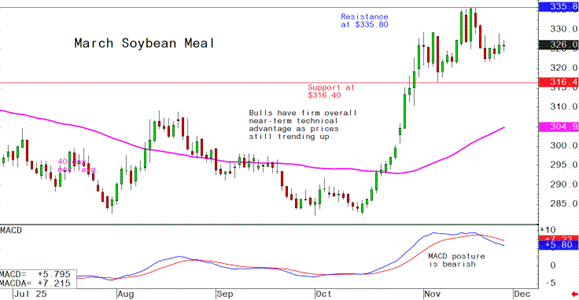
March soybean meal futures--$321.80 to $340.00, and with a sideways-higher bias
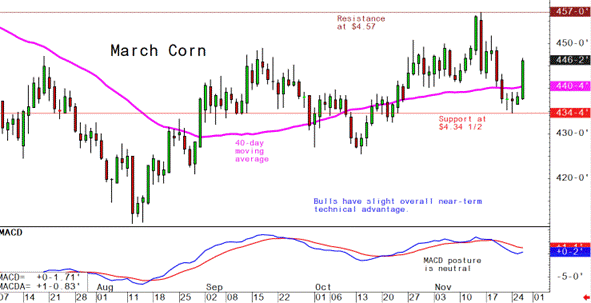
March corn futures--$4.34 1/2 to $4.57 and a sideways-higher bias
Latest analytical daily charts lean hog, soybean meal and corn futures