





Two organic acids, two delivery mechanisms
Supporting swine performance and economics with a combination approach
 2 December 2025
 6 minute read
 By:
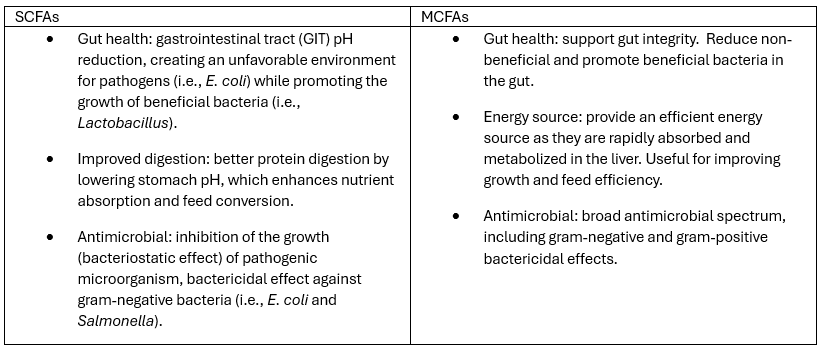
By: Organic acids, including short-chain fatty acids (SCFAs) and medium-chain fatty acids (MCFAs), are commonly used in pig feed and water to enhance growth performance. A dual approach that combines SCFAs and MCFAs is an emerging solution in animal nutrition. In pig production, this combination strategy reduces non-beneficial bacteria, improves gut health, enhances growth, and supports overall swine performance. As both types of fatty acids have unique properties and deliver distinct benefits, their combined use can deliver a synergistic effect.
Table 1. Effects of SCFAs and MCFAs
Benefits of a dual supplementation strategy
Organic acids can deliver a broader spectrum of benefits when supplementation uses an “and” versus an “or” strategy. When SCFAs and MCFAs are used in combination, they can complement each other's actions, resulting in broader health and performance benefits than would be achieved with independent SCFA or MCFA supplementation. Four benefits of combining SCFAs and MCFAs are:
- Synergistic antimicrobial effects: SCFAs are effective in lowering GIT pH. They also inhibit the growth of pathogenic microorganisms, promote the growth of beneficial bacteria, and help to reduce non-beneficial gram-negative bacteria. MCFAs have broad antimicrobial properties (gram-negative and gram-positive bacteria). Together, SCFAs and MCFAs can enhance pathogen control and reduce gastrointestinal challenges, especially during the post-weaning period. These effects result in a balanced gut microbiota, which is essential for optimal digestion, nutrient absorption, and immune function.
- Improved gut health: The combination approach supports a healthier gut environment due to the control of pathogens and improved digestive function.
- Enhanced nutrient utilization: SCFAs enhance protein digestion, while MCFAs are easily digestible and provide an immediate energy source. Combined, they improve overall feed utilization, lowering the feed conversion ration (FCR) and improving animal growth, particularly in the nursery and finishing phases.
- Cost-effectiveness: Both SCFAs and MCFAs are relatively cost-effective feed additives that can significantly improve growth and feed efficiency, leading to better profitability in pig production.
Effects of delivering SCFAs and MCFAs via two routes in swine production
While SCFAs and MCFAs have long been used in animal diets to support health and enhance performance, supplementing SCFAs via water is also a viable alternative strategy for delivering the benefits of organic acids to sows and their litters.
Supporting the sow and her piglets: Lactating sows tend to reduce their feed intake, especially in warmer weather. A drop in feed consumption can lead to significant body weight loss, which may result in diminished milk production and, ultimately, lower weaning weights for sows’ piglets. Water can serve as an effective delivery mechanism, especially when feed intake drops. Sows have high water needs (20-35 L/day). Adequate water intake is essential to prevent constipation and lower the risk of urinary tract infections while also supporting optimal milk production. Studies have shown that adding organic acids to sows’ water can offer positive effects that last beyond the lactation period.
Trouw Nutrition investigated whether supplementing feed with a combination of SCFAs + MCFAs (Selacid® Green - SG) and supplementing water with SCFAs (Selko® AlpHa - SApH) could provide comprehensive support for lactating sows and their piglets. This combined strategy sought to deliver the positive effects of organic acids when sows’ feed intake dropped during lactation. The dual-delivery approach resulted in improved feed intake and reduced body weight loss in sows. It also yielded better outcomes for piglets, including heavier weaning weights (Table 2).
Table 2. Effect of SCFAs and MCFAs on lactating sows and piglets’ performance
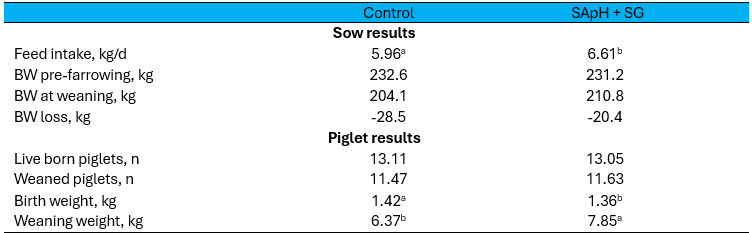
BW (body weight), SApH (Selko® AlpHa, blend of SCFAs applied via water), SG (Selacid® Green, blend of SCFAs and MCFAs applied via feed). Values within a row with different superscripts (a,b) are significantly different (p < 0.05). Study conducted in Brazil by Global Validation R&D Trouw Nutrition, including 36 multiparous sows. From five days before farrowing to 25 days after weaning, sows were assigned to either a control group (basal diet) or a treatment group (basal diet plus SG 2.5 kg/t feed and SApH 1 L/1000 L water).
Nursery piglets with a weight-gain carry-over effect in the fattening phase
Organic acids increase piglets’ water and feed intake, which is crucial during the transition phase when piglets are learning to eat solid feed. This support can help to enhance growth and help minimize post-weaning weight loss. Organic acids’ effects on feed digestibility are also important, since a young pig’s digestive system is still developing. Feed ingredients can be broken down more efficiently, aiding nutrient absorption. Furthermore, organic acids can help manage challenges related to pathogenic bacteria that are prevalent in the weaning phase. For fattening pigs, organic acids can help improve FCR and maintain gut health to support growth and increase overall profitability.
Another swine study demonstrated that supplementing weaned piglets with the same combination mentioned above - SCFAs via water (SApH) and a blend of SCFAs + MCFAs via feed (SG) resulted in improved performance. Final body weight increased by +880 g (+2.9%, p = 0.09), weight gain increased by +28 g/d (+6.6 %, P < 0.05) and FCR reduced by -4.5 points (-3.1%) (P>0.1). These benefits carried over into the fattening phase. Pigs that received the combination in the nursery phase had a final body weight that was 1.18 kg numerically higher and an FCR that was -1.3 points numerically lower compared to the control group (P>0.1). The carryover effect on weight gain was +0.3 kg for the SApH + SG group (Table 3).
Based on local feed, product, and livestock prices during the trial, the use of SCFAs via water and SCFAs + MCFAs via feed in the nursery phase resulted in a benefit of €0.83 per piglet, providing a return on investment (ROI) of 10.81. During the fattening phase, the benefit was €2.93 per pig, with an ROI of 2.93, as there were no additional treatment costs in this phase (Table 3).
Table 3. Effect of SCFAs and MCFAs on nursery piglets’ performance with a carryover effect in the fattening phase
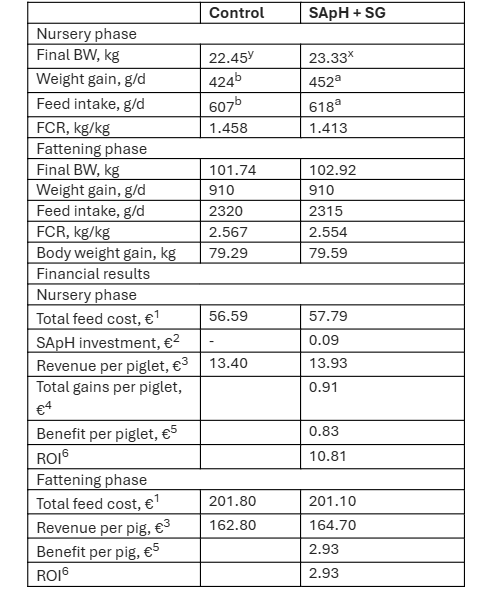
BW (body weight), FCR (feed conversion ratio), SApH (Selko® AlpHa, blend of SCFAs applied via water), SG (Selacid® Green, blend of SCFAs and MCFAs applied via feed). Values within a row with different superscripts (a, b) are significantly different (p < 0.05), (x, y) tend to differ (p = 0.09). Study conducted in Brazil by Trouw Nutrition, including 200 weaned piglets assigned to either a control group (basal diet) or a treatment group (basal diet plus SG 2 kg/t feed and SApH 0.5 L/1000 L water).
1Based on daily feed intake, feed price (nursery phase €2.74/kg, fattening phase €1.01/kg). SG investment is included in the total feed cost of the nursery phase.
2Based on water: feed ratio of 3.0, plus 20 % water intake (average from different studies), dosage of SApH.
3Based on final body weight and pig price (end of nursery €13.40 per piglet for control pig, end of fattening €1.60/kg live weight).
41-point improvement in FCR = €0.42 (for nursery pigs) and = €0.80 for fattening pigs, (FCR value x FCR points difference) + revenue difference.
5Total gains minus SApH investments.
6Return on investment: total gains / SApH investment for nursery pigs. For fattening pigs, same as the benefit, as there was no investment during the fattening period.
Conclusion:
Combining SCFAs with MCFAs provides a powerful tool for maintaining animal health and performance of pigs across all life stages. By synergizing beneficial effects that include enhanced pathogen control, digestion support, better nutrient absorption, and overall gut health, this combination approach can lead to more efficient and cost-effective swine production.

Karolina Von Zuben Augusto