




New swine research challenges net energy assumptions for soybean meal
Dr. Hans Stein explains why increased nitrogen retention in modern pigs is reshaping how swine nutritionists evaluate protein energy
 9 June 2026
 5 minute read
 By:
By: At the 2026 ASAS Midwest Section Meeting, Dr. Hans H. Stein, professor of swine nutrition at the University of Illinois, spoke at the U.S. Soy-sponsored Swine Application Symposium, challenging long-held assumptions about the net energy (NE) value of soybean meal in swine diets.
Drawing from calorimetry research, historical feeding systems and evolving pig genetics, Stein made a case for updating one of the most fundamental inputs in diet formulation. His message was clear: the way the industry currently calculates net energy contribution from soybean meal no longer reflects modern pig genetics and production.
“The modern genotypes of pigs have greater nitrogen retention,” Stein said. “And that is connected to the net energy of soybean meal.”
A system built on outdated assumptions
Net energy systems used today are rooted in decades-old assumptions about how pigs utilize nutrients. Historically, energy efficiency has been assigned by nutrient type – fat, starch, protein and fiber – based on research from the 1980s.
Fat has been considered highly efficient, with about 90% of its energy retained; starch follows at roughly 82%. Protein, however, has long been penalized, with an assumed efficiency of just 60%, while fiber ranges widely from 0% to 60% depending on its composition.
These assumptions are embedded in widely used systems such as the NRC and the Noblet equation, which start with digestible energy (DE) and adjusts based on nutrient composition. Protein carries a heavy penalty in these systems, significantly reducing calculated net energy values for protein-rich ingredients such as soybean meal.
“You really hammer down the net energy if there's high crude protein because the assumption is that a lot of that protein is not used and is excreted, leading to low efficiency,” Stein explained.
The result is a longstanding belief that corn delivers substantially more net energy than soybean meal. According to historic NRC values, corn provides about 3,025 kcal/kg NE, while soybean meal sits closer to 2,319 kcal/kg – roughly 78% of corn’s value.
However, Stein’s research suggests that gap may be significantly overstated.
New data from calorimetry challenges the model
Using an indirect calorimetry system at the University of Illinois, Stein’s team has conducted a series of experiments to directly measure energy utilization in pigs. These systems allow researchers to track oxygen consumption, carbon dioxide and methane production, along with total nutrient balance.
“We have four pigs per chamber so we can measure the gas exchanges, and we can collect all the feces and urine as well,” Stein said.
These experiments confirmed expected responses for fat and fiber. Adding soybean oil increased net energy linearly, while increasing fiber reduced net energy, which is consistent with traditional assumptions.
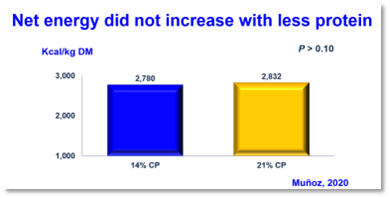
However, protein behaved very differently.
In one of the early calorimetry trials, diets containing 14% and 21% crude protein showed no difference in net energy – contradicting the expectation that higher protein diets would have lower energy efficiency.
“There was absolutely no difference,” Stein said. “So that was a little bit surprising.”
This finding set the stage for a broader reevaluation.
Low-protein diets: no energy advantage
One widely accepted concept in swine nutrition is that reducing crude protein while supplementing amino acids should increase dietary net energy. The logic is simple: replacing soybean meal with corn (a higher net energy ingredient) should boost overall energy.
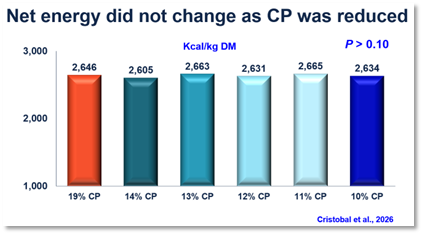
However, Stein’s research results did not support that theory. Across multiple experiments, including diets ranging from 20% down to 13% crude protein, no increase in net energy was observed. In some cases, energy values even trended downward as protein decreased.
“Low protein diets do not necessarily give us more net energy,” Stein emphasized.
Performance data supported the findings. Average daily gain and feed efficiency remained unchanged across diets, confirming that nutrient requirements were met and that energy differences were not masked by performance limitations.
These repeated results pointed to a deeper issue: the net energy assigned to soybean meal – and protein more broadly – is likely underestimated.
Increased nitrogen retention creates a shift
The central driver of this shift is the dramatic increase in nitrogen retention in modern pigs.
Traditional net energy equations were based on data suggesting pigs retained about 45% to 50% of absorbed nitrogen. That assumption underpins the large penalty assigned to protein in net energy calculations.
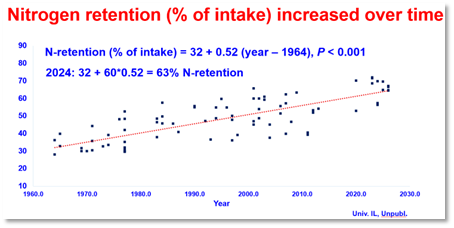
But genetic progress has changed the pig.
“Nitrogen retention (% of intake) has consistently increased over time,” Stein noted, citing a regression showing a steady rise from 32% in 1964 to approximately 63% in 2024.
“Pigs have changed since that time, and that's why the net energy of the protein fraction has changed,” he said. “Today’s pig retains more nitrogen.”
This shift has significant implications. When more dietary protein is used for lean tissue growth rather than being deaminated for energy, the efficiency of protein utilization increases.
Stein illustrated this with a comparison: moving from 45% to 70% nitrogen retention increases net energy contribution from soybean meal by approximately 163 kcal/kg.
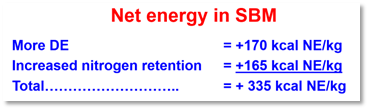
Combined with higher measured digestible energy values of about 170 kcal/kg above NRC estimates, this makes the total increase roughly 335 kcal/kg.
Using these adjustments, Stein proposed an updated net energy value for soybean meal:
- NRC baseline: 2,087 kcal/kg (as-fed)
- Adjustment: +335 kcal/kg
- New estimate: 2,422 kcal/kg (as-fed), or approximately 2,691 kcal/kg on a dry-matter basis

This aligns closely with independent calorimetry data from China, which reported values near 2,710 kcal/kg.
Additional studies estimating net energy from corn-soybean meal diets also consistently produced values above NRC predictions, further reinforcing this conclusion.
Implications for diet formulation
If soybean meal contains more net energy than previously believed, the implications for swine nutrition are significant.
- The long-standing gap between corn and soybean meal narrows considerably. Stein estimates that soybean meal now provides between 90% and 100% of the net energy of corn.
- Diet formulation strategies that rely on lowering crude protein to increase energy may need to be reconsidered. The assumption that low-protein diets inherently deliver more energy no longer holds under current conditions.
- Prediction equations themselves will require updating.
“We do need a new system to calculate net energy, so we can take into account the pigs we have today,” Stein said.
Stein also acknowledged that some of soybean meal’s energy contribution may not be explained solely by traditional nutrient analysis.
“It is possible some of those responses are due to some of the biological components in soybean meal,” he noted.
These components – potentially including bioactive compounds such as isoflavones and saponins – could influence metabolism in ways not captured by existing energy systems. While not yet fully understood, they represent another area where current models may fall short.
Take-home messages
Stein’s presentation delivered clear takeaways:
- Low-protein diets do not increase net energy
- Modern pigs retain more nitrogen, improving protein efficiency
- Soybean meal provides more net energy than current tables indicate
- Existing net energy prediction systems may underestimate protein ingredients
- Updated values place soybean meal close to corn in energy contribution
For swine producers and nutritionists, these findings signal a shift in how diets are created, evaluated and optimized. As genetic progress continues and analytical tools improve, energy systems will need to evolve alongside them.
In Stein’s view, the industry is at that inflection point.

Sarah Mikesell
Sarah Mikesell grew up on a five-generation family farming operation in Ohio, USA, where her family still farms. She feels extraordinarily lucky to get to do what she loves - write about livestock and crop agriculture. You can find her on LinkedIn.