





Weekly pig report: Export shipments hold steady despite mixed trends
Pork exports saw a modest weekly gain, though volumes remain below recent averages, signaling stable but not accelerating global demand
 18 April 2026
 4 minute read
 By:
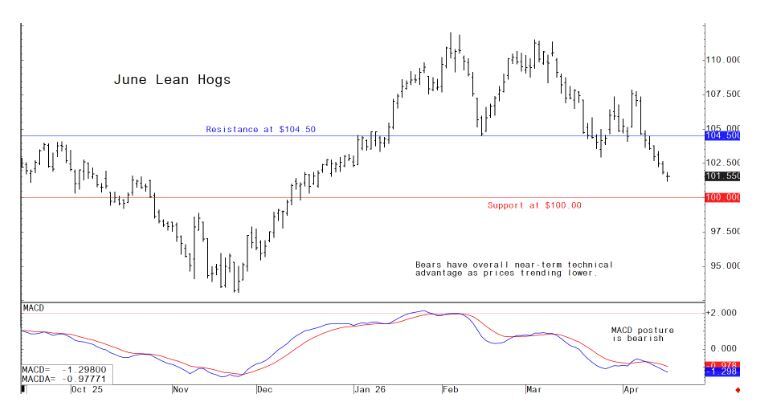
By: Lean hog futures bears are in technical control amid a price downtrend in place on the daily bar chart. June lean hog futures on Wednesday fell $0.50 to $101.95 and hit a more-than-three-month low. The lean hog futures market saw more technical selling pressure at mid-week, amid a price downtrend in place on the daily bar chart. The latest CME lean hog index is up 6 cents at $90.33. Thursday’s projected cash index price is up 27 cents at $90.60. The national direct five-day rolling average cash hog price quote Wednesday was $69.80.
Pork Industry and related news
Weekly USDA US pork export sales
Pork: Net US sales of 37,300 MT for 2026 were up 19 percent from the previous week, but down 3 percent from the prior 4-week average. Increases were primarily for Mexico (11,300 MT, including decreases of 300 MT), Japan (8,200 MT, including decreases of 400 MT), China (3,800 MT, including decreases of 100 MT), Canada (2,200 MT, including decreases of 500 MT), and Australia (2,000 MT). Total net sales of 200 MT for 2027 were for Japan. Exports of 35,300 MT were up 1 percent from the previous week, but down 6 percent from the prior 4-week average. The destinations were primarily to Mexico (15,600 MT), Japan (5,400 MT), South Korea (4,100 MT), China (2,900 MT), and Colombia (1,400 MT)
Red meat and Alzheimer’s risk — new research challenges dietary consensus
Wall Street Journal highlights emerging evidence that unprocessed red meat may benefit certain genetically at-risk individuals
A new opinion piece in the Wall Street Journal points to growing scientific evidence suggesting that red meat consumption — long criticized in mainstream dietary guidance — may offer cognitive benefits for a subset of the population genetically predisposed to Alzheimer’s disease.
The article, citing recent research including a study published in the Journal of the American Medical Association, focuses on individuals carrying the APOE4 gene variant, one of the strongest genetic risk factors for Alzheimer’s. Roughly 25% of people carry one copy of this variant, while about 2% carry two, significantly elevating their risk — particularly among women.
According to the research, higher consumption of meat — especially unprocessed red meat — is associated with a markedly lower risk of dementia among APOE4 carriers. In one study from Sweden’s Karolinska Institute, individuals with the gene variant who consumed the most meat (around 4.5 ounces daily) showed dementia risk levels comparable to those without the genetic risk.
Additional large-scale studies from the UK reinforce these findings. One found that each additional 50 grams of red meat per day reduced dementia risk by 36% among APOE4 carriers, while another showed cognitive advantages in older women with the variant who consumed at least one daily serving of unprocessed red meat.
Researchers suggest several possible mechanisms. APOE4 carriers tend to have higher cholesterol, which may accumulate in brain cells and contribute to Alzheimer’s pathology. Nutrients abundant in red meat — including vitamin B12, iron, and zinc — may help counteract these effects, particularly as absorption efficiency declines with age.
Meanwhile, the findings complicate broad public health recommendations. The American Heart Association has recently encouraged a shift toward plant-based proteins, partly in response to updated federal dietary guidance. However, the research suggests that such one-size-fits-all advice may overlook meaningful genetic differences in dietary needs.
The article underscores a broader takeaway: nutrition may be more individualized than current policy frameworks assume. While high red meat consumption may not benefit the general population, emerging evidence indicates it could play a protective role for those with specific genetic profiles — raising new questions for both dietary science and public health guidance.
USDA reports on global pork market
Global production in 2026 is forecast 1 percent higher to 120.2 million tons as increased production in the United States, Brazil, China and Canada offsets lower production in the European Union. Brazil pork production is forecast 3 percent higher to 4.9 million tons as abundant feed supplies and strong international demand supports sector growth.
China pork production is forecast marginally higher to 59.5 million tons as improvement in pigs per litter is anticipated to lead to higher slaughter, albeit at slightly lower weights given sector pressure to reduce production. Canada pork production is forecast 2 percent higher to 2.2 million tons as marginally higher sow stocks and steady pigs per litter growth will increase animals for slaughter.
EU pork production is forecast 1 percent lower to 21.7 million tons given tightening profit margins and ample supplies of pork within the EU. The decline in EU hog prices at the end of 2025, partly due to tariffs on pork exports to China and the discovery of African swine fever (ASF) in Spain, will likely pressure the EU to reduce herd inventories. Global exports are forecast virtually unchanged at 10.4 million tons as stronger shipments from Brazil, the United States, and Canada offset lower exports from the European Union.
Brazil exports are forecast 7 percent higher given gains in market access and strong price competitiveness against other major exporters. Canada exports are forecast 4 percent higher given greater exportable supplies and government efforts to increase market access. EU exports are forecast 8 percent lower given reduced exportable supplies and disease-related trade restrictions. US production and exports: US pork production is forecast 1 percent higher year over year to 12.7 million tons as continued growth in pigs per litter supports a larger 2026 slaughter despite a smaller sow inventory. Stable feed prices and relatively strong hog prices should support heavier hog weights in 2026.
US exports are forecast 3 percent higher in 2026 given robust demand in Mexico and Central America. Additionally, expected lower EU exports should provide opportunities for US exports to expand in key markets in Asia.
The next week’s likely high-low price trading ranges:
June lean hog futures--$100.00 to $104.00 and with a sideways-lower bias
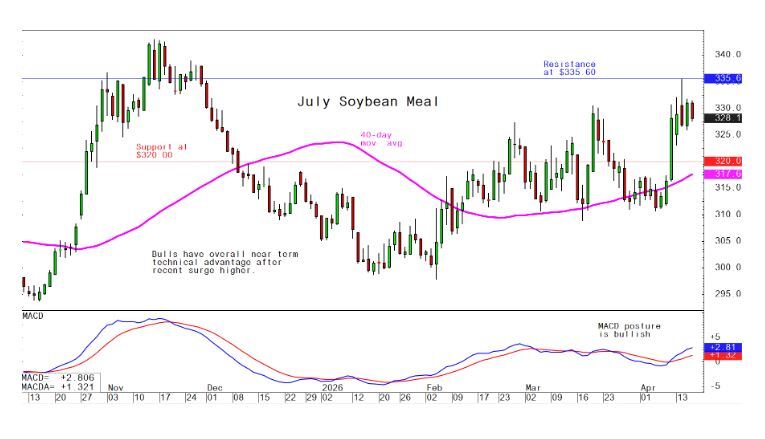
July soybean meal futures--$320.00 to $340.00, and with a sideways-higher bias
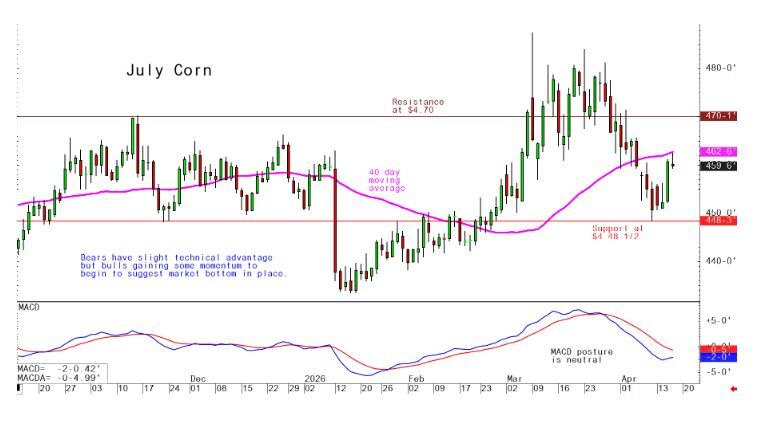
July corn futures--$4.50 to $4.75 and a sideways-higher bias
Latest analytical daily charts lean hog, soybean meal and corn futures