





Beyond the price tag: How digestible nutrients drive profitability in grow-finish swine
U.S. Soy consistently provides predictable performance and operational efficiency that nourishes a business.
 3 June 2026
 3 minute read
 By:
By: Most swine nutritionists know that feed cost represents the largest single expense in commercial swine production. According to Nutrient Requirements of Swine (NRC 1812) formulations, feed ingredients can account for 60% to 75% of total live production costs. With this major investment, the question to ask is NOT “What do feed ingredients cost?” The question is, “What value is the feed delivering?”
When evaluating ingredients on cost per unit of digestible nutrient,¹ soybean meal derived from U.S. Soy consistently provides the foundation for predictable performance and operational efficiency that nourishes a business.
Constant financial pressures can create the temptation to focus on reducing diet cost per metric ton. But purchasing ingredients based on price alone can create false savings, especially when calculations don’t account for nutrient digestibility1 and availability.
The true measure of feed value2 is not the ingredient’s price per metric ton, but its cost per unit of digestible nutrient, specifically, the digestible amino acids and energy that drive lean growth and carcass yield in an operation.
The real cost of protein
Grow-finish pigs require precision-balanced amino acids and energy to support efficient lean tissue deposition, feed conversion and carcass uniformity. Ingredients with lower amino acid digestibility3 may appear less expensive but ultimately cost more per kilogram of usable nutrition delivered.
Example: Cost per Unit of Digestible Lysine (Source: NRC 12)
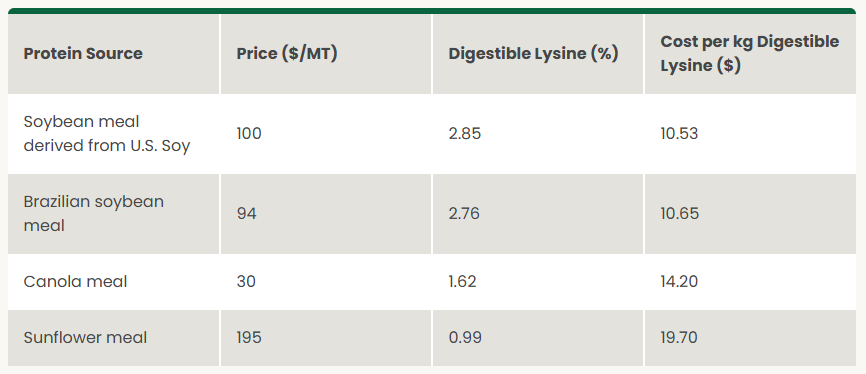
When digestible lysine content and digestibility rates are factored into diet formulation, research1, 2 supports that soybean meal derived from U.S. Soy offers a nutritional premium which can offset a higher per-ton price. Less expensive alternatives deliver less usable protein, require more synthetic amino acid supplementation and may reduce carcass yield due to suboptimal nutrient ratios.4, 5
Formulation reality in grow-finish diets
Swine diets are formulated for precise amino acid-to-energy ratios to optimize feed conversion and lean gain. Substituting soybean meal derived from U.S. Soy with lower-cost proteins like canola meal, dried distillers grains or sunflower meal introduces risk and complexity to formulations.6, 7, 8
For example:
- Canola meal provides only about 86% lysine digestibility versus greater than 90% for U.S. soybean meal.⁹, ¹⁰
- Sunflower meal is low in lysine and energy,3 requiring you to add fat or synthetic amino acids.
- Dried distillers grains vary widely in amino acid digestibility ¹¹ and oil content, demanding frequent formulation changes.
In short, what appears cheaper per metric ton often raises total diet cost once calculations account for digestibility corrections and performance variability.
Efficiency
Feed efficiency, carcass yield and nitrogen excretion all depend on amino acid digestibility, not crude protein content. Soybean meal derived from U.S. Soy consistently delivers superior standardized ileal digestibility 3,13 for key amino acids compared to other vegetable proteins.
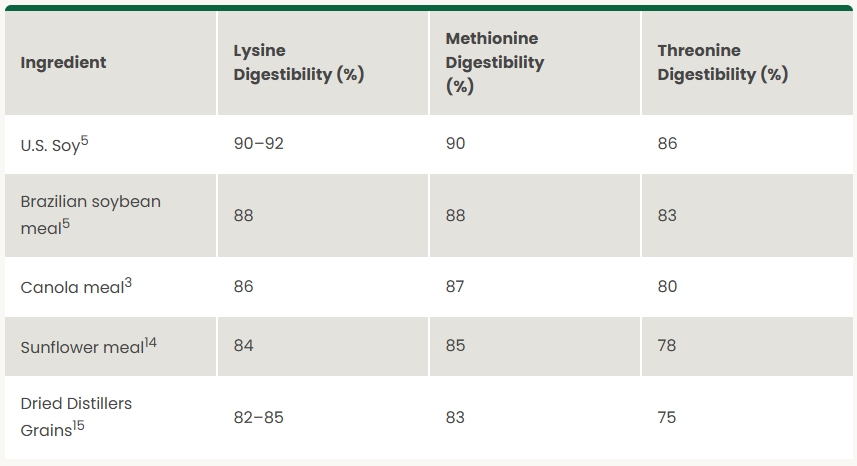
Higher amino acid and energy digestibility means pigs absorb more usable nutrients per kilogram of feed. That translates into lower feed cost per pound of gain and improved carcass uniformity. In trials comparing protein sources, grow-finish pigs fed soybean meal derived from U.S. Soy achieved superior feed conversion ratios16 and lean gain compared to those fed South American meals.
Superior amino acid digestibility becomes even more valuable during stressful periods including respiratory challenges, heat stress or post-weaning transitions. This is when functional compounds in U.S. Soy work synergistically with its nutrient density to maintain performance when synthetics alone fall short. 18
Consistency adds value
The nutrient consistency of soybean meal derived from U.S. Soy,1 especially in amino acid profile, digestibility and metabolizable energy, allows for formulating diets with precision, without large safety margins. This reduces the “hidden costs” that come from variability and reformulation when using alternative ingredients.
In contrast, protein meals from other origins often show greater batch-to-batch variability in amino acid content, oil and fiber levels, forcing nutritionists to formulate conservatively and accept lower performance predictability.12, 19 Consistency equals fewer surprises and more reliable ROI for the operation.
The economic takeaway
Evaluating protein sources on a cost-per-metric-ton basis hides the true economics of pig performance. When expressing cost per kilogram of digestible lysine or energy, soybean meal derived from U.S. Soy consistently outperforms lower-priced alternatives – delivering the most usable nutrition per dollar spent.
When accounting for what that nutrient density is actually worth at the formulation level, soybean meal derived from U.S. Soy represents at least $20 to $25 per metric ton1 in additional feed value, an advantage that compounds across every production cycle.
Practical takeaways
Moving from “cost per metric ton” to “cost per unit of digestible nutrition” reveals that soybean meal derived from U.S. Soy provides the most economical, consistent and performance-proven value in grow-finish swine diets. It supports improved average daily gain and feed conversion ratios, higher carcass lean percentage, lower nitrogen excretion and greater diet formulation precision.
Feed cost efficiency means extracting maximum usable nutrition per dollar invested and maximum return from every pig marketed.
By prioritizing digestible nutrient economics over ingredient price alone, operations gain improved average daily gain and feed conversion, higher carcass lean percentage, reduced environmental impact and the formulation precision that supports profitable operations.
That’s how U.S. Soy nourishes your business.
Partially funded by the Soy Checkoff