




Weekly pig report: Hog prices climb as export demand and cash markets align
A firm cash hog market and recovering export channels are reinforcing a positive outlook for swine markets heading into late summer
 24 July 2026
 4 minute read
 By:
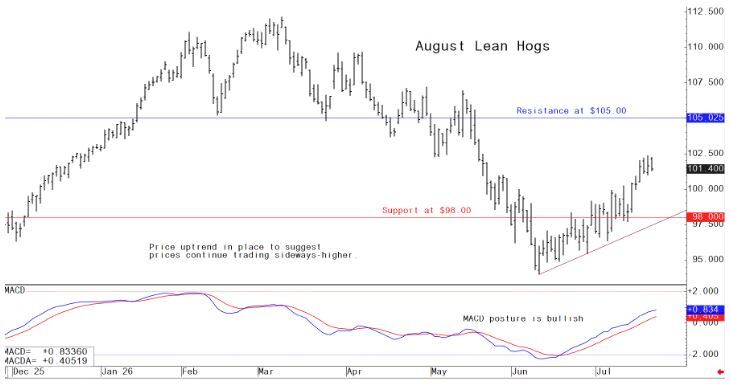
By: August lean hog futures on Wednesday fell $0.05 to $101.45. The hog futures market paused from recent good gains amid a price uptrend in place on the daily bar chart. Bulls have been encouraged by rising cash hog prices. The latest CME lean hog index is up 48 cents to $96.64. Today’s projected CME index price is up 44 cents at $97.08. The national direct five-day rolling average cash hog price quote for Wednesday was $100.46. August lean hog futures see a price uptrend firmly in place on the daily bar chart.
Pork Industry and related news
Mexico fully reopens market to US pork offal
Removal of PRV curbs restores $6 million to $7 million in weekly trade
Mexico has fully removed its pseudorabies-related restrictions on US pork offal, reopening trade in products including skins, jowls, snouts, stomachs, tongues, hearts and other head meat. The decision applies to newly produced goods and to product that accumulated in the export pipeline while the restrictions were in effect. The US Meat Export Federation (USMEF) estimated the disruption had halted $6 million to $7 million in trade each week.
Mexico imposed the restrictions after USDA confirmed pseudorabies antibodies April 30 in five boars at a small Iowa facility. The animals had originated at an outdoor Texas operation where exposure to feral swine was possible. Pork muscle cuts remained eligible because pseudorabies is not a food-safety threat and does not affect the safety of the commercial pork supply.
Mexico partially eased the restrictions in early June by allowing offal from states other than Iowa and Texas. But source-verification requirements and Iowa’s central role as the largest US hog-producing state continued to make shipments difficult. The impact was evident in May, when US pork variety-meat exports to Mexico plunged 80% from a year earlier to 3,157 metric tons. Total pork and variety-meat exports to Mexico fell 17% to 81,047 metric tons, while value declined $30 million to $185.7 million.
The full reopening is more important than the relatively small share of total pork volume might suggest. Many offal products have limited demand in the US, making access to Mexico — the second-largest foreign market for US pork variety meats after China — critical to maximizing the value of each hog. Restoring shipments should reduce inventory pressure, limit discounting of backed-up products and improve carcass values and processor margins.
Mexico’s decision also validates USDA’s effort to contain the isolated detections and persuade trading partners to recognize the US response. After surveillance found no additional cases and the affected premises were depopulated and disinfected, USDA declared June 17 that the US had regained freedom from pseudorabies in commercial swine.
Colombia, Chile and South Korea have also removed PRV-related restrictions or documentation requirements. China has not formally restricted US pork offal, but its requirement that every shipment be tested is delaying clearance by three to five weeks and generating substantial port and storage costs. Mexico’s reopening therefore removes the industry’s largest immediate PRV-related trade barrier, although exporters still face costly friction in their biggest variety-meat market.
Canadian weaner pigs dodge Trump's new 50% tariff hit
Live hogs absent from Section 338 annexes; dairy, alcohol and autos bear the brunt
Canadian live hogs — including the roughly 6 to 7 million weaner and feeder pigs shipped annually to US finishing operations, mostly in Iowa and southern Minnesota — escaped President Trump's new 50% tariffs on some $20 billion in Canadian goods announced Monday.
The duties, imposed under rarely used Section 338 of the Tariff Act of 1930 via three proclamations targeting Canada's treatment of US dairy, alcohol and motor vehicles, take effect around Aug. 19. The product annexes cover dairy, wine and spirits, autos, lumber, furniture, seeds, textiles and machinery — but no Chapter 1 (live animal) tariff lines, leaving live swine untouched. Energy, potash, fish, critical minerals and goods already under Section 232 duties are expressly excluded.
One flag for the hog trade: the White House says the new duties apply regardless of USMCA qualification. Weaner flows continue duty-free under USMCA for now, but that protection would not apply if live swine were added to a future annex. Final Federal Register notices — the binding text — and additional implementation guidance are expected before the effective date, so product lists could still shift.
Section 338 of the Tariff Act of 1930 lets a president impose duties of up to 50% on imports from countries found to discriminate against US commerce. The authority had never been used in its 96-year history until now, and unlike Section 301 or Section 232 actions it requires no formal investigation. Because the statute caps duties at 50% ad valorem, Monday's action goes in at the maximum rate. The administration frames the move as retaliation for Canadian dairy tariff-rate quota administration, provincial liquor board treatment of US alcohol, and Canada's response on autos. The roughly $20 billion in targeted goods equals about 5% of the $382 billion in US imports from Canada last year.
The North American hog sector is deeply integrated: Canadian farrowing operations, concentrated in Manitoba, Saskatchewan and Ontario, wean pigs that move south under contract to Corn Belt finishing barns. Isoweans (under 7 kg) and feeder pigs (7-50 kg) make up roughly three-quarters of the flow; the rest are market hogs and cull sows moving directly to slaughter.
The trade peaked near 10 million head in 2007 — about 9% of US federally inspected slaughter — then contracted through the mCOOL era and herd consolidation. By 2022 imports had settled around 6.5 million head, roughly 5% of US slaughter. Flows have re-accelerated since: USDA's Ottawa post pegs 2025 exports at about 6.6 million head and sees similar volume in 2026, citing strong weanling prices and disease pressure in US herds supporting demand for Canadian pigs.
The next week’s likely high-low price trading ranges:
August lean hog futures--$99.00 to $105.00 and with a sideways-higher bias
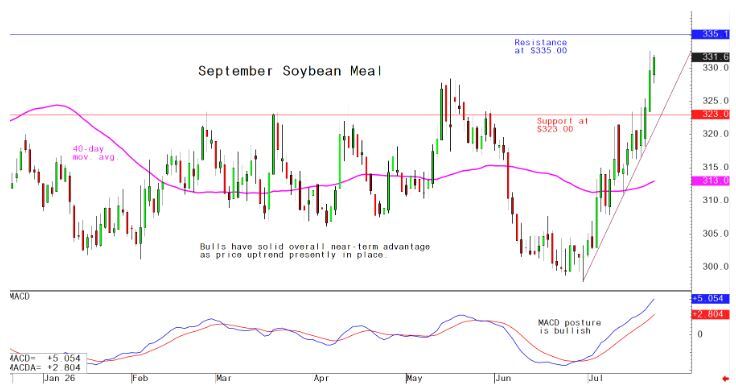
September soybean meal futures--$320.00 to $341.30, and a sideways-higher bias
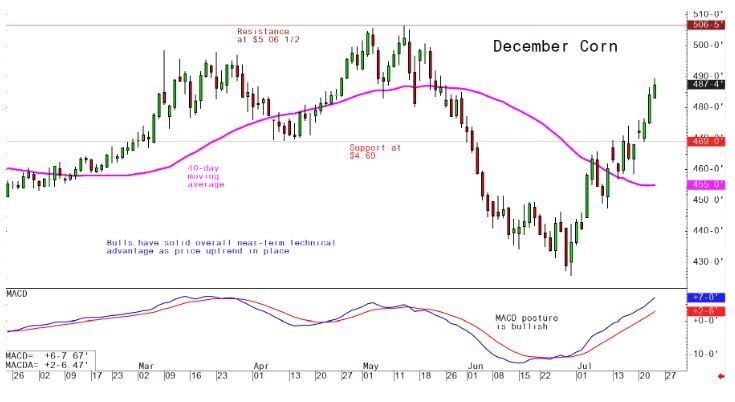
December corn futures--$4.69 to $5.06 1/2 and a sideways-higher bias
Latest analytical daily charts lean hog, soybean meal and corn futures