





Weekly pig report: Pork outperforms beef in latest US export data
US pork exports posted modest gains in February, supported by strong demand across Mexico, Asia and Central America, reinforcing steady global appetite
 11 April 2026
 4 minute read
 By:
By: Lean hog futures trading turns choppy
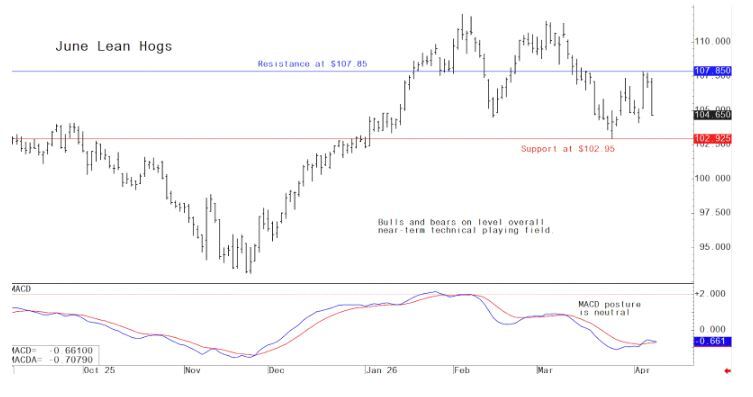
June lean hog futures on Wednesday fell $2.40 to $104.65. The hog futures market gave back most of Monday’s gains at mid-week, on profit-taking pressure and weak long liquidation from the shorter-term speculators. Trading has turned choppy and sideways. The latest CME lean hog index is up 13 cents at $90.06. Today’s projected cash index price is up another 24 cents at $90.30. The national direct five-day rolling average cash hog price quote Wednesday was $68.25.
Pork Industry and related news
Global food prices climb to six-month high as energy shock ripples through agriculture
Broad-based gains across oils, sugar, grains and meat highlight tightening supply dynamics and biofuel linkages
The Food and Agriculture Organization (FAO) Food Price Index rose for a second consecutive month in March 2026, reaching 128.5 points — its highest level since September — as higher energy prices tied to the Middle East conflict continued to ripple across global agricultural markets. The increase was broad-based, with every major commodity category posting gains, underscoring both tightening fundamentals and the growing influence of energy-agriculture linkages.
Dairy and meat prices rebound. Dairy prices increased 1.2% — the first rise since July 2025 — led by stronger quotations for skim milk powder, butter and whole milk powder. Meanwhile, meat prices rose 1%, primarily driven by higher pork prices, signaling firm demand and tightening protein supplies in key markets.
US meat exports show mixed February performance — pork gains
February trade data from USDA and the US Meat Export Federation (link) show a mixed but resilient picture for US red meat exports, with pork posting modest growth, beef facing headwinds tied to China, and variety meats delivering standout gains.
Pork exports reached 242,511 metric tons, up 1% year-over-year, with value also rising 1% to $678.8 million. Growth was driven by strong demand in Mexico, a rebound in Japan and increased shipments to South Korea, Central America, the Dominican Republic and Taiwan. For the first two months of 2026, pork exports are running 2% ahead of last year in both volume and value, slightly exceeding the record pace set in 2024.
China’s pork glut deepens as industrial expansion outpaces demand
Prices hit multi-year — and in some cases multi-decade — lows as Beijing moves to rein in output
China’s pork market is under mounting pressure as a prolonged supply glut pushes prices to their lowest levels in years, underscoring structural imbalances in the world’s largest pork industry. Recent market data show live hog prices have fallen into a rough $1.45–$1.75 per kilogram range, with some reports indicating prices briefly dipping below $1.45/kg in March — the lowest levels in more than a decade and in some regions, approaching 15–16-year lows.
Pork prices have followed the same trajectory, reflecting weak post-holiday demand, elevated cold storage inventories and persistent oversupply across the sector. The downturn has intensified into early 2026 despite a temporary Lunar New Year demand bump, reinforcing that the imbalance is structural rather than seasonal.
Meanwhile, producer margins have collapsed. Analysts estimate many farmers are now losing roughly $40–$50 per head, as falling hog prices collide with sharply rising feed costs driven by the global energy and grain rally tied to the Iran conflict.
The severity of the downturn has prompted Beijing to step in more aggressively. Authorities have urged producers to cut herd sizes, cap production and tighten capacity controls, while also signaling potential intervention through state pork reserves to stabilize prices.
Producers are also being squeezed from both sides. While revenues fall due to weak prices, input costs are rising amid global disruptions tied to the ongoing Middle East conflict, which has lifted energy, grain and feed costs. The mismatch between high production levels and softer consumption has left many farmers operating under significant financial strain.
Beyond economics, concerns are emerging about the long-term structure of the industry. Analysts note that the shift toward industrial-scale farming may be impacting meat quality and market balance, raising questions about sustainability as China navigates the consequences of rapid consolidation in its pork sector.
USDA's Canada livestock and products semiannual report
Report Highlights:
The Canadian cattle herd has entered the consolidation phase. Heifer retention practices in 2025 and a slight increase to the breeding herd to begin 2026 will support a larger 2026 calf crop. Consequently, slaughter and beef production are forecast to see growth in 2026. Heifer retention and reduced cow culls will continue in 2026 in efforts towards a herd rebuild. Increased beef production and market access opportunities will see Canadian beef exports grow in 2026. The Canadian swine herd is also forecast to remain relatively stable in 2026. Slaughter is forecast to see slight growth with a slightly larger pig crop and more processing capacity utilization. Pork exports will continue to remain strong on sustained global demand.
Swine Production:
Stability is forecast for the swine herd as producers seek to weather market volatility. Improved sow productivity sees a larger 2026 pig crop forecast and increased processing capacity utilization will support larger slaughter numbers.
Trade: Producers will be watching closely for impacts to live exports from the full implementation of “Product of USA”. Live exports are forecast up two percent with market hog exports forecast lower while feeder pig exports will be supported by strong US pricing.
Pork production is forecast to see one percent growth in 2026, on higher slaughter volumes.
Trade: Pork exports are forecast to see two percent growth in 2026. Export gains will be likely in the Indo Pacific while exports to the United States are forecast to fall.
The next week’s likely high-low price trading ranges:
June lean hog futures--$107.85 to $102.95 and with a sideways bias
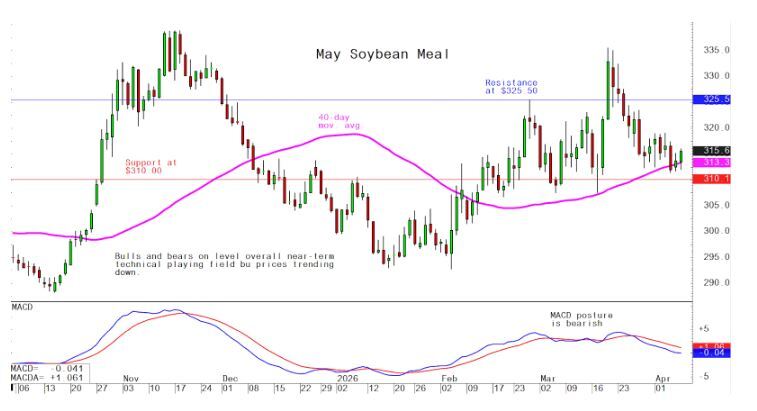
May soybean meal futures--$310.00 to $325.00, and with a sideways bias
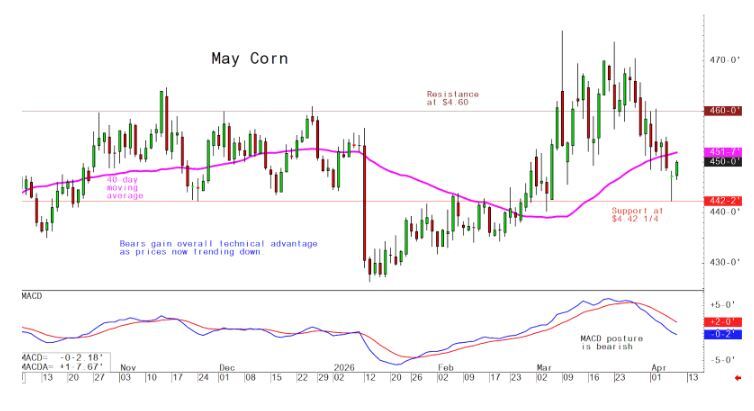
May corn futures--$4.42 1/4 to $4.60 and a sideways bias
Latest analytical daily charts lean hog, soybean meal and corn futures