






Four Star Veterinary Service: Keeping pace with current and evolving swine disease threats
Iowa State University's Dr. Phillip Gauger warns industry to stay vigilant as pathogen intensify
 13 April 2026
 7 minute read
 By:
By: As U.S. pork producers work to stabilize margins and sustain herd health in an environment where disease pressures continue to evolve, the Iowa State University Veterinary Diagnostic Laboratory (ISU VDL) remains on the front lines.
During his presentation at the 2025 Four Star Pork Industry Conference held in Muncie, Indiana in September, Dr. Phillip Gauger, professor at the Iowa State University Veterinary Diagnostic Laboratory, emphasized the scope, urgency and economic implications of the health challenges confronting swine operations nationwide.
Gauger said the ISU laboratory’s scale and mission is built on three pillars: service, teaching and discovery. It operates as a full-service, fully accredited Tier 1 laboratory through the US Department of Agriculture National Animal Health Laboratory Network (NAHLN).
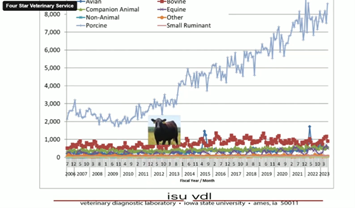
As one of the highest-capacity animal diagnostic facilities in the US, the lab processes ~130,000 cases per year and performs more than 1.5 million tests annually, with roughly 95% of diagnostic services supporting food animal agriculture – primarily swine (light blue line in chart below).
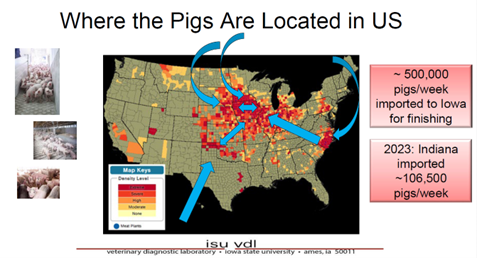
The scale reflects the geographic realities of modern pork production and its concentration in the Midwest. Iowa alone imports about 500,000 pigs per week for finishing, while Indiana imports about 106,500 pigs per week. This movement dynamic magnifies disease transmission risk across large systems.
Gauger emphasized that the VDL’s constant monitoring is an essential tool for prevention, early detection and containment. About 80% of laboratory submissions are for surveillance, including routine pathogen detection to monitor for the presence of disease.
“The samples come in; we run a test on them, primarily PCR,” he said. “There might be serology testing done looking for antibody, then the results are delivered. Much of it is straightforward, routine testing to monitor for the presence of pathogens of high economic significance.”
PRRSV: Persistent and intensifying threat
Porcine reproductive and respiratory syndrome virus (PRRSV) continues to dominate diagnostic caseloads, and Gauger stressed that new variants pose significant challenges.
“For PRRS, a lot of our testing is for control or elimination programs that are in place after a recent outbreak,” Gauger explained. “We do a large amount of genetic sequencing on PRRS-positive cases to see if the sequences of the viruses circulating on the farm that we’re dealing with are the same virus that’s been there or if a lateral introduction of a different virus representing a new outbreak has been introduced on the farm.”
He noted that “re-emerging strains are highly virulent,” and PRRSV infections can produce systemic, respiratory, neurologic and reproductive disease.
“Even with widespread vaccination and biosecurity efforts, PRRSV mutates and new strains emerge, and the resulting impact remains severe, with high morbidity and mortality,” he said.
New strain monitoring tools at ISU VDL support rapid identification of genomic changes. Gauger highlighted the lab’s internal system that flags genetic anomalies.
“Detecting strains of PRRSV is much different compared to other sequences in ISU VDL database,” Gauger noted. “The laboratory runs new sequences through a database, and we receive automated updates via email daily with results identifying known PRRSV lineages, while PRRSV “not designated” (unknown) are flagged as potential different or new strains. This helps us monitor for lineages that may be shifting to become more predominant.”
The economic stakes are substantial. Gauger referenced recent research estimating that PRRSV costs the US swine industry $1.2 billion annually. Variants emerging within the past 18 months have been particularly disruptive to both breeding and finishing herds, he said.
Influenza and H5N1: Animal-to-animal and zoonotic risk
Influenza A virus (IAV) remains a foundational health concern given its capacity to circulate among species.
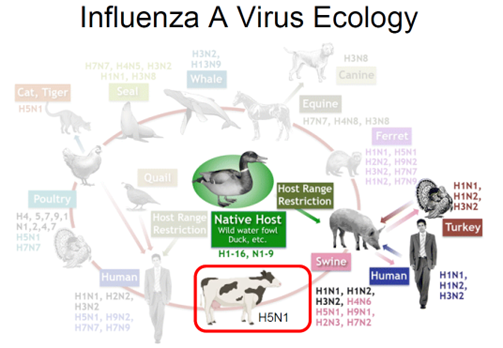
“IAV infects swine, humans and many avian species, and humans and swine share particular subtypes of IAV – H1N1, H1N2 and H3N2,” he explained.
Viral mutation and spillover continue to create uncertainty, particularly amid global attention to highly pathogenic avian influenza, also known as bird flu (HPAI).
Experimental trials indicate that swine can become infected and seroconvert, meaning they develop detectable antibodies in the blood serum, to H5N1.
“I will note that current research has shown the pigs can become infected, the infection is brief, replication is low, and they don’t shed and transmit it very well from pig to pig,” he said. “At least right now, it seems like H5 subtypes do not like to replicate or infect pigs. However, it doesn’t mean that couldn’t change. Pigs are considered a mixing vessel since they can be infected with human strains of flu and other species’ strains like avian. If this one were to spill over and become adapted to pigs, then that would be a serious concern.”
Recent events in the US dairy sector have heightened awareness. The mysterious 2024 clinical syndrome in dairy cattle did show milk confirmed positive for H5N1 HPAI.
He added that multiple wildlife species have also been affected and with similar H5N1 strains that have affected bovine species , reinforcing concerns about the unpredictable viral evolution among multiple animal species.
Mycoplasma, rotavirus and PEDV: Complex disease dynamics
Respiratory pathogens continue to drive case submissions, with ISU-generated data showing consistent diagnostic frequency across categories. He said mixed infections are very common, and some cases remain undiagnosed.
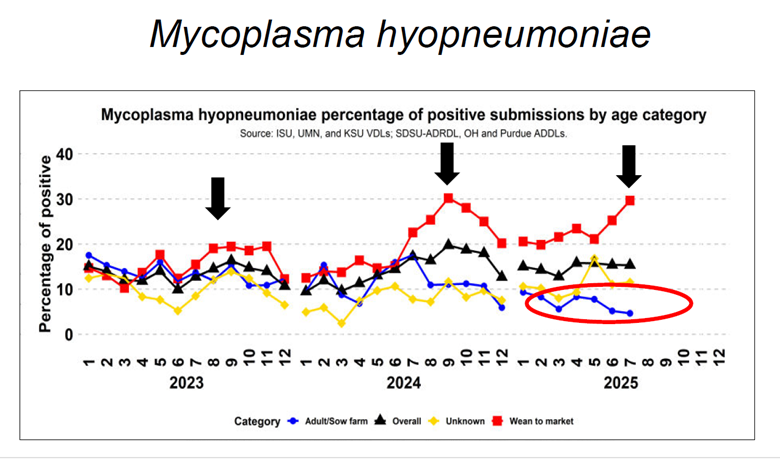
Mycoplasma hyopneumoniae has ongoing monitoring that typically illustrates periodic seasonal spikes in prevalence. Grow-finish numbers are currently seeing growth, but Gauger says sow farms are at some of their lowest levels in more than 10 years. There has been a push for a US industry-wide elimination program for Mycoplasma.
On the enteric disease side, rotavirus remains an ongoing concern that can be a highly consequential pathogen affecting pigs of younger ages. Gauger said rotavirus is an agent frequently detected in enteric disease, affecting both suckling and early nursery pigs. Sequencing remains routine as practitioners attempt to match vaccines to circulating strains, but diversity complicates control because challenges exist due to the genetic diversity. Gauger suspects the increase in sequencing is an effort to create farm-specific vaccines to help control the virus.
For Porcine Epidemic Diarrhea virus (PEDV), the industry faces both severe and mild variants. Gauger said PEDV remains a “constant threat and challenge,” and noted that the American Association of Swine Veterinarians is evaluating the feasibility of long-term elimination efforts. However, PEDV persistence continues in part due to the lack of an efficacious vaccine.
Misdiagnosed and emerging enteric pathogens
In addition to widely recognized agents, Gauger highlighted several pathogens that are sometimes missed in clinical diagnosis. For example, Ascaris suum can mimic pneumonia and lesions are easy to observe in the liver but may appear like interstitial pneumonia in the lung, leading to misinterpretation of respiratory disease events. A key symptom is when pigs are “thumping” or breathing hard, which is a symptom of many respiratory diseases.
Porcine sapovirus is also rapidly drawing attention as an emerging enteric virus responsible for diarrhea in neonates and suckling pigs. Clinical signs resemble rotavirus, and although mortality is typically low, production losses can occur. Sequencing is best for vaccine selection.
The resurgence of hemolytic E. coli marks another notable shift. He said that virulent pathotypes have been increasingly detected in diagnostic submissions throughout 2025.
Gauger also described genetic resistance initiatives based on the presence of the alpha-(1,2)-fucosyltransferase, or FUT1 gene, to prevent post-weaning E. coli and edema disease.
“The presence of the FUT1 gene provides pigs with resistance to certain strains of E. coli,” he said. “A DNA-based test can identify a pig’s FUT1 genotype, allowing selection for the resistant (AA) or susceptible trait to enhance research that can help further understand the pathogenicity of virulent pathotypes of E. coli.”
Re-emerging threat: New World screwworm
Beyond virology and enteric disease, Gauger spotlighted an escalating external parasitic threat: the New World screwworm (Cochliomyia hominivorax). The organism, which feeds on live tissue, is spreading northward after eradication success decades ago in the US. Detection counts surged dramatically “from an average of 25 cases per year to more than 6,500 cases in one year” in Panama—raising alarm for US livestock sectors earlier in the year. Cases have exploded recently in Mexico as well.
One of the control strategies relies on large-scale sterile male release, since female Cochliomyia hominivorax mate only once/life. Plans call for “production of 60-100 million sterilized flies per week” initially, expanding to “400-500 million flies per week” to rebuild interdiction zones critical to disease exclusion.
Industry resilience
Despite the breadth of current and emerging threats, Gauger closed with a positive economic perspective, noting that the US pork sector’s profitability is shifting more positive, driven by increased domestic demand and a return of some export demand.
However, he stressed that protecting that momentum requires unrelenting commitment to disease prevention through prioritizing biosecurity to protect herd health.
Key take-away
Dr. Gauger offered a clear message: US pork production cannot afford complacency when it comes to disease. With multiple pathogens evolving in parallel, emerging viruses appearing in new species, and parasitic threats migrating northward, surveillance and rapid diagnostics will shape the industry’s ability to remain economically viable and internationally competitive.
“Maintain vigilance,” Gauger emphasized, reminding producers that prevention remains the most powerful tool in safeguarding US swine health and profitability.