





More than 60% of pigs fall short on vitamin D in global survey
SciTell™ DBS Analytics tool gives producers a practical way to monitor herd status and optimize nutrition programs
 1 June 2026
 7 minute read
 By:
By: Nutrition is a central driver of productivity, health and reproductive performance in modern swine systems, yet not all nutrients are equally visible or easy to manage. Vitamin D has emerged as a critical – but often overlooked – component of herd performance, influencing everything from bone development to immune function and fertility.
Today, new diagnostic tools such as SciTell™ DBS Analytics are giving producers a practical way to measure vitamin D status directly on-farm, turning what was once a hidden variable into a manageable part of precision nutrition.
“Nutrition is inextricably linked to both production performance and animal health, and even small fluctuations from the recommended nutrient levels can have a substantial impact on the successful performance and well-being of the animal,” said Alexandra Desbruslais, Global Head of Swine Strategic Marketing and New Solutions, Animal Nutrition & Health at dsm-firmenich. “With SciTell™ DBS Analytics, producers can now easily track circulating vitamin D levels and align nutrition programs more closely with the biological demands of today’s high-performing pigs.”
Vitamin D under modern production pressure
As production systems intensify, pigs face increasing physiological demands. Sows are producing larger litters with higher competition for colostrum and milk, piglets are being weaned earlier and growing pigs are achieving faster gains. These advances require precise nutrient supply to maintain performance without compromising health.
“The overall nutrient balance of the animal plays an essential role in facilitating all of these processes and even borderline deficiencies will reduce the ability of the animal to fulfil these activities successfully,” Desbruslais said.
Vitamin D3 is particularly important because of its wide-ranging physiological roles. It supports calcium and phosphorus metabolism, enabling proper bone formation, but its influence extends beyond skeletal health to immunity and reproduction, growth and health status.
However, achieving adequate vitamin D status in commercial swine systems is inherently challenging. Most pigs are housed indoors with limited sunlight exposure, and common feed ingredients contain minimal levels of natural vitamin D.
“As such, supplementation is essential,” she explained.
From vitamin D3 to 25-OH-D3: why form matters
Understanding how vitamin D functions biologically helps explain why monitoring and supplementation strategies matter.
After ingestion or synthesis, vitamin D3 (cholecalciferol) must undergo two conversion steps to become biologically active. First, it is converted in the liver into 25-hydroxyvitamin D3 (25-OH-D3), the primary circulating form. It is then converted in the kidneys into the active hormone form, calcitriol, which regulates calcium and phosphorus absorption.
However, this metabolic pathway can limit efficiency. Traditional vitamin D3 must pass through the liver, which can act as a bottleneck in conversion and reduce availability.
“Supplementation of 25-OH-D3 (calcifediol) is far more efficient as it is far more hydrophilic, allowing easy absorption,” Desbruslais explained.
Because 25-OH-D3 bypasses the initial liver conversion step, it reaches circulation more quickly and consistently, improving vitamin D status. This distinction becomes especially important in high-performing animals where nutrient demands are elevated.
Traditional vitamin D3 is highly hydrophobic, making absorption in the gut more challenging, particularly under conditions of digestive stress. In contrast, 25-OH-D3 improves uptake efficiency and supports more consistent physiological outcomes.
Impacts on bone, immunity and reproduction
The consequences of inadequate vitamin D status are well documented across multiple production parameters.
Bone health is one of the most visible outcomes. Without sufficient vitamin D, calcium and phosphorus cannot be properly utilized, leading to poor mineralization and increased risk of skeletal disorders.
“Deficiencies have been widely shown to cause lameness issues, because without vitamin D, proper mineralization cannot occur,” Desbruslais said.
Conditions such as rickets, osteomalacia and osteochondrosis can emerge, increasing the risk of fractures and reducing mobility. These issues directly impact performance, welfare and culling rates.
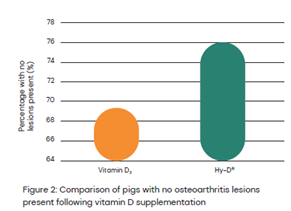
Research demonstrates measurable improvements when supplementing with 25-OH-D3. In a Brazilian study conducted on a commercial operation, pigs receiving 25-OH-D3 showed significantly higher circulating plasma levels of 25-OH-D3 and a greater proportion of animals without osteochondrosis lesions compared to those receiving standard vitamin D3.
Beyond skeletal health, vitamin D plays a critical role in immune function. Deficiency increases susceptibility to disease, particularly during high-stress periods like weaning.
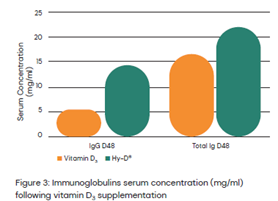
A recent study on newly weaned piglets supplemented with 25-OH-D3 had significantly higher immunoglobulin (IgG) levels after 48 days compared to those receiving standard vitamin D3, indicating a stronger immune response to Hy-D®.
In young pigs, early signs of deficiency include reduced feed intake and impaired growth. Over time, compromised immunity can lead to increased bacterial and viral infections, further impacting performance.
In sows, reproductive performance is closely tied to vitamin D status.
“Insufficient vitamin D levels will increase still births and reduce fertility and fecundity,” Desbruslais said. “Particularly during lactation when calcium demands are high for milk production, increased levels of lameness due to osteoporosis and osteomalacia are often seen.”
The impact extends to piglets as well. Offspring born to deficient sows are more likely to be deficient themselves due to limited transfer of vitamin D through colostrum and milk, perpetuating performance challenges across generations.
Measuring vitamin D on-farm got easier
Despite its importance, vitamin D status has historically been difficult to monitor in commercial herds, presenting logistical and welfare challenges.
“Monitoring the vitamin D status of a herd has been a substantial task requiring obtaining full serum or plasma samples from every animal,” she said. “Plus, samples must be chilled and expedited on dry ice to the lab for testing.”
These methods are time-consuming, costly and stressful for animals and workers, requiring animal restraint and all under a time-crunch to get samples to the laboratory.
To address these barriers, dsm-firmenich developed a dried blood spot (DBS) system that significantly simplifies sampling and analysis.
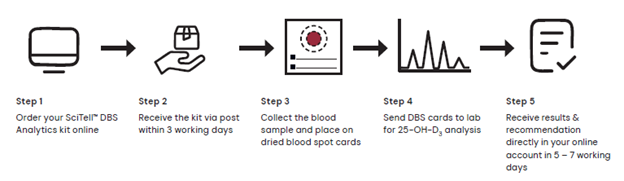
The process involves a simple ear prick to collect a small blood sample, which is placed on a special collection card and allowed to dry. The sample can then be shipped without refrigeration to a laboratory for analysis.
“This precision service is called SciTell™ DBS Analytics and uses a system called the Dried Blood Spot method or DBS,” Desbruslais said. “The system reduces stress on animals, lowers costs and enables more frequent monitoring, making vitamin D status a practical management parameter rather than a theoretical one.”
Results are delivered through a digital platform and compared against established reference ranges for 25-OH-D3 serum levels. The findings are correlated to phenotypic outcomes to enable enhanced precision of vitamin D3 application. This allows producers to quickly identify deficiencies and implement targeted nutritional interventions.
Global data reveals widespread deficiency
A dsm-firmenich global survey evaluating vitamin D3 status across commercial swine populations using the DBS system offered compelling insights into pig populations.
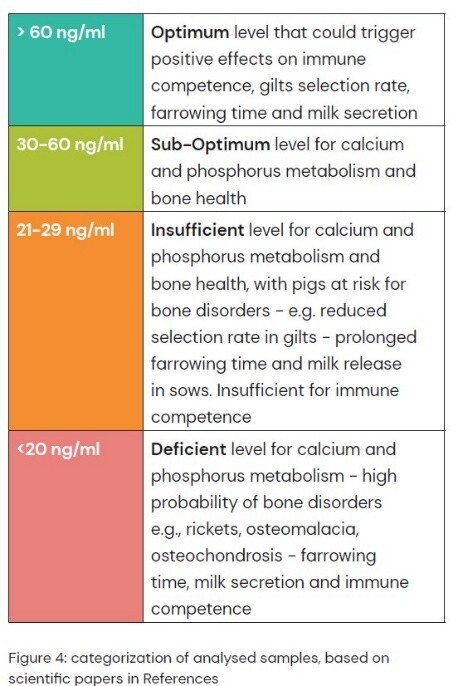
The dataset included 883 gilts from 47 farms in 14 countries and 684 fatteners from 52 farms in 12 countries. Analyzed levels were then categorized as either deficient, insufficient, sub-optimum, or optimal. The results highlight a widespread gap between current vitamin D status and optimal levels.
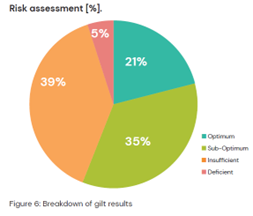
In gilts, only 21% had optimal vitamin D levels, while 39% were classified as insufficient and 5% as deficient. This means nearly half of the animals were below the level required to support optimal reproductive performance and immune function.
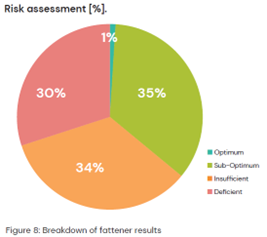
In fatteners, the situation was even more pronounced. Only 1% of pigs achieved optimal vitamin D status, with a mean level of 27.4 ng/mL, which is borderline deficient.
Overall, 34% of pigs were insufficient and 30% were clinically deficient, meaning more than 60% of animals were at risk of lameness, poor immunity and reduced growth performance.
“The results of the survey undertaken highlight the importance of monitoring vitamin D levels,” Desbruslais said.
The data also revealed regional differences. For example, pigs in Ireland, Italy and Poland had lower vitamin D levels, while those in Japan, the Netherlands and Germany had higher levels, suggesting variation in feeding strategies and supplementation practices.
From measuring to managing
The ability to measure vitamin D status consistently opens the door to more precise nutritional management.
Historically, vitamin supplementation has been based on generalized recommendations. However, the variability shown in the survey indicates that herd-level status can differ significantly across regions and production systems.
With DBS technology, producers can now track vitamin D levels in real time, identify deficiencies early and adjust supplementation strategies accordingly.
“Even a marginal nutritional deficiency will leave an animal vulnerable and detract from their ability to perform optimally, increasing the opportunity for disease and reduced performance,” Desbruslais said.
By integrating monitoring into routine management, producers can move from reactive to proactive nutrition strategies – aligning nutrient supply more closely with animal requirements.
Shifting toward precision nutrition
The combination of improved vitamin D understanding and practical monitoring tools reflects a broader shift in the swine industry toward precision nutrition.
As genetic potential continues to increase, the margin for nutritional error narrows. Tools like SciTell™ DBS Analytics enable producers to quantify what was previously difficult to measure, providing actionable data to support decision-making.
Ultimately, optimizing vitamin D status is not just about preventing deficiency. It is about unlocking performance by improving bone strength, enhancing immune resilience, supporting reproductive efficiency and maximizing growth.
With more than half of pigs in the global survey falling below optimal levels, the opportunity for improvement is substantial.
For producers, the message is clear: vitamin D is no longer a background nutrient. It is a measurable, manageable driver of herd performance – and one that can now be monitored directly on the farm.


Sarah Mikesell
Sarah Mikesell grew up on a five-generation family farming operation in Ohio, USA, where her family still farms. She feels extraordinarily lucky to get to do what she loves - write about livestock and crop agriculture. You can find her on LinkedIn.