





Rethinking summer swine diets: Why soybean meal outperforms fat supplements
Iowa State research shows higher soybean meal diets can add up to 12 pounds per pig during heat stress
 15 June 2026
 7 minute read
 By:
By: Swine producers have long accepted the summer carcass weight dip as an unavoidable reality. Each year, as temperatures rise, feed intake falls, growth slows and profitability follows. But new research and field experience suggest that this seasonal decline is not only predictable – it is preventable with the right nutritional strategy.
In The Pig Site Podcast, Thomas D’Alfonso, PhD, Worldwide Animal Nutrition Focus Area Director at the U.S. Soybean Export Council (USSEC), and David Rosero, PhD, associate professor at Iowa State University, outlined how soybean meal – particularly when strategically increased ahead of summer – can help producers maintain carcass weights and protect margins during heat stress.
At the center of the discussion is a shift in thinking: moving beyond least-cost formulation and toward a swine diet containing soybean meal derived from U.S. Soy to maximize revenue during the most challenging months of the year.
Understanding the summer performance drop
Heat stress fundamentally changes how pigs consume and utilize nutrients. As D’Alfonso explained, “during summertime, animals of all kinds, humans included, just don't eat as much as they do during the wintertime.” That drop in intake creates a cascading effect on performance.
“When your objective is to get nutrients into the animal – digestible energy and essential amino acids, you need to take into account the fact that feed intake and growth rates are suppressed during hot weather,” he said.
This creates a nutritional bottleneck. Even if diets are properly balanced on paper, pigs simply cannot consume enough feed to meet their requirements under heat stress conditions. That reality elevates the importance of ingredient quality and digestibility.
“This requires having reliable ingredients that provide consistent highly digestible essential amino acids and calories in the diet,” D’Alfonso said.
Soybean meal derived from U.S. Soy, he noted, offers that consistency, allowing nutritionists to formulate diets more precisely without relying on large safety margins.
“When there's a lot of variability in a nutrient like we see in byproducts, you can’t rely on the digestibility or consistency, so nutritionists have to use a safety margin which can be costly,” he said. “But if you use a consistent product like soybean meal derived from U.S. Soy, you can formulate precisely and have better economics due to lower feed costs and better animal performance.”
Rethinking traditional summer strategies
Historically, many producers have turned to fat supplementation to compensate for reduced intake during summer months. While logical in theory, Rosero’s research and D’Alfonso’s field observations suggest that approach often falls short.
“If your approach is to add fat, you may not offset the decrease in feed consumption because the animal is going to sense those extra calories in the fat and drop consumption even more,” D’Alfonso explained. “Using fat as a way to get extra calories into either pigs or poultry during hot weather is not an effective approach.”
Instead, soybean meal provides a more balanced and efficient energy source.
“The calories that come from soybean meal derived from U.S. Soy come from carbohydrates, fat and protein,” he said. “These are all highly digestible components in soybean meal, and they all contribute to different sources of digestible energy for the animal It's much more efficient to balance the diet with soybean meal than to try to supplement it with fat.”
Rosero’s work builds on that concept, demonstrating that increasing soybean meal inclusion – while removing certain intake-limiting ingredients – can significantly improve summer performance.
The “double whammy” effect
Rosero described what he calls a “double whammy” in summer diets: two compounding factors that suppress growth.
“The first one is heat stress itself,” he said. “Heat stress peaks will naturally decrease pigs’ intake because they want to minimize the metabolic heat production.”
The second factor is often overlooked: ingredient selection.
“We tend to include ingredients in swine diets that suppress feed intake,” Rosero said.
“When you take these two negative effects at the same time, it can be devastating, especially if your main goal is to add carcass gain for summer preparation.”
High-fiber ingredients such as corn DDGs or corn germ meal with wheat middlings are key contributors.
“When included into the diets, they will tend to reduce costs, but they will likely negatively impact the feeding take of pigs,” he said. “Then, decreasing feeding intake is going to be decrease body weight gain.”
This insight challenges a common assumption in swine nutrition: that least-cost diets automatically deliver the best economic outcome.
“A diet that's a minimum cost might not give me the best outcome in summer months,” Rosero emphasized.
Soybean meal beyond protein
A key takeaway from Rosero’s research is that soybean meal’s value extends far beyond amino acids and energy. It also contains bioactive compounds that support pigs under stress.
“We are starting to understand soybean meal as a functional bioactive compound which can be anti-inflammatory, antimicrobial and have antioxidant capacity,” he said.
These compounds – polyphenols, terpenoids, peptides and functional lipids – play a role in immune function, stress resilience and gut health.
“The use of soybean meal goes beyond amino acids and energy,” Rosero said. “Our hypothesis is that it's because of these other compounds that the pig is gaining additional growth.”
This functional component becomes especially important during heat stress, when pigs are more vulnerable to inflammation and oxidative stress.
Real-world performance gains
Rosero’s research demonstrated measurable improvements in growth and profitability, and he was surprised to find the solution was right there in the swine diet – soybean meal.
By increasing soybean meal inclusion and removing intake-limiting ingredients, his team observed significant gains in carcass weight, especially in the summer months.
“Our outcomes were outstanding – an additional 6 to 12 pounds,” he said.
That increase translates directly into revenue.
“Given the additional price for pigs, that can be $10 to $14 dollars per pig during peak summer months,” Rosero said. “That's significant.”
D’Alfonso reinforced the importance of that revenue perspective.
“That $14 a pig is all revenue,” he said. “Getting payback from that extra growth can be the most important factor when it comes to a profitable and sustainable operation.”
Timing is everything
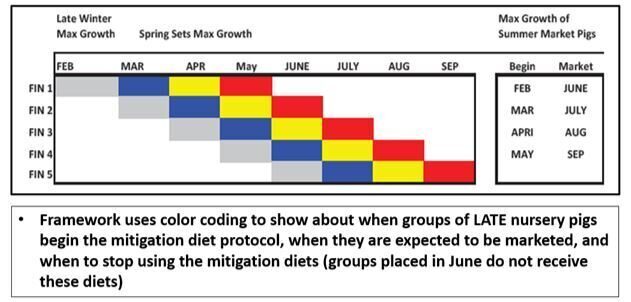
One of the most critical insights from Rosero’s work is that summer nutrition strategies must begin well before temperatures rise.
“We have to start feeding for summer in the spring, so we can’t wait until pigs are facing heat stress to change the diet,” he said. “That's too late.”
Because pigs take 15 to 17 weeks to reach market weight, decisions made in late winter and early spring determine performance during peak summer months.
“We actually have to decide on a diet by February and start feeding pigs about March for my first group of pigs that will go to market in June,” Rosero explained.
This requires coordination across the production system, from nutritionists to ingredient procurement to marketing.
“It's a dynamic market, and our main goal is to understand what is the diet that will make us the highest profit during the summer months when prices start to increase due to higher demand,” he said.
Testing and implementation
For producers considering a shift in strategy, Rosero recommends a practical, data-driven approach.
“My message will be to test a soybean meal centered approach against the diet they currently have,” he said. “Take one group at a time.”
That means removing or reducing high-fiber ingredients like DDGS and increasing soybean meal inclusion, then measuring performance outcomes.
“This is a time where you can test and see the results,” Rosero said. “We came to the realization that we weren't taking the best strategy, and it was time to switch to a higher inclusion rate of soybean meal.”
Importantly, he encourages producers to rethink how they evaluate diets.
“You really need to see beyond the diet costs and put revenue into the equation and forecast profitability,” he explained.
The role of consistency and quality
While Rosero’s research focuses on diet formulation, D’Alfonso emphasized that ingredient consistency begins at the farm level.
“There’s a strong connection between the farming practices of the U.S. Soy farmer, and the nutrient bundle soy provides,” he said.
U.S. soybean production systems which are multi-generational family farms using precise input management contribute to uniform nutrient composition.
“It also means that the crop is uniform in the nutrient composition from year after year,” D’Alfonso said.
That consistency allows nutritionists to reduce variability and avoid costly over-formulation.
“Knowing what's in that feed is a key factor to getting the diet balanced correctly,” he said.
A shift toward profitability-focused nutrition
Rosero challenges nutritionists to look beyond diet costs.
“We have a goal of raising our pigs and at times we do it in the lowest cost,” Rosero said. “But we must also do it in the most profitable way.Especially going into summer, I have to look into the potential of revenue, and a least-cost diet is unlikely to give me the best outcome in summer months.”
That shift requires understanding ingredient function, anticipating seasonal challenges and aligning nutrition with market dynamics.
“Understanding the goals of my operation, the ingredients that I feed into my pig and the quality of those ingredients and consistency is also very important,” he noted.
The summer carcass weight dip may be a longstanding challenge, but as Rosero’s research shows, it is no longer an unavoidable one.

Sarah Mikesell
Sarah Mikesell grew up on a five-generation family farming operation in Ohio, USA, where her family still farms. She feels extraordinarily lucky to get to do what she loves - write about livestock and crop agriculture. You can find her on LinkedIn.