





Sow removal in commercial breeding farms from Spain: main reported reasons
New data from Spanish breeding farms sheds light on why sows are leaving herds - and what it means for long-term efficiency
 6 May 2026
 8 minute read
 By:
By: High sow mortality and early removal rate are becoming a growing concern in swine industry worldwide, rising important issues about productivity and animal welfare. From an economic standpoint, proper caretaking of sows should minimize the proportion of sows exiting the breeding herd before reaching their maintenance investment costs. Expanding sow productive lifespan supports lifetime performance, lowers gilt replacement rate and improves the efficiency and productivity of breeding farms.
To achieve this goal, correct record keeping and regular surveillance of performance outcomes, physical health and lifetime stress can help spot risk factors associated with early removal and sudden death as well as production-related problems that may jeopardize sow longevity and well-being. Altogether, assessing the main reasons for removal throughout sows´ productive life can help support on-farm herd management decisions to attain a parity structure that maximizes long-term herd health, well-being and profitability.
The following article describes the main reported reasons for sow removal in commercial breeding farms from Spain and identifies risk factors responsible for sow removal. To do so, complete cycle records of 173,054 white sows removed in 2024 from 246 breeding farms subscribed to BDporc® dataset (www.bdporc.irta.es/en) were retrieved for descriptive analyses.
Key reasons for sow removal
Multiple factors impact sow stayability in the breeding herd leveraging farm outcomes such as sow replacement rate, gilt retention rate, parity structure and average parity at removal. From a management perspective and besides mortality due to sudden deaths, sow removal rate is driven by culling strategies to sustain long-term herd performance by adjusting the age structure of the breeding cohort. These culling decisions are often classified as voluntary and involuntary decisions depending on urge of removing a sow from the breeding herd. For example, involuntary removal decisions refer to those in which producers are forced to euthanize or exclude sows due to physical or reproductive problems such as severe lameness, anestrous, infertility, prolapses or high piglet pre-weaning mortality.
On the side, voluntary removal decisions include culling strategies, as part of the herd management plan, to optimize breeding success and farm resources over time. Some examples include culling sows due to suboptimal production (below average farm performance) as well as retiring mature sows to leave room for replacement gilts. Indeed, proper management of the breeding herd can help lower the incidence of involuntary culls and sudden death. Yet, to develop a solid culling strategy that supports sow health, welfare and performance (while minimizing instances of euthanasia and sudden death) is important to understand the main reasons for sow removal and how they distribute across their lifetime.
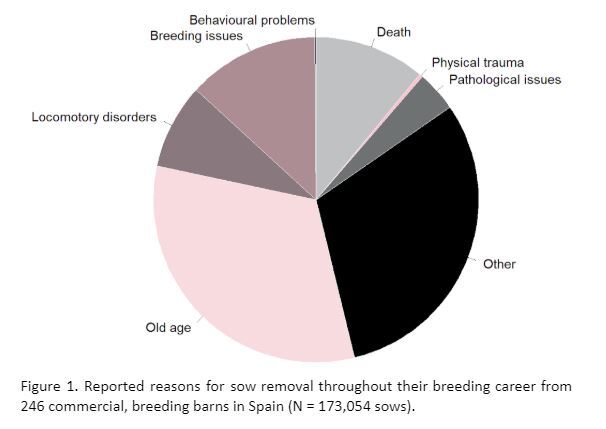
Removal due to old age was the main reported removal reason of breeding sows. Producers start retiring sows after parity four or five, depending on the farm culling strategy for herd management, to replace mature sows by new gilts. Yet, this type of removal may be overestimated in the previous figure due to unrefined annotation on-farm as the percentage of old age reported removals was higher than expected in early cycles (see below for more details). Thus, young sows reported to be removed due to “old age” in this study may refer instead to other involuntary culling reasons such as reproductive failure or other breeding issues which are common in early cycles.
The second most common reported reason for sow removal was “other reasons”, which also rises uncertainty. This category may refer to involuntary culling decisions outside the other mentioned categories in which further detail was not recorded, limiting our capacity to draw conclusions about the implications of this result. Breeding issues accounted for 15 % of sow removal although this percentage may be underestimated as some of the removals noted as “old age” could indeed refer to reproductive failure and low prolificity in early cycles. In the cases where more detailed was noted under this category, the key breeding issues responsible for sow removal were low prolificity (45%), conception problems and infertility (17%), multiple abortions (14%) and anestrous (13%).
Data retrieved from commercial breeding farms highlight overall the need for better annotation when reporting the removal reasons of commercial sows and suggest an elevated proportion of sows removed because of involuntary decisions such as reproductive failure and health problems to a minor extent. Refining the annotation of reasons for removal and minimizing the use of the catch-all “other reasons” will help distinguish the type of removal in more detail and improve herd management to reduce instances of involuntary culling, euthanasia and death. Particularly, removal due to old age should be clearly limited to sows culled voluntarily from the breeding herd as they approach to the end of their breeding career according to the company replacement policy.
Removal reasons by breeding cycle
The age structure of breeding herds often resembles a pyramid, with a high proportion of young sows in early cycles and fewer mature sows in late cycles. Therefore, the likelihood of removal is high in the first cycles due to unequal number of sows per cycle. If interested in the age structure of commercial breeding farms in Spain, check it out at: Data and census - BDporc!. Still, almost a third of sow removals occurred in early cycles (14.8% in the first cycle and 12.6% in the second cycle) before sows have been paid-off which happens around the third parity.
Early cycles are a sensitive phase for young sow survival since peripartum complications can lead to death losses and producers tend to remove young sows that failed to farrow or had low prolificity. Nonetheless, spanning sows’ productive lifetime until their most productive cycles (third and forth) is advised for economic sustainability, resource use and productivity as long as there is no health or welfare concerns going on. As a result, the removal rate of young sows lowers and gilt retention goes up until mid cycles. Our results indicate that, out of the total removed, 40.4% of the sows reached the fifth cycle. From that point on, the likelihood of removal increased markedly in the following cycles and 82.5% of them were removed by the seventh cycle.
Figure 2 shows in detail the reported removal reasons of commercial breeding sows by breeding cycle. Overall, the percentage of sows removed in each cycle due to breeding issues, locomotor disorders and pathological issues was relatively high in early cycles and declined over time as sows aged. A similar trend is observed looking at the percentage of sows reported to be found dead which started to drop after the third cycle. As expected, the percentage of sows removed from the breeding herd due to old age increased exponentially in the fourth cycle and became the predominant reason for removal from the seventh cycle onwards. Yet, more than 10% of the sows were reported to be removed due to “old age” in cycles one to three, which support incorrect annotation as noted above. This percentage of removed sows may instead refer to those culled due to reproductive problems and low prolificity, common in immature sows, underestimating the actual percentage of sows removed due to breeding issues in the current study (which still had the highest incidence in cycle one and two). Also, the percentage of sows removed due to “other causes” was high across cycles ranging from 35% in cycle one to 20% in cycle eleven (Figure 2). We assumed that sows removed due to other reasons may include those sold, relocated or culled involuntarily because of complications such as prolapses, vulva bites, low feed intak, and poor body condition. Still, the high proportion of “other reasons” reports rises concerns about how removals are coded on farm.
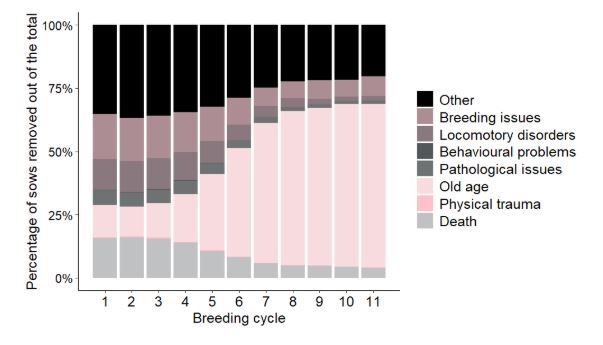
The first parity is a crucial step for gilts since difficulties during late gestation and peripartum can threaten their survival. Indeed, data from this study support that, throughout their productive lifetime, sow mortality is the highest in the first cycle so is the percentage of sows removed due to breeding issues. Specifying the etiology of death in further detail can help develop preventive strategies and individual sow care to tackle these problems and support gilt retention in early cycles.
Young sows are often removed by the end of cycle two in the case of reproductive failure like conception difficulties, abortions during gestation, and high proportion of stillborn at birth. From an economic standpoint, management practices encourage breeders to retain young sows until they reach mid cycles (when they become resource-efficient and productive). However, sows with breeding issues in early cycles tend to carry on these problems throughout their breeding career. So, producers must assess the odds of sow survival and the likelihood of upcoming breeding issues when developing a solid culling strategic plan. By doing so, they can support herd wellbeing and productivity while reducing the incidence of involuntary culling and maintaining a proper age structure on-farm.
Results in Figure 2 also indicate that the proportion of sows reported dead and removed due to breeding, locomotor and pathological problems lowers over time. When interpreting these results is worth noting that sows poorly fitted to farm conditions and management are sorted out from the breeding herd early on, so those remaining in late cycles are those outperforming and sustaining good physical health during their breeding career. Then, after cycle five onwards, old age becomes the main reason for removal while the incidence of physical problems and breeding issues is minor. Yet, the number of removals due to “other causes” is questionably sizeable across cycles as previously mentioned.
In conclusion, the reported data analyzed in this study from 246 commercial breeding barns points toward high mortality on-farm (exceeding 10% of the total removed sows), elevated percentage of sow removed due to involuntary culling (reproductive failure and physical health problems), and out of proportion frequency of unknown removals. Improving annotation of sow culling records on-farm can help identify accurately risk factors for early sow removal and endorse accurate herd management decisions based on precise removal reasons. Certainly, early identification of production problems followed by adequate corrective management practices, when possible, can mitigate elevated mortality and involuntary culling in breeding herds. Proper record keeping comes also handy to develop a preventive action plan against potential risks factors (e.g., peripartum in immature sows) and forthcoming issues (e.g., reproductive failure) as soon as possible. All together support the decision-making process behind a solid culling strategy so breeding farms can attain a well-balanced age structure that maximizes long-term productivity, minimizes problems in sows and piglets and facilitates the renewal of old sows as needed to prevent breeding fatigue.