





USDA finalizes swine inspection changes expected to cut industry costs
FSIS finalized new swine inspection rules that eliminate certain manual inspection procedures, with the USDA estimating up to $14.7 million in annual savings for pork processors
 29 May 2026
 3 minute read
 By:
By: Lean hog futures bears in control
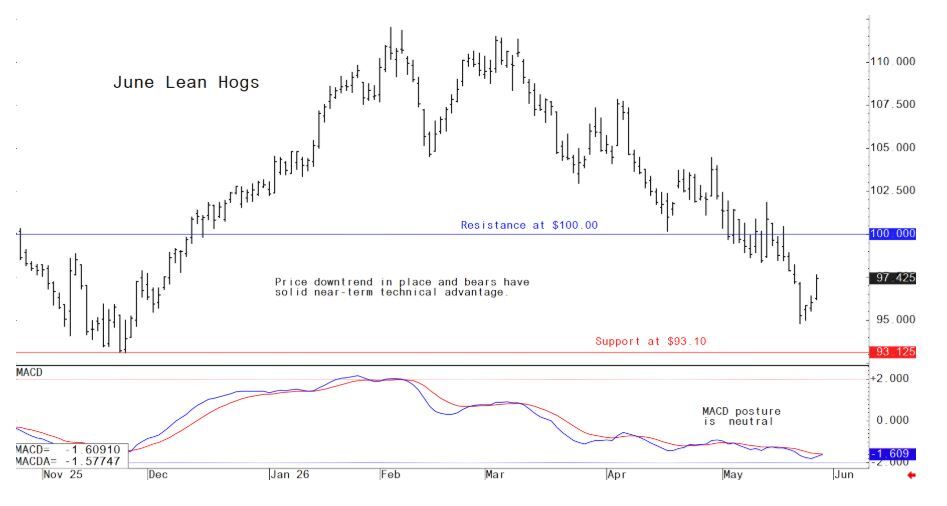
June lean hog futures on Wednesday rose $1.475 to $97.60, near the daily high. The hog futures market saw short covering and perceived bargain hunting. Solid gains in the cattle futures markets Wednesday also spilled over into some better buying interest in hog futures. Buying interest was limited as the near-term technical posture for June hogs remains firmly bearish. Prices are still in a steep downtrend on the daily bar chart. The latest CME lean hog index is down 18 cents at $90.70. Today’s projected cash index price is down 12 cents at $90.58. The national direct five-day rolling average cash hog price quote Wednesday was $94.25.
Pork Industry and related news
Republicans and pork industry lobbyists push Senate Ag chairman to revisit California livestock confinement language in farm bill talks
Senate Ag Committee Chair John Boozman (R-Ark.) is facing growing pressure from some Republicans and agricultural groups to reconsider excluding Proposition 12 pre-emption language from the Senate farm bill, as lawmakers debate which controversial provisions can survive the chamber’s bipartisan threshold.
Sen. Chuck Grassley (R-Iowa) publicly criticized Boozman’s decision Tuesday, arguing the farm bill represents the best — and possibly only — legislative vehicle to address California’s animal confinement standards law. Grassley said Boozman’s effort to craft a bipartisan package has complicated inclusion of the provision because several Democrats oppose overturning or weakening Proposition 12.
Boozman reportedly supports finding a fix to Proposition 12 but believes the current language lacks the bipartisan backing needed to secure the 60 votes necessary for Senate passage. Boozman intends to continue discussions aimed at finding a compromise solution.
The debate centers on language approved by the House that would effectively preempt California’s Proposition 12 standards, which regulate the confinement of breeding pigs, egg-laying hens and veal calves and impose requirements on products sold into the California market. Pork producers and many farm-state Republicans argue the law creates costly compliance burdens and allows one state to dictate production standards nationwide.
The National Pork Producers Council is actively lobbying Senate Democrats in hopes of demonstrating enough bipartisan support to convince Boozman to revisit the issue.
The House Rules Committee blocked consideration of a bipartisan amendment from Rep. Anna Paulina Luna (R-Fla.) and Rep. Jim Costa (D-Calif.) that would have stripped the Proposition 12 preemption language from the House farm bill. Luna and Costa argued that overturning the standards would disadvantage farmers who already invested heavily to comply with California’s requirements.
FSIS finalizes changes to swine inspection procedures
USDA says eliminating certain manual inspection requirements will reduce costs while maintaining food safety standards
USDA’s Food Safety and Inspection Service (FSIS) has finalized a rule eliminating mandatory incision of mandibular lymph nodes and palpation of viscera during post-mortem swine inspections at all federally inspected pork slaughter facilities, including plants operating under both traditional inspection systems and the New Swine Slaughter Inspection System (NSIS).
FSIS said the inspection steps are no longer necessary to ensure food safety because condemnation rates in swine are low and most disease conditions that would warrant condemnation can be identified visually through other pathological changes in carcasses or carcass parts.
The agency first proposed the change in August 2025, arguing that the older inspection methods added labor and processing costs without providing meaningful additional food safety benefits. Industry groups had generally supported the proposal, saying the changes better align inspection practices with modern slaughter operations and current disease risks.
According to FSIS, the final rule will take effect July 20 and is expected to generate annual savings of roughly $7.4 million to $14.7 million for the pork industry, while reducing agency costs by an estimated $2.0 million to $8.4 million annually.
The move continues USDA’s broader effort to modernize meat inspection procedures and shift toward risk-based inspection systems that rely more heavily on visual inspection and plant-level preventive controls.
The next week’s likely high-low price trading ranges:
June lean hog futures--$94.00 to $100.00 and with a sideways-lower bias
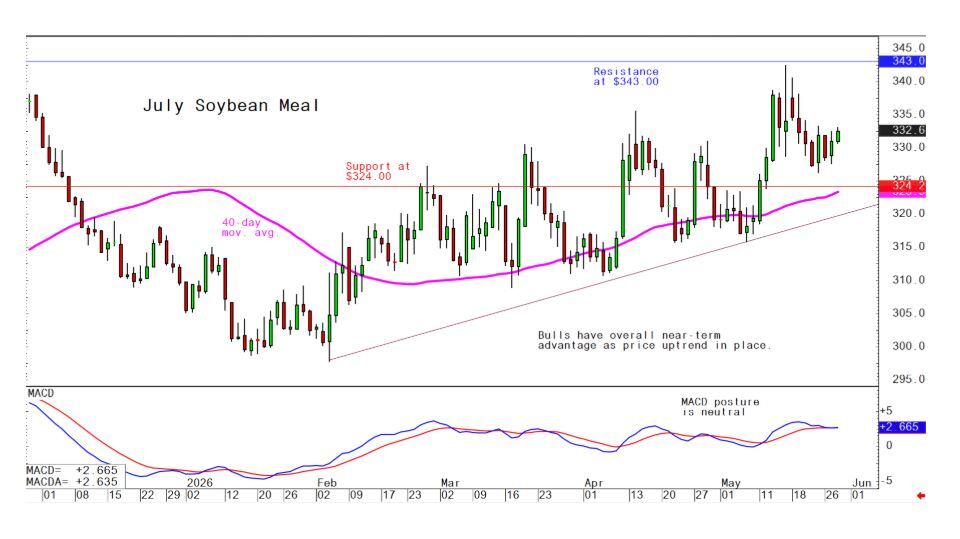
July soybean meal futures--$325.00 to $342.50, and with a sideways-higher bias
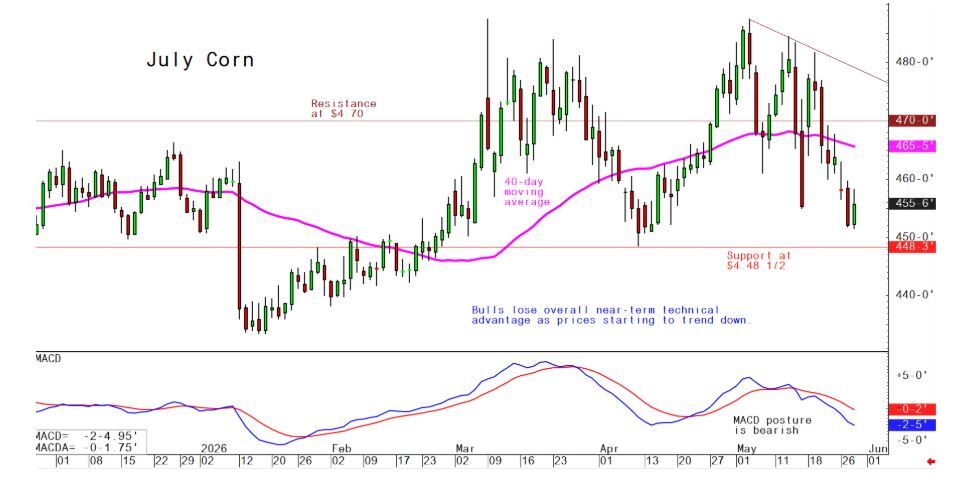
July corn futures--$4.50 to $4.75 and a sideways-higher bias
Latest analytical daily charts lean hog, soybean meal and corn futures