




Weekly pig report: Cash strength fuels continued hog market momentum
Rising cash hog prices and a climbing CME index are underpinning futures, giving producers added confidence in near-term pricing
 17 July 2026
 7 minute read
 By:
By: Lean hog futures bulls remain in technical control
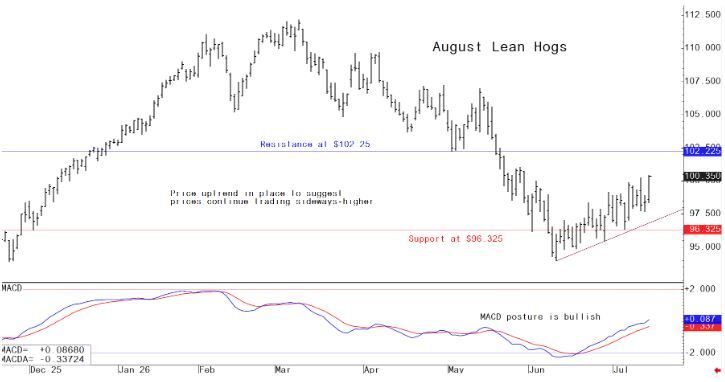
August lean hog futures on Wednesday rose $1.875 to $100.325, nearer the daily high and hit a six-week high. The lean hog futures market saw solid technical buying from the speculators today as a price uptrend remains in place on the daily bar chart. Bullish futures traders were also encouraged by rising cash hog prices. The USDA noon pork report today showed cutout value was up $0.27 at $101.48, led by gains in bellies. Movement at midday was 157.68 loads. The latest CME lean hog index is up 76 cents to $93.87. Thursday’s projected CME index price is up 73 cents at $94.60. The national direct five-day rolling average cash hog price quote for today is $98.78. August lean hog futures see a price uptrend in place on the daily bar chart. The next upside price objective for the hog bulls is to close August futures prices above solid chart resistance at $104.00. The next downside price objective for the bears is closing prices below solid technical support at last week’s low of $96.325. First resistance is seen at $101.00 and then at $102.00. First support is seen at today’s low of $98.35 and then at $97.00.
Pork Industry and related news
Pork industry presses USTR to challenge China’s trade barriers
NPPC says tariffs and sanitary rules still constrain a critical export market
The National Pork Producers Council (NPPC) is urging the Office of the US Trade Representative to confront Chinese tariffs, subsidies and sanitary restrictions that continue to limit US pork exports despite market-access commitments made under the 2020 Phase One trade agreement.
In comments to USTR, NPPC argued that several Chinese policies conflict with World Trade Organization rules and international standards. Among them is China’s requirement that all US pork shipments test negative for ractopamine residues, even though the feed additive has a maximum residue limit established by the UN Codex Alimentarius Commission and accepted in many other markets.
NPPC also challenged China’s increased inspections and testing of pork from certain US plants following alleged detections of diseases such as porcine reproductive and respiratory syndrome. The group noted that PRRS is endemic in China and that common tests can produce false positives in animals that have been vaccinated.
The organization endorsed USTR’s consideration of a government-to-government US/China Board of Trade. NPPC said such a mechanism could provide regular talks on market access and use technical committees, similar to those under the US-Mexico-Canada Agreement, to track commitments involving sanitary measures and other non-tariff barriers.
The stakes are substantial for US producers. China was the third-largest market by value for US pork in 2025, purchasing nearly $893 million. It also accounted for 59% of US pork variety-meat exports, including feet, heads, stomachs and hearts — products for which the industry has few alternative markets capable of absorbing comparable volumes and value.
USDA sets FY 2027 sugar quotas at WTO minimum
Raw access stays flat as specialty-sugar imports remain constrained
USDA’s Foreign Agricultural Service established the opening FY 2027 tariff-rate quotas for raw cane and refined sugar at the minimum levels required under US World Trade Organization commitments. The quotas cover Oct. 1, 2026, through Sept. 30, 2027, and allow eligible sugar to enter at the lower, in-quota tariff rate. Link
The raw cane sugar TRQ was set at 1,117,195 metric tons raw value, equivalent to about 1.231 million short tons raw value. The refined sugar TRQ was established at 22,000 MTRV, including 20,344 MTRV available for sugars, syrups and molasses and only 1,656 MTRV reserved for specialty sugar. USDA added no discretionary volume to the specialty allocation, which will open on a first-come, first-served basis Oct. 1.
The announcement is essentially a continuation of the FY 2026 policy rather than an expansion of low duty import access. USDA also began FY 2026 with a 1,117,195-MTRV raw sugar quota and a 22,000-MTRV refined quota, including the same 1,656-MTRV specialty allotment. By comparison, the FY 2025 refined quota included an additional 210,000 MTRV specifically for specialty sugar.
That comparison makes the specialty decision the most consequential part of the announcement. USDA’s Economic Research Service estimated that the absence of additional specialty quota in FY 2026 would push high-tier organic sugar imports to a record 244,000 MTRV, accounting for roughly 80% of US organic sugar supplies. Maintaining the minimum specialty allotment for another year suggests organic food manufacturers and other specialty users could remain heavily dependent on imports paying the much higher over-quota tariff unless USDA later expands access or domestic supplies improve.
For the broader sugar market, the initial quota should not create a major new supply shock. USDA’s July 10 supply-and-demand report already projected FY 2026/27 TRQ imports at 1.422 million STRV, unchanged from June. The increase in USDA’s total import forecast—to 3.579 million STRV—came instead from larger expected imports from Mexico and slightly higher high-tier imports. USDA currently projects 1.346 million STRV from Mexico, compared with only 220,000 STRV in 2025/26.
USDA’s July balance sheet places 2026/27 ending stocks at 1.697 million STRV and the stocks-to-use ratio at 13.5%, the level around which the US-Mexico sugar suspension agreements generally manage Mexican access. That indicates the WTO quota announced Tuesday was already incorporated into USDA’s market expectations and that Mexico — not an expansion of the WTO quota — is expected to provide most of the additional supply needed to balance the market.
The announced volumes are also an opening baseline, not necessarily the final amount that can enter during FY 2027. USDA retains authority to modify raw and refined sugar TRQs later in the year, while the Office of the US Trade Representative will separately allocate the raw quota among eligible supplying countries. USDA increased the FY 2024 raw sugar quota by 125,000 MTRV when additional imports were needed, illustrating the flexibility available if domestic production, refinery requirements or inventories deteriorate.
The market implication is mildly supportive for domestic sugar prices because USDA declined to front-load additional low-duty supplies. That benefit could be limited, however, by the sharp projected rebound in Mexican shipments and continued use of high-tier imports. Domestic cane and beet producers gain protection from an early quota expansion, while refiners and specialty users remain more exposed to the cost and availability of Mexican and over-quota sugar.
Mexico offal curbs dent US pork export momentum; beef values hold firm
USMEF says May pork exports were higher year over year but masked disruption from Mexico’s PRV-related restrictions, while beef export value rose despite lower volume as demand improved in several non-China markets
The US Meat Export Federation (USMEF), citing USDA data, said May pork exports posted solid year-over-year gains, but the numbers were flattered by an unusually weak May 2025 comparison and sharply limited by Mexico’s restrictions on US pork offal. Beef exports, meanwhile, slipped in volume but edged higher in value, underscoring a market where tight US cattle supplies and stronger pricing are helping offset weaker tonnage.
Pork exports totaled 245,874 metric tons in May, up 10% from a year earlier, with value rising 8% to $701 million. But the comparison comes against May 2025, when trade tensions with China temporarily lifted China’s tariff rate on US pork as high as 172%, severely cutting into pork variety meat shipments. This year, variety meat exports topped 40,000 metric tons in May, but that was still the lowest monthly total of 2026 and well below the January-April average of nearly 49,000 metric tons.
The main drag was Mexico. May pork variety meat exports to Mexico fell 80% from a year earlier to just 3,157 metric tons after restrictions were imposed following the April 30 detection of pseudorabies virus antibodies in five Iowa boars. USMEF President and CEO Dan Halstrom said the restrictions are costing the US industry millions of dollars per week while also disrupting Mexican customers that rely on US product.
The broader pork story is still constructive. Japan posted its largest intake of US pork since 2021, Colombia delivered strong growth, and Central America remained a bright spot. For January through May, US pork and pork variety meat exports reached 1.28 million metric tons, up 5%, with value also up 5% to $3.59 billion. That keeps exports less than 1% below last year’s record pace.
The analytical takeaway is that pork demand remains resilient, but the market is now more vulnerable to regulatory friction. Mexico is the central issue because it is both a high-volume market and a critical outlet for variety meats. Even after Mexico eased restrictions in early June to allow offal shipments from states other than Iowa and Texas, source verification requirements and Iowa’s role as the leading US hog-producing state continue to complicate trade flows. Until Mexico fully normalizes access, strong demand in Japan, Colombia and Central America may cushion the impact but not fully replace the value lost in offal channels.
The next week’s likely high-low price trading ranges:
August lean hog futures--$96.325 to $102.50 and with a sideways-higher bias
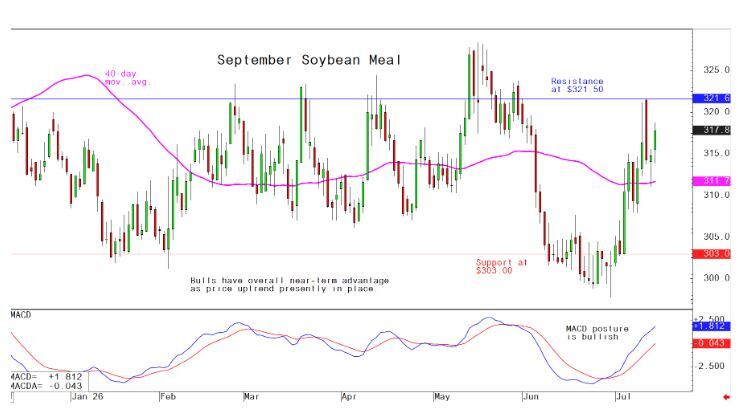
September soybean meal futures--$311.10 to $328.40, and a sideways-higher bias
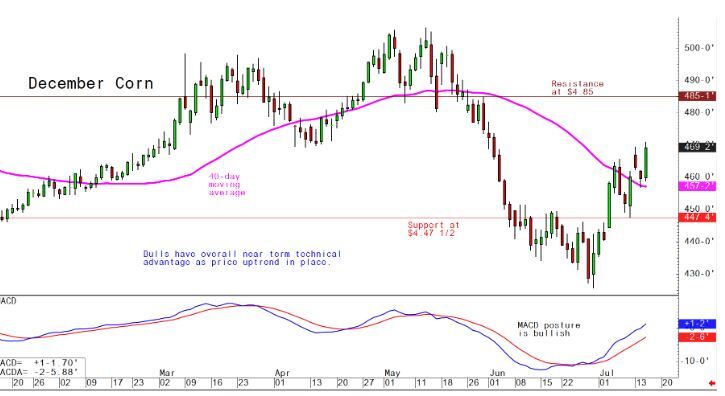
December corn futures--$4.47 1/2 to $4.85 and a sideways-higher bias
Latest analytical daily charts lean hog, soybean meal and corn futures