




Weekly pig report: Lean hog futures drift higher as market eyes tight supply
With prices showing a sideways-to-higher bias, traders are watching production levels and export demand closely as the hog market searches for direction
 10 July 2026
 22 minute read
 By:
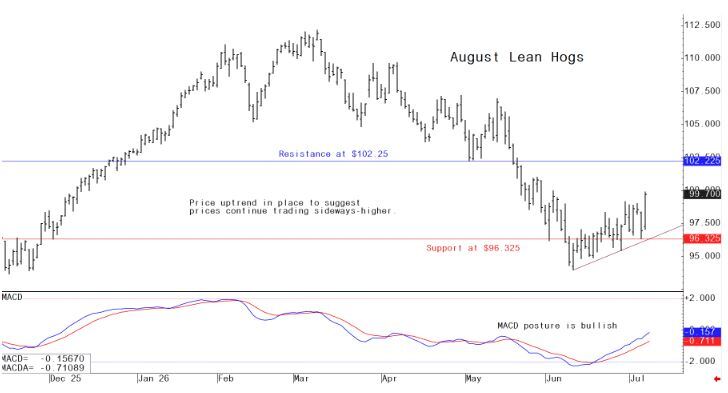
By: August lean hog futures on Wednesday rose $2.725 to $99.65 and closed at six-week high close. The hog futures market saw a good corrective bounce to keep the price uptrend alive on the daily bar chart and to provide the bulls fresh technical momentum. The latest CME lean hog index is up 11 cents to $91.66. Thursday’s projected CME index price is up 32 cents at $91.98. The national direct five-day rolling average cash hog price quote for Wednesday was $96.64.
Pork Industry and related news
USDA set to unwind Biden-era livestock market rules, with nothing yet slotted to replace them
The 2026 regulatory agenda targets the fed cattle price discovery proposal and all three finalized Packers and Stockyards rules — a wholesale reversal that reopens the oldest fight in livestock marketing policy
The Trump administration’s 2026 unified regulatory agenda confirms what the livestock sector has anticipated since Inauguration Day: USDA intends to systematically dismantle the suite of Packers and Stockyards Act (P&S Act) regulations completed in the final stretch of the Biden administration. The agenda, released by the Office of Management and Budget, lays out a sequenced program of withdrawals, delays and rescissions at USDA’s Agricultural Marketing Service (AMS) — and, notably, schedules nothing to replace what is being removed.
What’s on the chopping block. AMS lists July 2026 as the target date for withdrawing the Price Discovery and Competition in Markets for Fed Cattle rulemaking. The Biden administration published that action Oct. 11, 2024 — technically an advance notice of proposed rulemaking (ANPR) rather than a full proposed rule — and extended the comment period through Jan. 10, 2025. The ANPR floated regulatory options aimed at formula pricing in alternative marketing arrangements (AMAs), which now account for the large majority of fed cattle trade, including requirements that base prices in formula contracts be tied to broadly representative benchmarks and that major packers file annual “market fairness” compliance plans with AMS. Withdrawal kills the effort before it ever reached the proposed-rule stage.
The agenda takes a two-track approach to the Poultry Grower Payment Systems and Capital Improvement Systems final rule — the tournament-system regulation former USDA Secretary Tom Vilsack finalized Jan. 14, 2025, in the closing week of the Biden administration, with an original effective date of July 1, 2026. AMS published an action June 1 delaying the effective date until Dec. 31, 2027, and separately lists a July 2026 target for withdrawing the final rule altogether through notice-and-comment rulemaking. The delay is belt-and-suspenders: it keeps the rule from taking legal effect this month while the slower rescission process runs its course.
The administration also plans to rescind the two P&S Act rules that are already in force — the Inclusive Competition and Market Integrity rule, finalized in March 2024, which bars discrimination against and retaliation toward producers who communicate with regulators, join grower associations or assert contractual rights, and the Transparency in Poultry Grower Contracting and Tournaments rule, finalized in November 2023, which requires poultry integrators to disclose key contract terms and tournament information to growers before and during contracts.
Why this is no surprise. All three final rules were pushed across the finish line late in the Biden term over sustained opposition from the National Chicken Council, the Meat Institute and the National Cattlemen’s Beef Association (NCBA), which argued the rules exceeded USDA’s statutory authority and would unravel value-based marketing arrangements. NCC president Harrison Kircher blasted the tournament rule at finalization as a last-gasp piece of an “anti-business regulatory agenda” issued with days left in the administration. The Biden USDA itself blinked on the most ambitious piece of the package — the Fair and Competitive Livestock and Poultry Markets proposed rule, which would have defined “unfair practices” under Section 202(a) — withdrawing it in January 2025 after more than 13,000 comments, citing the complexity of finalizing it. NCBA cheered that withdrawal as a rejection of “Bidenomics” overreach.
There is also clear precedent. In his first term, Trump’s USDA withdrew the Obama-era GIPSA “Farmer Fair Practices” interim final rule — the 2016 attempt to clarify that a producer need not prove industry-wide competitive harm to bring a P&S Act claim — and never finalized a meaningful replacement. The 2026 agenda is, in effect, the second verse of the same song, with the added twist that this time the administration is removing rules that are already operative, not merely shelving proposals.
The procedural and legal road. Rescinding final rules is harder than withdrawing proposals. The Inclusive Competition and Transparency rules are in effect, meaning AMS must run full notice-and-comment rulemaking with a reasoned explanation for the reversal — the Administrative Procedure Act standard courts applied aggressively against both administrations’ regulatory U-turns. Grower advocacy groups and organizations such as Food & Water Watch, which called the move “a slap in the face” to producers, are all but certain to challenge the rescissions, and litigation could stretch the timeline well past the July and October 2026 rulemaking targets. The Dec. 31, 2027, delay on the tournament rule gives the administration cushion if the withdrawal rulemaking bogs down.
The political crosscurrents. The rollback sits awkwardly alongside the administration’s populist rhetoric on beef prices and packer concentration. The White House has repeatedly leaned on the meatpacking sector over retail beef prices, and the Justice Department and USDA have both signaled scrutiny of packer pricing behavior during the current record cattle market. Removing the price discovery ANPR — the one rulemaking aimed squarely at how packers set base prices for fed cattle — hands ammunition to R-CALF USA and other producer groups that have long argued the shrinking negotiated cash market (in some regions well below 20% of trade) leaves formula prices anchored to an ever-thinner benchmark. Expect renewed pressure for a legislative fix along the lines of Sen. Chuck Grassley’s (R-Iowa) 50/14 mandatory cash-purchase concept and the Cattle Price Discovery and Transparency Act, a debate that has repeatedly split NCBA’s own membership between regions.
Bottom line: The direction of travel is unambiguous: by the end of 2026 the Biden P&S Act framework will likely be gone or mortally wounded. The key open question is whether the administration eventually comes forward with replacement rules of its own — as the first Trump USDA briefly attempted after the GIPSA withdrawal — or leaves the field to case-by-case enforcement and the courts. The 2026 regulatory agenda schedules no replacement action, which tells producers the deregulatory posture is the policy, not a placeholder. That leaves contract poultry growers back under pre-2023 disclosure standards, cattle producers without a regulatory vehicle on formula pricing, and Congress — with a farm bill still pending and a compressed calendar — as the only remaining venue for structural change in livestock markets.
Argentina pork exports surge as sector builds from a small base
A 157% jump in export value through May signals stronger foreign demand and better market diversification, but Argentina’s pork industry remains primarily domestic, with exports still a small share of total production
Argentina’s pork sector posted a sharp export gain in the first five months of 2026, with pork and byproduct shipments reaching 7,645 tonnes from January through May, according to the Secretariat of Agriculture under the Ministry of Economy. Export revenue climbed to $10.04 million, up 156.8% from the same period last year, while volumes rose 91.2%. The gap between value growth and tonnage growth suggests Argentina is not only shipping more pork, but also benefiting from stronger pricing, a better product mix or improved access to higher-value markets.
China remains an important outlet, with shipments there up 24%, but the broader story is Argentina’s attempt to widen its pork export footprint. The addition of destinations such as the Philippines points to a sector trying to reduce reliance on any single buyer while building credibility in Asian protein markets. That matters because Argentina has long been a more prominent beef exporter than pork exporter, and its pork industry is still working to establish scale, sanitary access and commercial relationships abroad.
The export gain is being supported by a larger domestic production base. Pork output reached 354,588 tonnes during the January-May period, up 11.8% from a year earlier, while slaughter rose 9.7% to 3.72 million head. That indicates the export increase is not simply the result of diverting product away from the domestic market; it is coming alongside broader sector expansion.
Domestic demand also remains firm. Per capita pork consumption reached 19.59 kilograms per inhabitant per year in May, up 8.4% from the same month last year. That is important because exports still represent only a small slice of Argentina’s pork production — roughly 2% of January-May output by volume. In other words, the domestic market remains the anchor, while exports are becoming a more important growth channel.
The main strategic takeaway is that Argentina’s pork sector is gaining momentum, but from a modest export base. Sustained growth will depend on whether producers can keep expanding output, maintain cost competitiveness, secure more sanitary approvals, and compete with larger global pork exporters such as Brazil, the United States and the European Union. For now, the numbers show a sector with improving export traction and a stronger production platform, but not yet one large enough to reshape global pork trade.
The initial fight pork never fought: How Proposition 12 rewrote the rules of interstate pork trade
By Jim Wiesemeyer
A $13 million campaign, a $600,000 opposition led by another animal welfare group, a bet on the courts that failed 5-4 — and a Supreme Court that told the pork industry exactly where to go next
Nearly eight years after California voters went to the polls, Proposition 12 remains the single most consequential state-level intervention in the US pork trade in modern memory. It reshaped sow housing investment decisions from Iowa to North Carolina, created a two-tier national pork market, spawned copycat measures and congressional counterattacks, and produced one of the most closely watched dormant Commerce Clause rulings in decades. Yet the story that matters most for the industry may be the one told least often: how the measure got on the ballot, who paid for it, and why the organized voice of American agriculture was, by the account of some observers, barely in the arena when the fight was winnable.
The beginning
Proposition 12 did not arrive out of nowhere. It was the deliberate second act of a strategy the Humane Society of the United States (HSUS) began with Proposition 2 in 2008, which set space standards for egg-laying hens, veal calves and breeding sows housed in California but — crucially — did not reach products imported into the state. In late August 2017, HSUS filed the successor initiative with the California attorney general's office, and the fix was structural: rather than regulating only California farms, the new measure would regulate California's grocery shelves. It banned the in-state sale of whole pork meat, veal and eggs derived from animals confined below specified space minimums, wherever in the world those animals were raised. For breeding sows, the standard ultimately meant 24 square feet of usable floor space per animal and freedom to lie down, stand up, fully extend limbs and turn around — a de facto prohibition on conventional gestation stalls for any producer wanting access to a state that consumes roughly 13% to 15% of the nation's pork while producing a negligible share of it.
The campaign organized under the banner Prevent Cruelty California, a coalition anchored by HSUS and joined by the ASPCA, the Center for Food Safety, Farm Sanctuary, veterinary and public health advocates, and hundreds of California animal shelters and rescue groups. Signature gathering proceeded through the winter of 2017-18, and by June 2018 the measure had qualified for the November ballot, comfortably clearing the 365,880 valid-signature threshold. From the earliest days, the proponents' framing was disciplined and consumer-facing: cage confinement was cruel, and crowded animals posed food safety risks. The pork industry's economic arguments about production costs and interstate commerce never seriously penetrated that narrative — in part because almost no one was funded to make them.
Who funded it
The money tells the story. Prevent Cruelty California raised approximately $13.3 million and spent nearly all of it. The single largest contributor was the Open Philanthropy Action Fund, the advocacy arm of the Silicon Valley-based Open Philanthropy network, at $4 million, followed by philanthropist Cari Tuna at $3 million, donor Deborah Stone at $2.65 million, and HSUS itself at more than $2.1 million including in-kind petition-gathering and voter-education support. Tuna, the wife of Facebook co-founder Dustin Moskovitz, chairs Open Philanthropy — meaning the two largest funding channels were really one Silicon Valley philanthropic network, aligned with the effective altruism movement, which had concluded that ballot initiatives were among the most cost-effective interventions available for farm animal welfare. Tech wealth, not agriculture or even traditional animal charity, was the campaign's financial engine.
Hollywood, by contrast, supplied star power rather than money: Brad Pitt and Leonardo DiCaprio backed the measure, with Pitt appearing in a get-out-the-vote video urging support ahead of the midterms, and Ellen DeGeneres publicly urged Californians to vote yes in October 2018 — yet no entertainment figures appear among the reportable major donors California law required the committee to disclose.
The measure also drew an unusual endorsement architecture: newspaper editorial boards were split (several major California papers, including the San Francisco Chronicle and the Sacramento Bee, recommended a no vote, arguing the Legislature was the proper venue), but the ground game, paid media and celebrity validation belonged almost entirely to the yes side.
The strange opposition
Here is the twist that still puzzles those who did not follow the campaign closely: the only registered opposition committee, Californians Against Cruelty, Cages, and Fraud, was not an agriculture group at all. It was sponsored and funded — to the tune of roughly $550,000 to $700,000 — by the Humane Farming Association, a rival animal welfare organization that branded Prop 12 the "rotten egg initiative" and attacked it as too weak, arguing HSUS had betrayed voters on Proposition 2 and was now codifying egg industry cage guidelines rather than eliminating them. PETA and Friends of Animals also opposed the measure from the left. In other words, the official case against Proposition 12 presented to California voters was that it was insufficiently aggressive toward animal agriculture. The pork industry's actual concerns — compliance costs estimated in the billions, the extraterritorial reach into every hog state, the precedent of one state dictating national production practices — were essentially absent from the paid campaign.
Was agriculture asleep at the switch?
This is the uncomfortable question, and more than a few observers answer yes. The National Pork Producers Council (NPPC) and the Farm Bureau were on record against the measure and understood its mechanics, but neither organization — nor the packers, nor the broader animal agriculture coalition — funded a serious California campaign. The spending disparity approached twenty to one, and none of the opposition money came from the industry that had the most to lose.
Note: California's campaign finance system (Cal-Access, overseen by the FPPC) requires disclosure of contributions to ballot measure committees, so if NPPC or the American Farm Bureau had put meaningful money into the fight, it would be on the public record. It isn't. Ballotpedia's campaign finance summary states directly that none of the agriculture-related trade associations, including the Association of California Egg Farmers and NPPC, formed a political action committee to oppose Proposition 12 — leaving the contest as one between PACs organized by groups focused on animal treatment. There was exactly one committee registered in support (Prevent Cruelty California, the Humane Society committee that raised $13.31 million), and the lone opposition committee was the Humane Farming Association's operation. NPPC and AFBF don't appear as contributors to it in the disclosed donor records. So, their 2018 campaign-period spending was limited to what doesn't require California disclosure: press statements, member communications, and public advocacy. Both groups were formally opposed and argued publicly that the changes would raise food prices and create meat and egg shortages, and the California Farm Bureau's president authored opposition arguments, but opposition-in-principle never translated into a funded No campaign. Where the money did flow was after election day. The litigation campaign — district court, Ninth Circuit, cert petition, merits briefing, and oral argument at the Supreme Court with elite appellate counsel — ran from December 2019 through May 2023 and certainly cost millions, though as trade associations neither group publicly itemizes its legal spending, so no authoritative figure exists. So, the industry's Prop 12 dollars were spent almost entirely in courtrooms rather than on California airwaves, and the courtroom bet was placed only after the ballot fight had already been forfeited. That asymmetry — zero disclosed campaign spending in 2018, then years of seven-figure litigation and now a multi-year congressional lobbying campaign — is arguably the sharpest single data point supporting any "late to the fight" critique.
Several explanations circulate, none flattering in hindsight. First, the industry had absorbed Proposition 2 and California's earlier egg sales law without existential damage and may have underestimated how different a sales-based pork mandate would be. Second, California ballot fights are brutally expensive, and national commodity groups concluded that persuading coastal urban voters to side with gestation stalls was a losing proposition on the merits of public opinion — polling consistently showed lopsided support for confinement restrictions. Third, and most consequentially, the industry's legal advisers believed the dormant Commerce Clause offered a reliable backstop: let it pass, then kill it in federal court, where precedent on extraterritorial state regulation seemed favorable.
That litigation-first posture meant the one moment when Proposition 12 could have been defeated outright — at the ballot box, before it became law — passed with the industry's checkbook mostly closed. Critics inside and outside the sector have since argued that even a well-funded no campaign probably faced steep odds in California, but that the near-total absence of one guaranteed the outcome and ceded the public narrative for years to come.
The vote
On Nov. 6, 2018, Proposition 12 passed overwhelmingly: roughly 62.7% yes to 37.3% no, with about 7.5 million Californians voting in favor. It was not close, and the margin itself became a legal and political fact — cited repeatedly in later court filings and congressional debates as evidence of voter intent that Congress or the courts would be overriding.
The legal counterattack
On Dec. 5, 2019, NPPC and the American Farm Bureau Federation sued California Department of Food and Agriculture Secretary Karen Ross in the US District Court for the Southern District of California, arguing Proposition 12 violated the dormant Commerce Clause — the doctrine, inferred from Congress' Article I commerce power, that bars states from discriminating against or unduly burdening interstate commerce.
The industry's theory rested on two pillars. The first was extraterritoriality: the claim that Proposition 12 impermissibly regulated conduct occurring wholly outside California. The second invoked Pike v. Bruce Church, Inc., a 1970 Supreme Court decision that has anchored dormant Commerce Clause litigation for half a century and deserves a moment of explanation. In Pike, Arizona ordered a cantaloupe grower to pack its melons inside Arizona — so the fruit would carry an Arizona label — rather than ship them to its existing California packing shed, a mandate that would have forced the company to build a roughly $200,000 in-state facility for no operational reason. The Court struck the order down and, in doing so, articulated the balancing test that bears the case's name: even when a state law treats in-state and out-of-state interests evenhandedly and serves a legitimate local purpose, it is unconstitutional if the burden it imposes on interstate commerce is clearly excessive in relation to the putative local benefits. Pike thus gave challengers a second path to victory beyond proving outright discrimination — persuade a court to weigh the law's interstate costs against its local benefits and find the scale tips too far. That was precisely the pork industry's play: stack billions of dollars in nationwide sow-housing conversion costs, borne almost entirely by out-of-state producers, against what it characterized as speculative in-state benefits, and ask the courts to do the arithmetic.
Judge Thomas Whelan dismissed the case in April 2020, the Ninth Circuit affirmed in July 2021, and the Supreme Court granted certiorari on March 28, 2022. Notably, the Biden administration's solicitor general sided with the pork industry, urging the Court to strike the law. Oral argument on Oct. 11, 2022, was closely watched across agriculture; the industry warned of a balkanized national market in which fifty states could impose fifty conflicting production codes.
Why the Supreme Court said no
On May 11, 2023, the Court ruled against the industry, 5-4, in National Pork Producers Council v. Ross, affirming dismissal of the complaint. Justice Neil Gorsuch wrote the lead opinion, joined in the controlling portions by an ideologically scrambled majority of Justices Thomas, Sotomayor, Kagan and Barrett. The reasoning matters for understanding why the industry lost. The core of dormant Commerce Clause doctrine, Gorsuch wrote, is an antidiscrimination principle — and the pork producers had conceded that Proposition 12 treats in-state and out-of-state producers identically. Everyone selling pork into California faces the same rule. The Court then rejected the industry's proposed "almost per se" rule against state laws with extraterritorial effects, reasoning that in an interconnected national economy, virtually every state law influences behavior beyond its borders, and California's outsized market power could not by itself convert an evenhanded sales regulation into a constitutional violation.
That left the Pike claim as the industry's last theory standing, and here the Court fractured in a way that has kept lawyers arguing ever since. Five justices voted to reject the claim, but for two different reasons, neither commanding a majority. A three-justice plurality — Gorsuch, Thomas and Barrett — attacked the balancing test itself, arguing that when the costs and benefits at issue are incommensurable, judges have no principled way to run Pike's scale: how does a court weigh higher production expenses for Iowa hog operations against Californians' moral conviction that gestation stalls are cruel? Dollars and ethics, Gorsuch wrote, are not units a judge can compare, and pretending otherwise invites courts to substitute policy preferences for law. Justices Sotomayor and Kagan declined to go that far; they preserved Pike balancing as a live doctrine but concluded more narrowly that the complaint failed at the threshold, because the producers had not plausibly pleaded a substantial burden on interstate commerce — higher compliance costs and shifted market share among competing out-of-state producers, without more, do not qualify. Chief Justice Roberts, joined by Justices Alito, Kavanaugh and Jackson, dissented in relevant part; the four would have held that a substantial burden was adequately alleged and remanded the case for the lower courts to actually perform the Pike balancing.
The upshot: Pike survived, but wounded. Six justices in total (the two concurring liberals plus the four dissenters) affirmed that interstate burdens can still be weighed against local benefits, yet the plurality's incommensurability critique signaled that at least three members of the Court view the test as unworkable whenever moral and economic values sit on opposite sides of the scale — precisely the configuration of every future Prop 12-style challenge.
The unusual coalitions on both sides underscored that this was a case about federalism and judicial power, not partisan ideology.
The roadmap the justices left behind
To the question of whether the Court told the industry what to do next — yes, explicitly, and from two directions.
Justice Gorsuch's opinion pointedly noted that if pork production truly demands a single national standard, petitioners "are free to petition Congress to intervene," since the actual (as opposed to dormant) Commerce Clause empowers Congress to pre-empt conflicting state laws and Congress is better positioned than courts to weigh the competing economic and political interests. That single sentence became the intellectual charter for everything that followed legislatively: the EATS Act, its successor the Food Security and Farm Protection Act, and the Save Our Bacon Act, whose pre-emption language now sits as Section 12006 of the pending House farm bill. But similar language is not part of the proposed Senate Farm Bill 2.0 (see box below for details).
Separately, Justice Kavanaugh — concurring in part and dissenting in part, and writing only for himself — went further, effectively sketching a future litigation strategy. He warned that state laws conditioning in-state sales on out-of-state production practices may raise serious questions under three constitutional provisions the industry had not invoked: the Import-Export Clause, the Privileges and Immunities Clause, and the Full Faith and Credit Clause. He called Proposition 12 a potential blueprint for states seeking to impose their policy preferences on the nation, language the industry has quoted ever since. Whether those alternative theories can overcome adverse nineteenth-century precedent — the Import-Export Clause has been limited to foreign trade since 1868 — remains an open question that some scholars believe the current Court's originalist bent could eventually revisit.
Perspective
The through-line from 2017 to today is a lesson in political economy that the pork sector learned expensively. A well-funded, professionally run initiative campaign backed by roughly $13 million — including $4 million from a single philanthropic fund — met an opposition that never exceeded $700,000 and was not even arguing agriculture's case. The industry's decision to husband its resources for litigation rather than contest the ballot was defensible under then-prevailing readings of Commerce Clause precedent, but it was a bet, and the bet lost 5-4. Since then, the fight has migrated exactly where Gorsuch pointed it: to Congress, where pre-emption language has now been written into successive farm bill drafts and just as reliably stripped or stalled amid opposition from states'-rights conservatives, animal welfare groups and thousands of independent farms that invested in compliance and now view federal pre-emption as pulling the rug from under them. Meanwhile the market has done what markets do — a compliant-pork premium segment has developed, packers have segregated supply chains, and a meaningful share of the sow herd has converted to group housing. The durable irony is that Proposition 12, which the industry once expected the courts to erase, has instead become the status quo that its opponents must now spend political capital to dislodge. In Washington as in Sacramento, the side that shows up early and funded tends to write the rules.
A veteran Washington consultant says, “The longer-term issue is the precedent it sets… activists trying to enact ballot initiatives or state laws that dictate the terms of production not just for farmers in that state but for anyone shipping into that state. That is the activists’ playbook… and more are coming. In addition, over time the strong federal pre-emption agriculture thought it had at USDA, EPA and FDA has been eroded over time via court decisions.”
The next week’s likely high-low price trading ranges:
August lean hog futures--$96.325 to $102.50 and with a sideways-higher bias
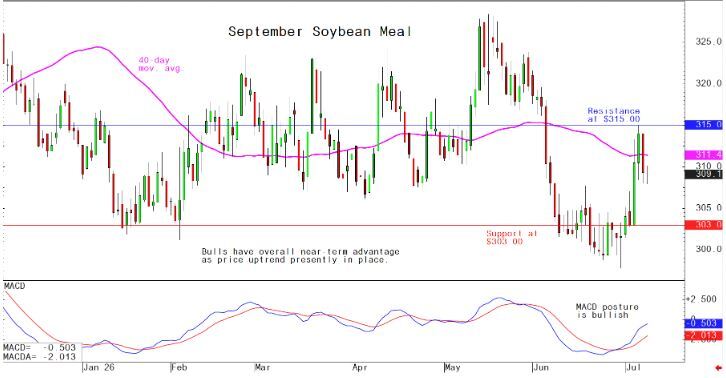
September soybean meal futures--$305.00 to $320.00, and a sideways-higher bias
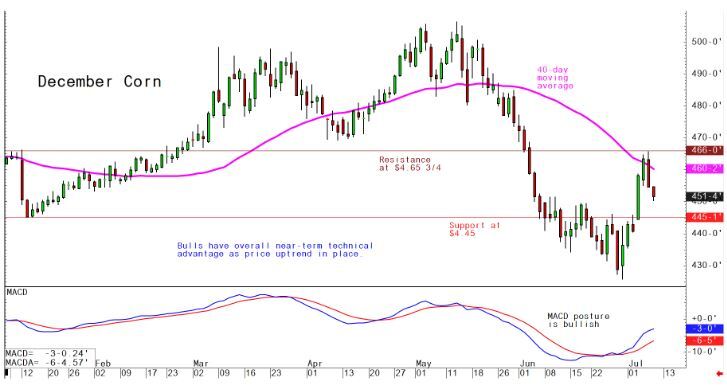
December corn futures--$4.45 to $4.70 and a sideways-higher bias
Latest analytical daily charts lean hog, soybean meal and corn futures