





Weekly pig report: Lean hog futures face continued pressure amid weak chart outlook
Pseudorabies detected in US swine herds triggers coordinated response
 9 May 2026
 6 minute read
 By:
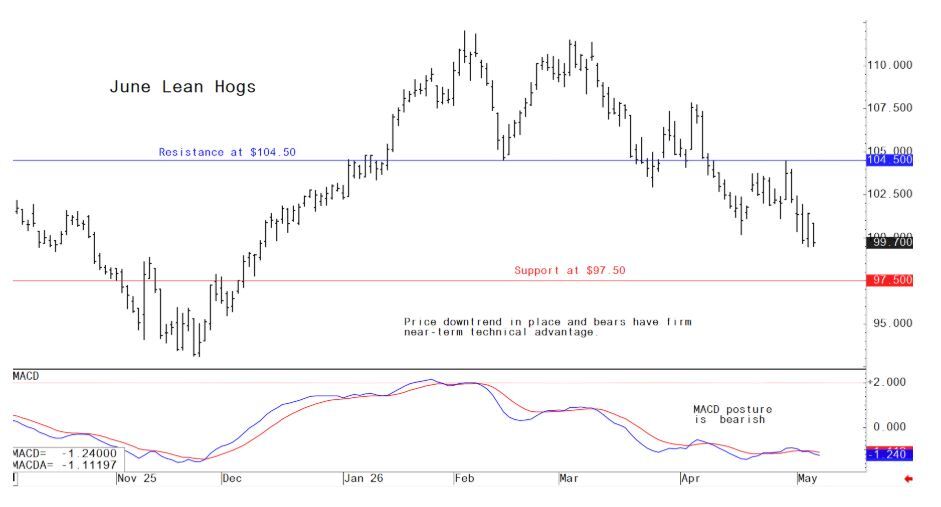
By: June lean hog futures on Wednesday fell $1.725 to $99.70 and closed at a 4.5-month low close. The hog futures market saw technical selling kick in again at mid-week. The near-term chart posture for June hogs has deteriorated to suggest still more selling from the speculators in the near term. Prices are in a downtrend on the daily bar chart. The latest CME lean hog index is up 7 cents at $91.10. Today’s projected cash index price is up 9 cents at $91.19. The national direct five-day rolling average cash hog price quote Wednesday was $94.75.
Pork Industry and related news
US DOJ signals imminent antitrust action in meatpacking probe
--DOJ plans to settle Agri Stats case, White House official says
--Officials preview “historic settlement” as broader protein markets — not just beef — come under scrutiny
Federal officials on May 4 outlined an aggressive escalation of the Justice Department’s antitrust investigation into the US meatpacking sector, signaling that a major enforcement action — potentially a “historic settlement” — is expected within days and could directly impact pricing across chicken, pork, and turkey markets.
Acting Attorney General Todd Blanche emphasized that the probe extends beyond beef, with authorities examining alleged practices such as price fixing, bid rigging, and coordinated data-sharing. Meanwhile, USDA Secretary Brooke Rollins and White House adviser Peter Navarro highlighted deep industry concentration — with roughly 85% of beef processing controlled by four firms — as a core driver of producer stress, consumer prices, and potential national security risks.
Ranchers reinforced these concerns, pointing to long-term declines in cattle operations and reduced bargaining power, while officials confirmed that both civil and criminal enforcement pathways remain under consideration. The anticipated near-term settlement — likely tied to information-sharing practices — is expected to serve as the first concrete outcome of a broader federal push to reshape competition across the protein supply chain.
Pseudorabies detected in US swine herds triggers coordinated response
Iowa and Texas cases linked through animal movement, with feral swine exposure cited as likely source
USDA’s Animal and Plant Health Inspection Service (APHIS) has confirmed cases of pseudorabies in commercial swine herds in Iowa and Texas, prompting an immediate containment and eradication response led by state and federal officials. According to Iowa Secretary of Agriculture Mike Naig, the Iowa case involves a small commercial herd that had recently received animals from the affected Texas operation, where outdoor housing conditions likely allowed contact with infected feral swine.
Naig emphasized that Iowa officials are “moving decisively to eliminate the disease,” highlighting years of preparation for animal health incidents and coordination with partners including USDA APHIS, Iowa State University College of Veterinary Medicine, and industry stakeholders. The response underscores the vulnerability of domestic herds to pathogens still circulating in wild swine populations, despite prior eradication successes.
Pseudorabies was officially eliminated from US commercial swine herds in 2004 following a long-running state-federal-industry campaign. However, the virus persists in feral swine, which remain a key transmission risk to domestic livestock operations—particularly those with outdoor exposure or biosecurity gaps.
Officials stressed that the outbreak does not pose a food safety or public health risk. The virus does not affect humans, and the US pork supply remains safe. Consumers are advised, as always, to handle and cook pork properly, but no additional precautions are required.
State Veterinarian Dr. Jeff Kaisand and Secretary Naig are scheduled to provide further details during a virtual media briefing, as containment efforts continue and trace-back investigations assess the extent of exposure
USDA Lowers 2026 Food Inflation Outlook
Revised forecasts show price growth moderating toward long-term averages as declines emerge in key categories
USDA has revised its 2026 food price outlook lower, signaling easing inflation pressures across grocery stores and restaurants. Updated projections show overall food prices rising closer to their 20-year averages, with notable downward revisions in several key categories, including beef and eggs.
USDA now expects all food prices to increase 2.9% in 2026, down from a 3.6% forecast in March.
Grocery prices, or food at home, are projected to rise 2.4%, compared to the prior estimate of 3.1%.
Restaurant prices, or food away from home, are seen increasing 3.6%, slightly below the earlier 3.9% forecast.
Perspective: If realized, these figures would align closely with long-term averages of 3.0% for all food, 2.6% for groceries, and 3.5% for restaurants.
Within food categories, price trends remain mixed. Seven categories — including beef and veal, fish and seafood, fresh vegetables, processed fruits and vegetables, sugar and sweets, nonalcoholic beverages, and other foods — are expected to rise faster than their historical averages. Meanwhile, pork, poultry, cereal and bakery products, fresh fruits, and other meats are forecast to increase at a slower pace than usual.
Only a handful of categories are projected to decline outright in 2026. Egg prices are expected to fall sharply by 29.4%, a deeper drop than previously anticipated, while dairy prices are forecast to decline 1.4%, and fats and oils are expected to decrease modestly by 0.8%. These declines reflect improving supply conditions and easing pressures from prior disruptions.
Beef prices, while still rising, are now expected to increase at a more moderate pace. USDA forecasts a 6.3% increase in retail beef and veal prices, a significant reduction from the 10.1% increase projected in March. Despite stable cattle inventories, consumer demand has remained firm, supporting prices even as the rate of increase slows. Pork prices are also expected to see minimal growth, rising just 0.4% in 2026.
Bottom Line: Despite the more moderate outlook, USDA cautions that food price forecasts have become increasingly volatile. Data disruptions during the fall 2025 government shutdown required the use of statistical models to estimate missing Consumer Price Index figures, and monthly forecast revisions have varied significantly since a new methodology was introduced in 2023. This suggests that further adjustments are likely as market conditions continue to evolve.
Protein boom offers lifeline for struggling US farmers
Rising demand for pulse crops offsets weak grain prices, high input costs, and trade pressures
A surge in demand for protein-rich foods — fueled by GLP-1 weight-loss drugs and social media diet trends — is emerging as a rare bright spot for US farmers grappling with low crop prices, high input costs, and trade disruptions, according to reporting by Reuters.
The broader farm economy remains under pressure, with a grain oversupply, tariff-related trade tensions, and elevated fertilizer and diesel costs squeezing margins. US farmers are now facing a fourth consecutive year of low-to-negative profitability, even as government support remains near record levels. Meanwhile, farm bankruptcies jumped 46% from 2024 to 2025, underscoring the severity of the downturn.
Against that backdrop, pulses — including peas, lentils, and chickpeas — are gaining traction as a more profitable alternative. Farmers are shifting acreage away from wheat toward pulses, citing significantly better margins. One Montana farmer estimates losses of roughly $35 per acre on wheat compared to profits of about $8 per acre on lentils, highlighting the growing economic divergence between traditional grains and protein crops.
The appeal of pulses extends beyond pricing. These crops require relatively low fertilizer inputs due to their natural nitrogen-fixing properties — a key advantage as the US/Iran conflict disrupts global fertilizer supplies and drives up costs. Industry leaders argue this structural benefit positions pulses to outperform in a high-input-cost environment.
Demand is being driven in part by a broader shift in consumer behavior. Food manufacturers are increasingly incorporating pea protein and lentil-based ingredients into mainstream products, from cereals and pasta to beverages and snack foods. This innovation wave has accelerated since the pandemic, supported by health trends and aggressive marketing around protein consumption.
However, some nutrition experts warn that the protein boom may be overhyped. Research suggests that most Americans already consume sufficient protein, and critics argue that “protein-maxing” trends promoted on platforms like TikTok may be more about marketing than actual dietary need.
Still, for farmers facing mounting financial strain, the shift toward pulses is less about dietary debates and more about survival. With domestic consumption rising — even as exports of yellow peas have dropped sharply — producers are increasingly betting that protein demand will remain strong enough to stabilize incomes in an otherwise challenging agricultural economy.
The next week’s likely high-low price trading ranges:
June lean hog futures--$97.50 to $104.45 and with a sideways-lower bias
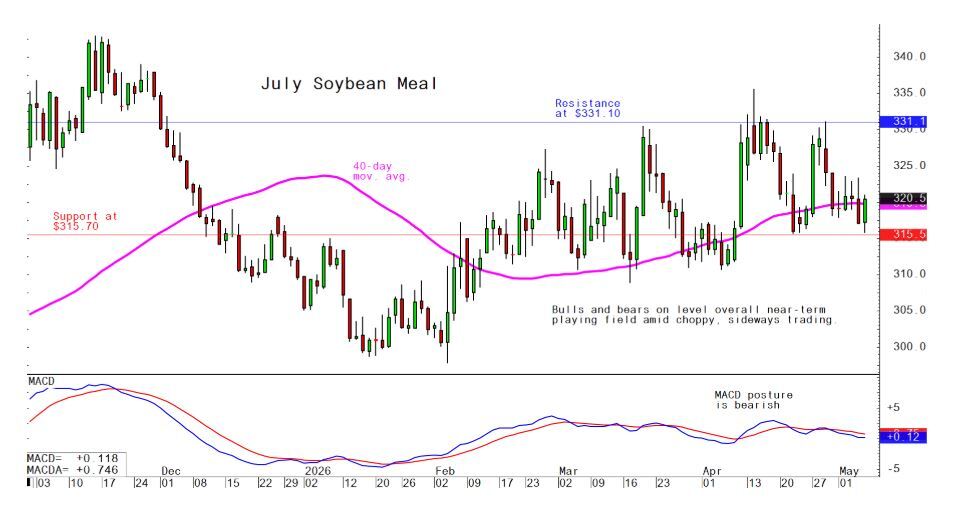
July soybean meal futures--$310.00 to $331.10, and with a sideways-higher bias
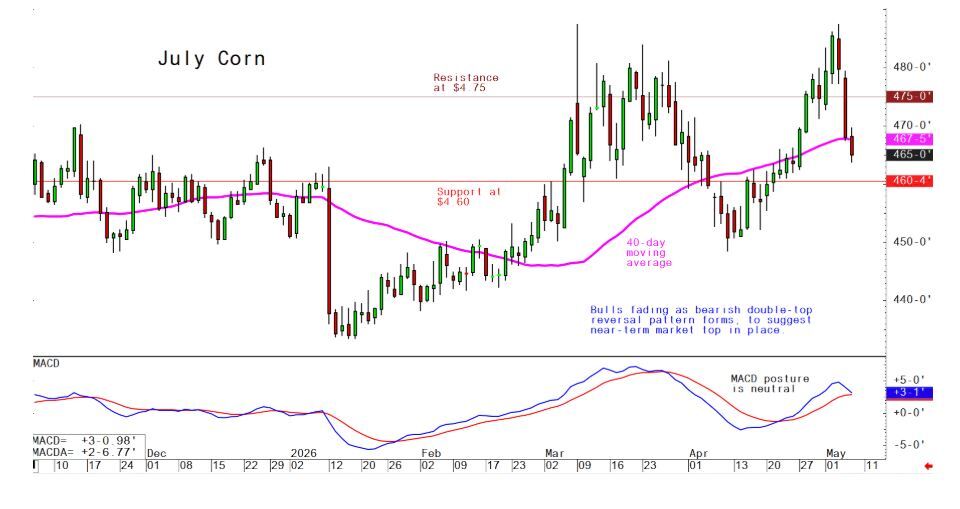
July corn futures--$4.60 to $4.75 and a sideways bias
Latest analytical daily charts lean hog, soybean meal and corn futures