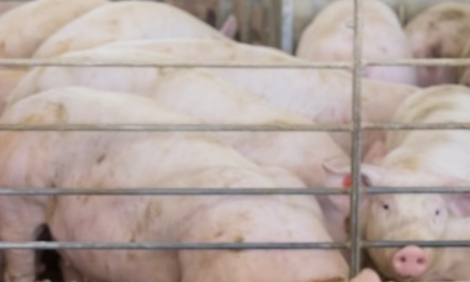






Weekly pig report: Pig producers raise alarm as California Prop 12 moves forward in the Senate
US meat organizations and producers have raised concerns about the lack of a Prop 12 solution in the Senate farm bill
 27 June 2026
 8 minute read
 By:
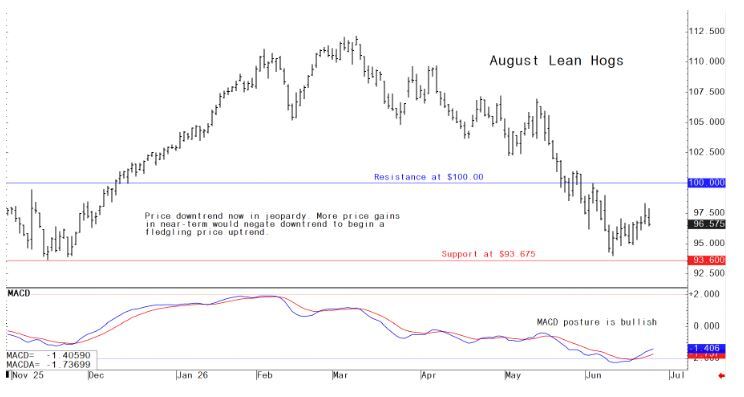
By: Lean hog futures continue to see chart-based selling ahead of quarterly USDA H&P data. August lean hog futures on Wednesday fell $0.525 to $96.70. The lean hog futures market saw some modest technical selling and a corrective pullback from four sessions in a row of price gains in the August contract. More price gains late this week would negate the price downtrend to suggest a market bottom is in place.
Hog traders are awaiting this afternoon's quarterly USDA hogs and pigs report. The size of the US hog herd was slightly larger on June 1 than a year earlier, according to a Reuters survey. All hogs inventory as of June 1 is expected to be 100.9% of the herd seen one year ago at the same time. Kept for breeding is seen at 99.3% from June 1, 2025. Kept for market numbers are seen at 101.1% from a year ago. The March-May pig crop is seen at 101.2% from June 1 of 2025. The latest CME lean hog index is down 17 cents at $91.47. Today’s projected cash index price is up 38 cents $91.95. The national direct five-day rolling average cash hog price quote Wednesday was $96.73.
Pork Industry and related news
Trump to host US farmers at White House dinner
The White House said President Donald Trump on Thursday will host a White House Rose Garden dinner honoring farmers, ranchers, cattlemen and growers from across the country. The dinner is on the first night of the Great American State Fair. Cabinet members slated to attend include USDA Secretary Brooke Rollins, Health and Human Services Secretary Robert F. Kennedy Jr., Treasury Secretary Scott Bessent and Administrator of the US Centers for Medicare and Medicaid Services Mehmet Oz, reports said, citing a White House official. Sens. John Boozman, R-Ark., Roger Marshall, R-Kan., and Joni Ernst, R-Iowa, will also be in attendance.
California pork Prop. 12 fight moves to the Senate front burner
Farm bill draft leaves out pork industry priority, setting up a major political and policy battle ahead
The release of Senate Ag Committee Chairman John Boozman's (R-Ark.) farm bill discussion draft without a Proposition 12 fix marks a significant setback for the pork industry's top legislative priority, but it is far from the end of the fight. Instead, it signals that one of the most contentious agricultural issues in Washington remains unresolved and is likely headed for an intense battle as the Senate moves toward formal farm bill consideration.
The competing statements issued Tuesday underscore just how sharply divided agriculture, animal welfare advocates, and lawmakers remain over California's Proposition 12, the voter-approved law that establishes housing standards for breeding pigs whose pork is sold in California regardless of where the animals are raised. Since the Supreme Court upheld the law in 2023, the debate has shifted from the courts to Congress, where the industry has sought federal legislation to pre-empt state production standards that affect interstate commerce.
For the National Pork Producers Council (NPPC), the omission of a Prop. 12 fix from the discussion draft is disappointing because the organization views the issue as an existential threat to a national livestock marketplace. The group argues that California's law creates a precedent allowing individual states to impose production standards beyond their borders, potentially leading to a patchwork of conflicting regulations for pork, poultry, eggs, cattle and other agricultural products. NPPC's decision to assemble a coalition of more than 330 agricultural organizations demonstrates the breadth of concern among many commodity groups about the interstate commerce implications rather than solely the specifics of pig housing requirements.
The pork industry's campaign received a significant legislative boost earlier this year when the House included a Proposition 12 fix in its version of the farm bill, demonstrating that a majority of lawmakers in one chamber were willing to support federal limits on state livestock production mandates. Supporters point to that vote as evidence that a bipartisan coalition exists for federal action. They also argue that compliance costs disproportionately affect smaller and mid-sized producers who lack the capital necessary to retrofit facilities or segregate supply chains for different markets. Industry economists have long contended that the law raises production costs and ultimately food prices, although the magnitude of those impacts remains debated.
Yet the political landscape in the Senate appears considerably more challenging. Senate Minority Leader Chuck Schumer (D-N.Y.) is publicly opposing the Save Our Bacon Act and that highlights the uphill climb facing supporters. Schumer's statement reflects the arguments advanced by animal welfare organizations and many progressive lawmakers who view federal pre-emption as an attack on states' rights and voter-approved standards. Their position is that states have long exercised authority over food safety, consumer protection and animal welfare, and that Proposition 12 simply reflects California consumers' preferences regarding how animals are raised.
The political irony is that both sides are framing the debate around states' rights. Pork producers argue that California is effectively dictating production practices to farmers in Iowa, North Carolina and other states. Opponents argue that federal legislation overturning Proposition 12 would prevent states from establishing standards desired by their own voters. That competing interpretation of federalism has complicated efforts to build a durable Senate coalition.
Another factor working against immediate action is the broader farm bill coalition itself. Farm bills traditionally succeed because lawmakers avoid including provisions that threaten support from key constituencies. Proposition 12 has become one of those divisive issues that risks alienating lawmakers whose votes are needed for final passage. Chairman Boozman's decision to leave the language out of the discussion draft may reflect a strategic calculation that it is easier to add controversial language later than to remove it after opposition hardens.
The absence of a fix from the draft should not be interpreted as Senate rejection of the industry's position. Rather, it suggests leadership is attempting to advance the broader farm bill while keeping options open during negotiations. Senators including Joni Ernst (R-Iowa), Chuck Grassley (R-Iowa), Kevin Cramer (R-N.D.), Ted Budd (R-N.C.), Pete Ricketts (R-Neb.), Thom Tillis (R-N.C.), John Cornyn (R-Texas), and Mike Rounds (R-S.D.) are expected to continue pressing for inclusion as the legislative process advances.
Looking ahead, the most likely outcome is that Proposition 12 becomes one of the central amendment fights during Senate farm bill deliberations. The pork industry retains substantial support among agricultural-state lawmakers and many national farm organizations. However, opposition from Schumer and animal welfare groups ensures that any attempt to add a fix will face intense scrutiny and procedural hurdles.
The broader significance extends beyond pork production. The outcome will help determine whether Congress is willing to place limits on state laws that affect agricultural production beyond state borders. That precedent could influence future debates involving livestock production practices, environmental standards, labeling requirements and food system regulations. For that reason, both supporters and opponents view the battle over Proposition 12 as much larger than pork, making it one of the most consequential unresolved issues in the 2026 farm bill debate.
Major US meat and livestock organizations: The groups that shape policy, trade and production
From cattle ranchers and feedlots to pork producers, poultry companies, processors, exporters, and emerging advocacy groups, these organizations represent the diverse interests of the American meat industry and play a major role in Washington policymaking
The US meat and livestock industry is represented by a broad network of national and regional organizations that advocate for producers, processors, marketers, exporters, and allied industries. While dozens of groups operate across the country, roughly a dozen organizations stand out for their influence on federal policy, trade negotiations, animal health programs, food safety regulations, labor issues, environmental policy, and state initiatives such as California's Proposition 12.
At the processor and packer level, the most influential organization is the Meat Institute. Formerly known as the North American Meat Institute, the organization represents companies responsible for the overwhelming majority of US meat and poultry processing, including major firms such as Tyson Foods, JBS USA, Cargill, and Smithfield Foods. The Meat Institute is heavily involved in food safety, labor issues, animal welfare regulations, trade policy, sustainability initiatives, and state regulatory matters.
The pork sector is represented primarily by the National Pork Producers Council, the industry's leading lobbying organization. NPPC advocates on trade, labor, environmental regulations, animal health, farm bill provisions, and Proposition 12-related issues. Complementing NPPC is the National Pork Board, which administers checkoff-funded research, promotion, consumer education, and market development programs for pork producers.
A newer entrant into the policy arena is the American Meat Producers Association. Formed in 2025, AMPA represents farmers, ranchers, meat producers, and allied companies that generally support state animal-welfare standards and oppose federal efforts to override laws such as Proposition 12. While smaller than long-established organizations such as NCBA, NPPC, or the Meat Institute, AMPA has become increasingly visible as debates over animal housing standards and federal preemption have intensified.
International trade and export promotion are led by the US Meat Export Federation, which works to expand overseas demand for US beef, pork, and lamb. Because exports contribute significantly to producer profitability, USMEF is one of the industry's most influential organizations in trade negotiations and international market development.
Smaller processors and specialty sectors also maintain significant representation. The American Association of Meat Processors represents independent and regional meat processors across the country and frequently advocates on regulatory, inspection, and workforce issues affecting smaller facilities. The Livestock Marketing Association represents livestock auction markets and marketing agencies, providing a critical voice on animal movement, disease response, and price discovery. The American Sheep Industry Association serves sheep and lamb producers on issues ranging from trade and predator control to grazing rights and wool programs.
Together, these organizations form the leadership structure of the US meat and livestock sector. The Meat Institute, NCBA, NPPC, USMEF, NCC, NTF, and TCFA are generally regarded as the most influential organizations in Washington because of their size, membership, and longstanding relationships with policymakers. At the same time, organizations such as AMPA, AAMP, LMA, ASI, USPOULTRY, USAPEEC, UEP, and the National Pork Board provide specialized expertise and increasingly important perspectives on the issues shaping the future of American meat production. As debates continue over trade, animal health, labor, sustainability, and animal welfare standards, these groups collectively serve as the principal voices representing one of the largest and most economically important sectors of US agriculture.
The next week’s likely high-low price trading ranges:
August lean hog futures--$93.975 to $100.00 and with a sideways bias
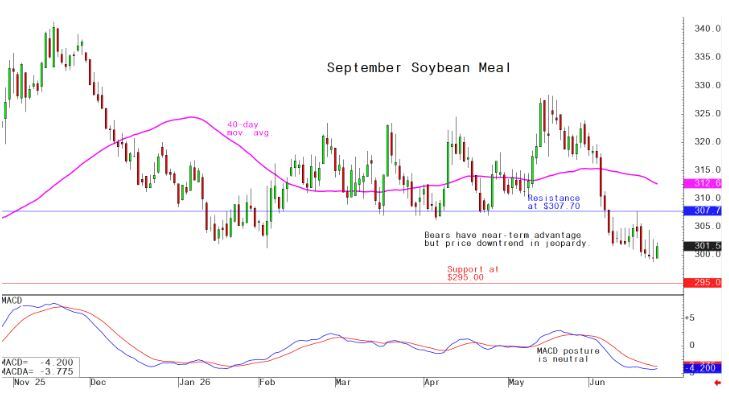
September soybean meal futures--$295.00 to $310.00, and with a sideways bias
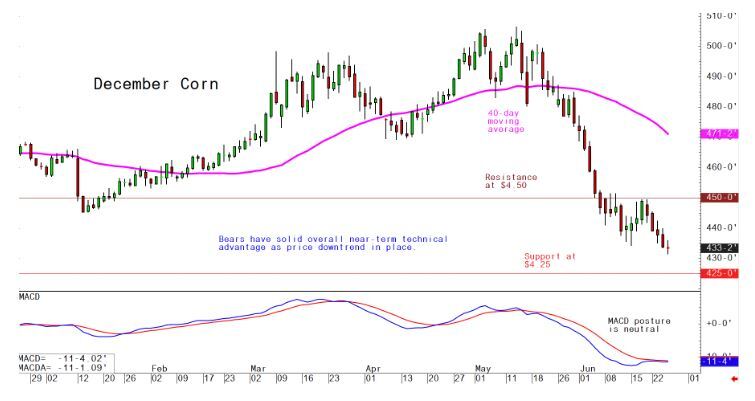
December corn futures--$4.25 to $4.45 and a sideways bias
Latest analytical daily charts lean hog, soybean meal and corn futures