





Pig outlook: USDA proposes faster line speeds for poultry and pork plants
USDA’s FSIS unveiled proposals to increase line speeds in poultry and pork plants, aiming to boost processing capacity and ease food-price pressures
 21 February 2026
 5 minute read
 By:
By: Lean hog futures bulls work to stabilize prices
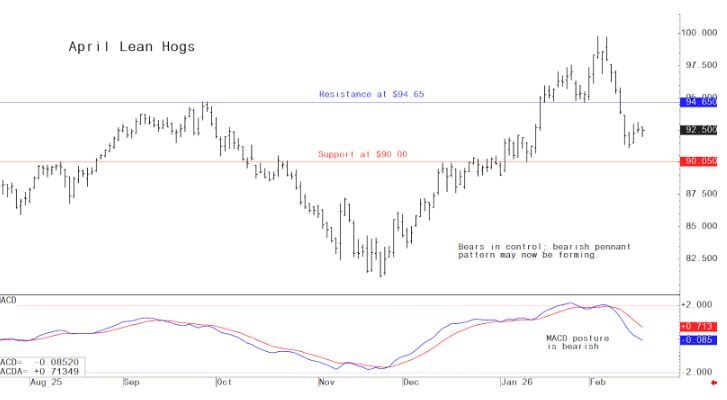
April lean hog futures on Wednesday rose 25 cents to $92.55. Hog futures saw a pause following the recent steep sell off that has produced serious chart damage. Bulls are still shaky. More price strength in lean hog futures is needed this week to at least stabilize the market. The latest CME lean hog index is up 7 cents at $87.13. Today’s projected cash index price is up 5 cents at $87.19. The national direct five-day rolling average cash hog price quote Wednesday was $62.50.
Pork Industry and related news
USDA proposes faster line speeds for poultry and pork plants
Administration frames changes as supply-chain boost; labor unions raise worker-safety concerns
USDA’s Food Safety and Inspection Service (FSIS) has unveiled two proposed rules that would increase slaughter line speeds at certain poultry and pork facilities, marking a significant regulatory shift aimed at expanding processing capacity and easing food-price pressures.
The proposals — one covering poultry plants and another addressing pork facilities — cleared review at the Office of Management and Budget (OMB) on Feb. 12 after meetings with stakeholders.
Poultry: higher speeds under NPIS. Under the proposed rule for poultry establishments operating within the New Poultry Inspection System (NPIS):
- Young chicken plants could operate at speeds up to 175 birds per minute (bpm).
- Turkey plants would see their maximum allowable speed increase from 55 bpm to 60 bpm.
FSIS also proposes to formally define “maximum line speed” as the time necessary for an inspector to effectively conduct online carcass inspection procedures — a clarification intended to tie speed directly to inspection capability rather than a fixed numerical cap.
The rule would also:
- Clarify circumstances under which establishments must operate at reduced speeds.
- Eliminate the requirement that NPIS facilities submit annual worker-safety attestations.
Pork: greater flexibility under NSIS. For pork facilities operating under the New Swine Slaughter Inspection System (NSIS), USDA is proposing a more flexible framework:
- Plants would be allowed to set their own line speeds, provided they demonstrate the ability to maintain process control.
- FSIS inspectors would retain authority to reduce operational speed at any stage if there is a “loss of process control” or if carcass inspections cannot be completed effectively within the available time.
The rule would also remove annual worker-safety attestation requirements for NSIS establishments.
Industry support, labor pushback. The pork and poultry industries have largely welcomed the proposal, viewing it as a way to increase throughput, modernize inspection systems, and strengthen supply chains.
Labor unions representing meatpacking workers, however, have raised concerns about the impact of faster line speeds on worker safety and injury rates — an issue that has been contentious in prior regulatory debates over inspection reform.
Broader policy framing. The administration is presenting the proposed rules as part of a broader strategy to:
- Increase domestic meat-processing capacity
- Improve supply-chain resilience
- Help moderate food costs for consumers
If finalized, the changes would further expand the role of plant-based inspection models under NPIS and NSIS while shifting more operational flexibility — and responsibility — to processors, with FSIS maintaining oversight authority tied to inspection effectiveness and process control standards.
Smithfield Foods to build new pork facility in Sioux Falls, S.D.
Smithfield Foods, Inc. on Monday announced it will build a new state-of-the-art packaged meats and fresh pork processing facility in Sioux Falls, South Dakota. The new facility will replace Smithfield’s existing plant, which has been in existence for more than 100 years. The company currently employs 3,200 people in Sioux Falls, according to a Smithfield news release. Smithfield’s preliminary cost estimate of the proposed facility is up to $1.3 billion over the next three years. “The proposed combined fresh pork and packaged meats facility will be the most modern of its kind in the US, with highly efficient process flow, advanced automation technology and a streamlined design. The new, best-in-class facility will deliver significant efficiency gains to Smithfield’s fresh pork and high-value packaged meats operations,” the company said.
US pork secures expanded access to Taiwan market
Tariff cuts and regulatory changes mark breakthrough after 15-year industry push
US pork producers scored a significant trade victory as President Donald Trump finalized a new agreement with Taiwan that reduces longstanding tariff and non-tariff barriers on American pork exports.
The deal represents the culmination of more than 15 years of advocacy by the National Pork Producers Council (NPPC), which has pushed successive administrations to improve access to Taiwan — a high-value Asian market that has historically imposed strict import rules. “Our 15-plus year endeavor to break down trade barriers in the high-value market of Taiwan has paid off,” said NPPC President Duane Stateler, a pork producer from McComb, Ohio. “This means more US pork on international tables and more opportunities and prosperity for American producers.”
Key provisions of the agreement. The agreement delivers both tariff relief and regulatory reform:
- Tariffs cut in half on US pork exports.
- Adoption of Codex standards for ractopamine residue levels in pork fat, kidney, liver, and muscle, with a 0.09 ppm (90 ppb) limit for other edible swine offal. Standards align with those set by the Codex Alimentarius Commission.
- Elimination of restrictive import licensing procedures and removal of facility and product registration requirements that previously slowed trade flows.
- End to 100% batch-by-batch inspections for ractopamine residues, replacing them with compliance-history-based import inspection rates.
- Removal of country-of-origin labeling requirements specific to US pork.
- Automatic acceptance of eligible US plants listed in the US Department of Agriculture’s Meat and Poultry Inspection Directory, maintained by the Food Safety and Inspection Service (FSIS), without requiring additional pre-export audits.
- Recognition of USDA FSIS export certificates and electronic documentation, while limiting additional attestations.
Why it matters: Taiwan has long been viewed as a premium destination for US pork cuts and variety meats. Regulatory hurdles — particularly surrounding ractopamine — have constrained market growth for years. By aligning residue standards with international benchmarks and streamlining inspection and certification processes, the agreement could meaningfully expand export volumes and improve price realization for US producers.
Upshot: For the pork industry, which has faced volatility from tariff disputes and shifting Asian demand in recent years, the Taiwan breakthrough provides both diversification and renewed competitiveness in a strategic export market.
USDA Ag Outlook Conference forecasts on pork
Hogs and pork: Commercial pork production is projected at 28.3 billion pounds, up 3% from 2025.
- Exports: up 2%, supported by favorable exchange rates and disease-related disruptions in Europe
- National base hog price (51%–52% lean): $69 per cwt
USDA noted disease pressure in the US herd affected hog availability, contributing to a modest decline in slaughter numbers despite higher overall production.
The next week’s likely high-low price trading ranges:
April lean hog futures--$90.00 to $93.75 and with a sideways-lower bias
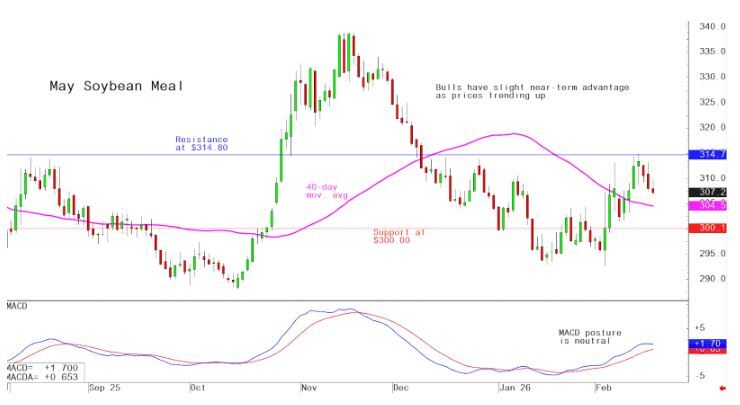
May soybean meal futures--$300.00 to $315.00, and with a sideways-higher bias
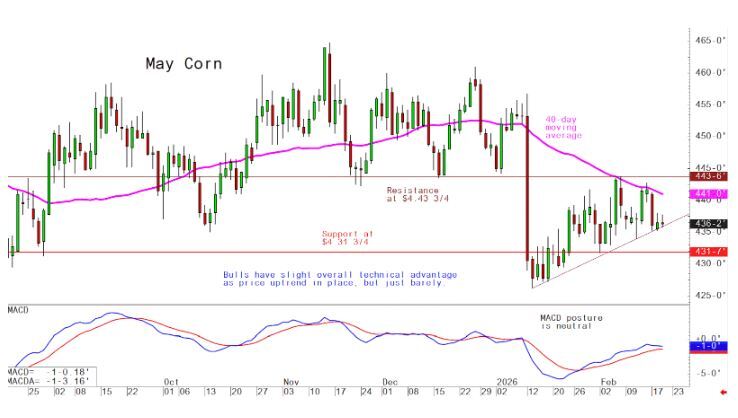
May corn futures--$4.30 to $4.45 and a sideways-higher bias
Latest analytical daily charts lean hog, soybean meal and corn futures